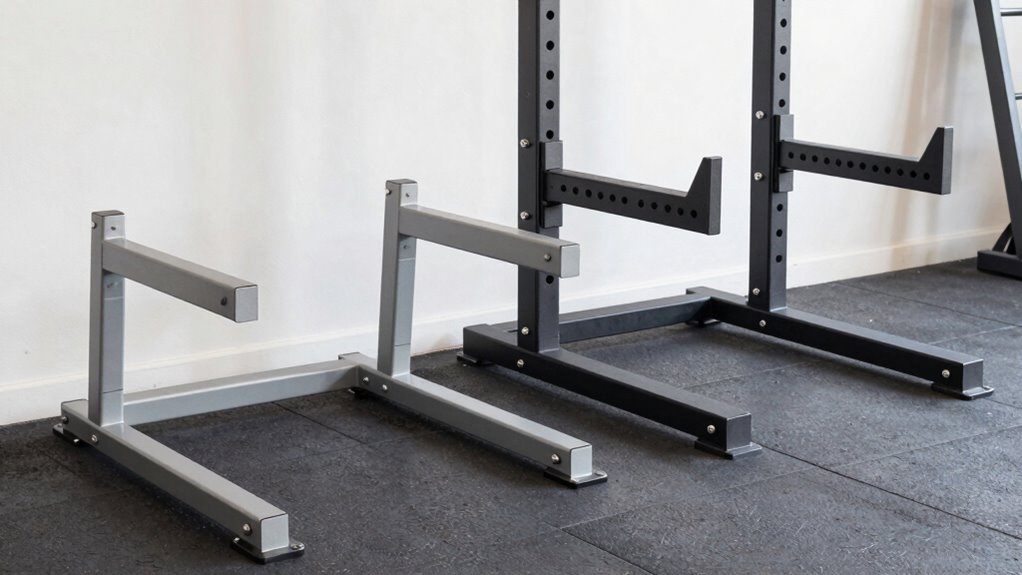

If you’re choosing a compact squat rack, decide if you need the stability of an anchor or the flexibility of a freestanding model. Anchor racks are fixed to the floor or wall, offering more stability for heavy lifts and saving space. Freestanding racks are easier to adjust and move, but may require more room and securing for safety. Understanding these differences helps you make the best choice for your space and workout style. Keep exploring to discover the perfect fit for your needs.

Turn your quiet moments into listening time
- Thousands of audiobooks, podcasts and originals
- Listen on your phone, tablet or Echo — also offline
- Cancel anytime
Key Takeaways
- Anchor squat racks save space and are ideal for small or multi-purpose rooms due to fixed mounting.
- Freestanding squat racks offer adjustable height and versatility for different exercises and users.
- Anchor racks provide superior stability and durability for heavy lifting compared to freestanding models.
- Freestanding racks are easier to install and relocate, offering greater flexibility in workout environments.
- Both types can be compact; choice depends on space, adjustability needs, and lifting intensity.

When choosing a squat rack, understanding the difference between anchor and freestanding models is essential to making an informed decision. Both types have their unique advantages and drawbacks, so your choice depends on your space, goals, and preferences. One of the key factors to evaluate is adjustability options. Anchor racks are often fixed to the floor or wall, which limits their adjustability but provides stability for heavy lifts. Freestanding racks, on the other hand, usually come with multiple height options for the barbell, making them versatile for various exercises and user heights. If you prioritize fine-tuning your training setup, a freestanding model might offer more convenient adjustments. However, if your focus is on heavy lifting and safety, an anchor rack’s sturdy design ensures that it won’t shift or wobble during intense sessions. Additionally, stability considerations play a crucial role in ensuring safety and performance during heavy lifts. Proper installation and quality construction are vital for both types to maximize safety and durability. The ease of installation of anchor racks can be a significant advantage for those who prefer a quick setup without the need for extensive assembly.
Space requirements are another critical aspect. Anchor racks typically occupy less floor space because they are mounted in place, making them ideal for smaller or multi-purpose rooms. Since they are secured to the floor or wall, they don’t need extra clearance around them for stability. Freestanding racks, conversely, need more room to accommodate their base and allow safe access from all sides. If your workout area is limited, a compact anchor model could be the better fit, providing a solid platform without sacrificing much space. Moreover, workspace flexibility can be enhanced by choosing the right type of rack based on your available area. If you have a dedicated gym area with ample room, a freestanding rack’s flexibility might be more appealing.
Durability and stability also influence your decision. Anchor racks tend to be more rugged since they’re fixed in place, making them suitable for heavy lifts and prolonged use. Freestanding models, although generally stable, may wobble slightly under heavy loads, especially if the base isn’t wide enough or if they’re not secured to the floor. Consider your workout intensity and how much weight you plan to lift regularly. If you’re lifting very heavy weights and want maximum stability, anchoring to the floor or wall provides peace of mind. Moreover, craftsmanship and materials can significantly affect the longevity and safety of either type. Choosing high-quality materials ensures longevity and safety, especially for frequent, heavy use.
Ultimately, your choice depends on your available space, the type of exercises you do, and how much adjustability you need. If you want a simple, space-efficient solution and plan to lift heavy, an anchor model could be your best bet. If you prefer flexibility, easier setup, and a more adaptable workout environment, a freestanding squat rack might suit you better. Both options can serve your training needs well, but understanding these key differences helps you pick the right compact squat rack for your home gym.
compact squat rack with adjustable height
As an affiliate, we earn on qualifying purchases.
As an affiliate, we earn on qualifying purchases.
Frequently Asked Questions
Which Squat Rack Type Is More Budget-Friendly Long-Term?
A freestanding squat rack is generally more budget-friendly long-term because it offers better material durability and aesthetic appeal without the need for anchoring. You won’t have to worry about installation costs or potential damage to your wall, saving you money over time. Plus, its versatile design keeps it looking good in your space, making it a cost-effective, attractive option that lasts longer and requires less maintenance.
Are There Safety Differences Between Anchor and Freestanding Racks?
Did you know that 85% of users report fewer stability concerns with anchored racks? Safety differences mainly hinge on stability and installation complexity. Anchor racks provide better stability because they’re fixed to the floor, reducing wobbling during heavy lifts. Freestanding racks are easier to set up but may wobble more, especially under intense loads. So, if safety is your priority, anchoring offers a more secure, stable option.
Can Freestanding Racks Be Moved Easily?
Freestanding racks are generally easier to move, making them a good choice if you’re concerned about portability. You can often relocate them without much effort, which helps if you have limited space or want flexibility in your workout area. However, keep in mind that their portability depends on size and weight—heavier models may require more effort or assistance. Overall, freestanding racks suit those who value easy repositioning and adaptable space considerations.
Do Anchor Racks Require Professional Installation?
Anchor racks typically require professional installation because they involve bolting into the floor, which demands careful attention to installation considerations and guaranteeing the proper space requirements. You can’t just set them up yourself without proper tools and expertise, as incorrect installation may compromise stability. Hiring a professional ensures safety and stability, especially if your space has specific structural considerations. This way, you’re confident your equipment is securely anchored.
Which Rack Type Offers More Versatility for Different Exercises?
Think of your workout as a versatile garden—your rack as the trellis supporting diverse blooms. A freestanding rack offers more flexibility, with adjustable height and higher weight capacity, accommodating a wide range of exercises like pull-ups, bench presses, and squats. Its independence lets you move around and switch workouts effortlessly. In contrast, anchor racks excel in stability but may limit the variety of exercises you can perform comfortably.
anchor squat rack for heavy lifting
As an affiliate, we earn on qualifying purchases.
As an affiliate, we earn on qualifying purchases.
Conclusion
Choosing between an anchor and freestanding squat rack is like picking between a sturdy tree and a flexible vine—you want stability or versatility? If you prefer a permanent, rock-solid setup, go anchor. For flexibility and easy relocation, a freestanding rack is your best bet. Whichever you choose, remember it’s about creating a safe, reliable space for your gains. Think of it as planting a strong foundation for your fitness journey—your progress will grow tall from there.
freestanding space-saving squat rack
As an affiliate, we earn on qualifying purchases.
As an affiliate, we earn on qualifying purchases.
wall-mounted squat rack for small gyms
As an affiliate, we earn on qualifying purchases.
As an affiliate, we earn on qualifying purchases.
Fall Picks
fall essentials
As an affiliate, we earn on qualifying purchases.
![A Better Way To Tie Your Gym Shorts. (Or Any Drawstring) [Video]](https://oboval.com/wp-content/uploads/2026/07/a-better-way-to-tie-your-gym-shorts-or-any-drawstring-video-featured-560x300.jpg)