
To optimize your subwoofer placement, start by following the manufacturer’s recommendations, then use the “subwoofer crawl” technique—play bass-heavy music and find where it sounds best before positioning the sub there. Avoid placing it too close to walls or corners to prevent muddiness, and consider symmetry with your main speakers. Fine-tune with phase and crossover adjustments, and use measurement tools for precise tuning. Keep experimenting to maintain the best sound; more tips ahead will help you perfect your setup.
Key Takeaways
- Start with recommended initial positions near walls or corners, then fine-tune by listening for the best bass response.
- Use the subwoofer crawl method: move the sub around the room to find spots with fullest, clearest bass.
- Consider boundary effects: avoid placing the sub too close to walls or corners to prevent boomy or muddy bass.
- Ensure proper phase and symmetry with main speakers for cohesive, balanced sound; adjust phase if needed.
- Use measurement tools like SPL meters or room correction software to verify and optimize subwoofer placement.
Understanding Your Room and Its Acoustics

Your room’s shape, size, and furnishings substantially influence how your subwoofer performs. A small, square room can create standing waves, causing sound to bounce and create boomy or muddy bass. Larger rooms tend to distribute sound more evenly but may require more power for full bass response. Soft furnishings like curtains, carpets, and furniture absorb low frequencies, reducing bass intensity, while hard surfaces reflect sound, enhancing bass but possibly causing echoes. Knowing these characteristics helps you anticipate how your subwoofer interacts with your space. To optimize performance, consider how your room’s dimensions and materials shape sound waves. Recognizing these factors allows you to make smarter placement choices, ensuring your subwoofer delivers clear, balanced bass without unwanted resonances or dead spots. Understanding room acoustics is key to achieving optimal sound quality and maximizing your subwoofer’s performance. Additionally, experimenting with subwoofer placement can help you find the sweet spot for your specific environment, taking into account the presence of standing waves and other acoustic phenomena. Being aware of room acoustics can also help you adjust your listening position or add acoustic treatments to further improve sound quality.
Starting With the Subwoofer’s Recommended Positioning

When setting up your subwoofer, it’s helpful to start with the placement recommended by the manufacturer. Many subwoofers come with suggested positions, often near a wall or corner, to enhance bass response. Begin there and listen carefully. This initial placement provides a solid foundation for ideal sound. Keep in mind that the manufacturer’s suggestion is based on general principles and may not be perfect for your specific room. Once you’ve placed the subwoofer, sit in your usual listening spot and evaluate the bass. If it sounds too boomy or weak, you can fine-tune the position from this starting point. Using the recommended placement as a baseline helps streamline the setup process and ensures you’re not starting from scratch. Additionally, understanding the room acoustics can further improve your subwoofer’s performance. Adjustments such as subwoofer placement optimization based on your room’s unique characteristics can lead to significantly better sound quality. Considering contrast ratio and how it affects overall sound clarity can also aid in achieving balanced audio. Furthermore, experimenting with subwoofer positioning can reveal unexpected improvements in bass response and sound integration within your space. Incorporating tools like a sound level meter can assist in precisely tuning your setup for optimal performance.
Utilizing the “Subwoofer Crawl” Method
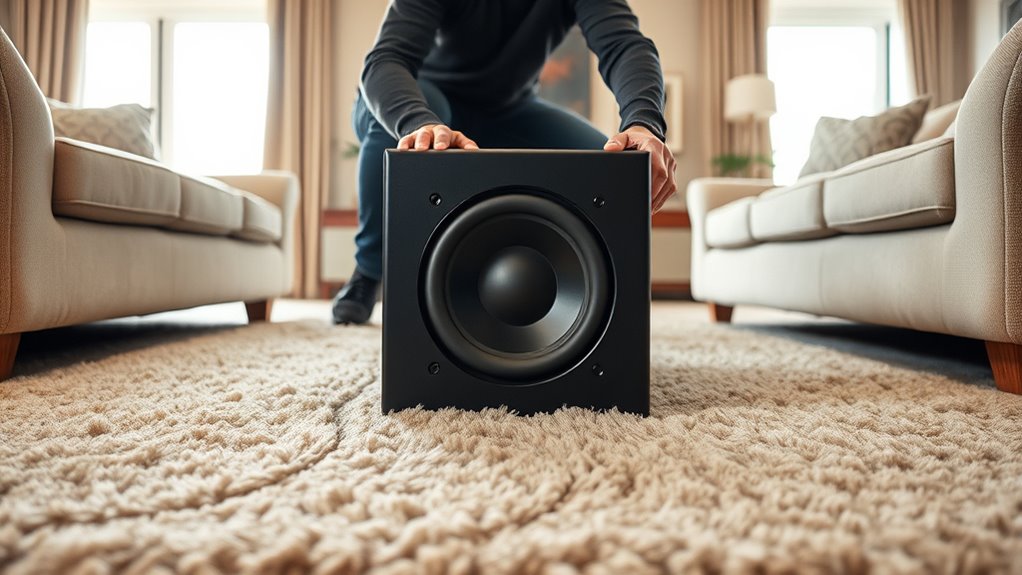
To find the perfect spot for your subwoofer, the “Subwoofer Crawl” method offers an effective, hands-on approach. Place your subwoofer in your main listening position temporarily. Play a bass-heavy track at a moderate volume. Then, crawl around your room, paying attention to where the bass sounds fullest and most balanced. As you move, notice the spots where the bass feels tight and clear. Mark these locations. Once you’ve identified these areas, move the subwoofer from your listening spot to those spots, testing again and fine-tuning as needed. This method helps you locate positions that optimize bass response, ensuring a richer, more even sound throughout your space. It’s a simple yet powerful way to improve your subwoofer’s placement without complex calculations. Understanding room acoustics can further enhance your placement choices for ideal sound quality, as room acoustics significantly influence how bass frequencies propagate and are perceived. Additionally, considering the subwoofer’s interaction with room surfaces can help reduce unwanted resonances and standing waves, leading to clearer bass. Incorporating proper subwoofer placement techniques can also minimize phase issues and improve overall sound integration within your audio system. Paying attention to bass response and resonance patterns during the crawl can help you fine-tune your setup even further.
Considering the Room Boundaries and Wall Reflections
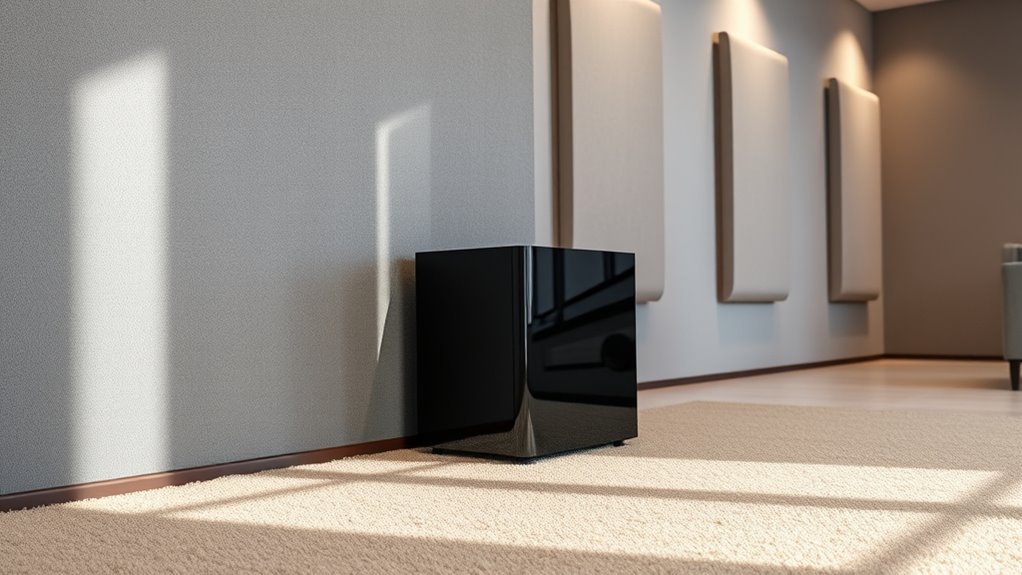
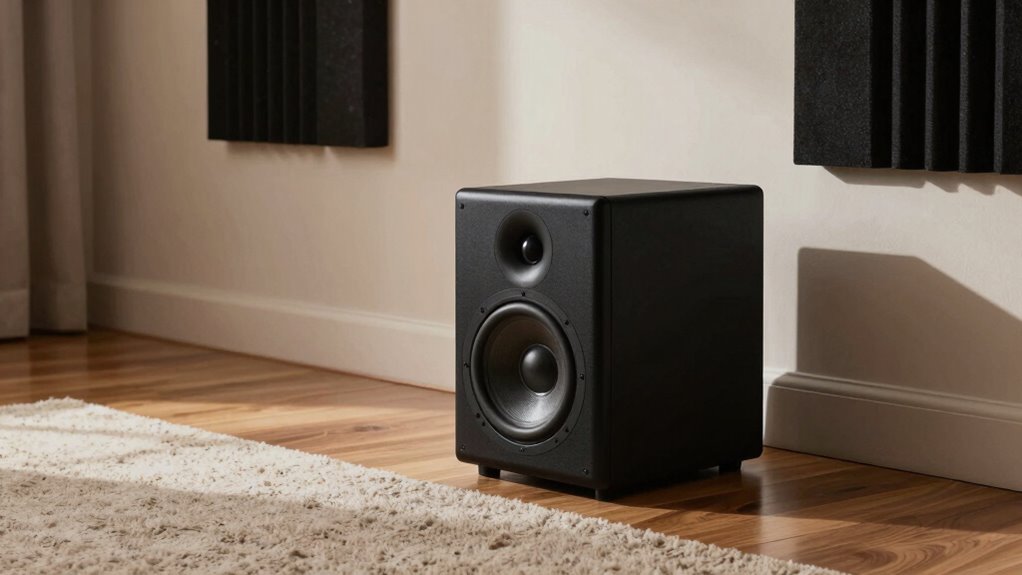
Room boundaries and walls can considerably influence your subwoofer’s sound, creating boundary effects that boost or weaken bass. Wall reflections can cause echoing or muddiness, making clarity a challenge. Adjusting your placement with these factors in mind helps guarantee cleaner, more accurate bass performance. Additionally, understanding boundary effects can help you position your subwoofer to maximize bass response and minimize unwanted sound distortions. Being aware of room acoustics is also essential for fine-tuning your setup and achieving optimal audio quality. Recognizing how sound wave interactions with surfaces impact sound can further improve your placement strategy for the best listening experience. Considering acoustic treatments can also be beneficial in optimizing sound quality by managing reflections and reverberations effectively. Being mindful of room size and shape can further influence how sound waves behave within the space, ultimately affecting your subwoofer’s performance.
Boundary Effects on Sound
Boundary effects markedly influence how sound waves from a subwoofer behave within a room. When your subwoofer is near walls or corners, sound waves reflect and interact with these boundaries, altering the frequency response. These effects can boost bass, creating boomy or muddy sounds, or cause cancellations that reduce overall bass clarity. The proximity to boundaries amplifies certain frequencies due to boundary reinforcement, but it can also lead to uneven bass distribution. To optimize sound, you need to understand how these boundary effects modify the subwoofer’s output. Moving your subwoofer away from walls or adjusting its position can help control boundary-induced boosts or cancellations. Recognizing these effects allows you to refine placement for cleaner, more balanced bass performance. Additionally, understanding room acoustics can help you anticipate and counteract these boundary influences for optimal sound quality, especially when considering how sound reflections interact with your listening environment. Being aware of speaker placement strategies is essential for achieving the best sound experience in your space. Incorporating measurement tools can further assist in analyzing how boundary effects impact your specific room setup.
Wall Reflection Impact
Wall reflections play a crucial role in shaping your subwoofer’s sound by bouncing sound waves back into the room. These reflections can enhance bass response if they arrive at your ears in phase, creating reinforcement. However, if they arrive out of phase, they cause cancellations, resulting in uneven bass or dead spots. The position of your subwoofer relative to walls influences these reflections considerably. Placing the sub near a wall or corner increases boundary reflections, boosting overall volume but risking boomy, muddled sound. Conversely, avoiding close proximity to walls minimizes unwanted reflections and can produce cleaner bass. Understanding how wall reflections interact with your subwoofer helps you fine-tune placement for ideal sound clarity and bass response, ensuring you get the best possible performance from your setup.
Placement Strategies for Clarity
To achieve clear, precise bass, you need to carefully consider your subwoofer’s placement relative to room boundaries and reflections. Positioning near walls can boost bass volume but may cause muddiness from excessive reflections. To minimize this, try placing the subwoofer away from corners or experimenting with different distances from walls. Use strategic placement to reduce destructive interference and enhance clarity.
| Boundary Effect | Placement Strategy |
|---|---|
| Wall reflections cause muddiness | Keep the subwoofer away from walls |
| Corner placement boosts bass | Experiment with slightly offset positions |
| Reflections can create nulls | Use a subwoofer crawl test to find optimal spot |
| Proper placement improves clarity | Adjust position based on sound quality |
Adjusting for Symmetry and Listening Area

Ensuring your subwoofer is positioned symmetrically relative to the listening area can considerably improve sound quality. Place the subwoofer so that it mirrors the main speakers on the opposite side of the room, creating balanced sound distribution. This symmetry helps prevent uneven bass response and reduces phase issues that can muddy your audio. Additionally, consider the shape and size of your listening space. If possible, position the subwoofer closer to the center of the room or along a wall that divides the space evenly. Avoid placing it near corners or uneven surfaces, as these can cause exaggerated bass. Adjusting for symmetry and the listening area’s layout guarantees a more consistent and immersive listening experience.
Fine-Tuning With Phase and Crossover Settings
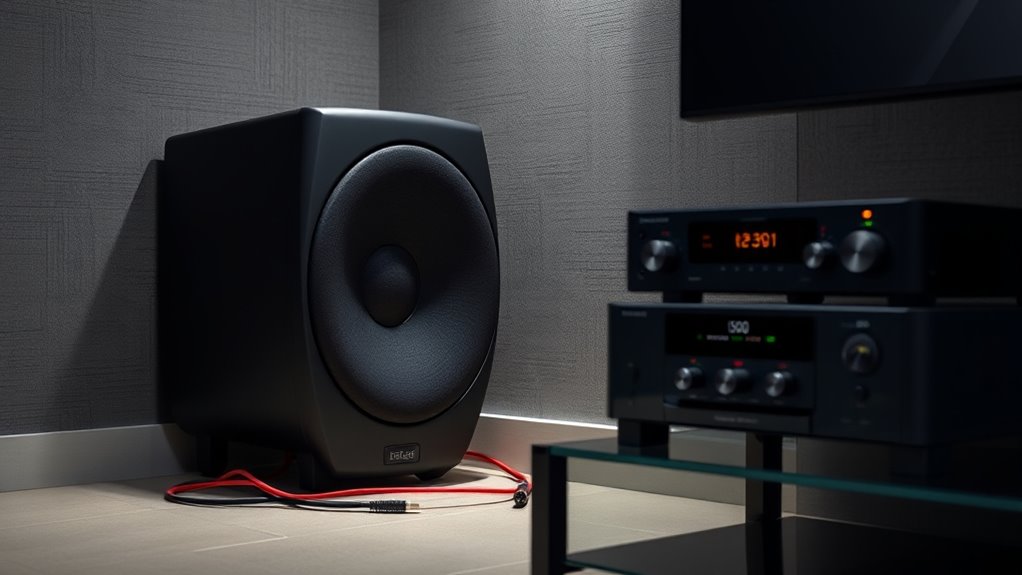
To get the most out of your subwoofer, you need to fine-tune the phase and crossover settings. Adjusting the phase alignment guarantees your subwoofer integrates smoothly with your main speakers, while setting the right crossover point directs bass where it’s needed most. Let’s explore how to optimize these settings for the best sound quality.
Adjusting Phase Alignment
Adjusting phase alignment is essential for achieving seamless integration between your subwoofer and main speakers. When the phases are mismatched, you may notice a hollow or boomy sound, reducing overall clarity. To correct this, start by slowly rotating the phase switch or dial on your subwoofer while listening for the most balanced, punchy bass. You might also use a test tone or music with strong bass to identify the point where the subwoofer and speakers sound most cohesive. Small adjustments can make a big difference in how the bass combines. Remember, the goal is to synchronize the waveforms so they reinforce each other rather than cancel out. Proper phase alignment ensures your system delivers tight, accurate bass with smooth integration.
Setting Optimal Crossover
Once your subwoofer’s phase is aligned, fine-tuning the crossover frequency helps blend the bass seamlessly with your main speakers. Start by selecting a crossover point where your sub and speakers naturally meet, typically between 80-120 Hz. Use your receiver’s or speaker’s settings to gradually adjust this frequency while listening to familiar tracks. You want a smooth progression , so the bass should feel cohesive and balanced without gaps or overlaps. If you notice a disconnect or boominess, tweak the crossover slightly up or down. Trust your ears rather than relying solely on measurements. Remember, the goal is a seamless bass experience that supports your main speakers without overpowering them. Fine-tuning takes patience but results in a richer, more integrated sound.
Using Measurement Tools for Precise Placement

Using measurement tools is essential for achieving the most accurate subwoofer placement. With tools like a SPL meter or room correction software, you can objectively identify the best spot for your subwoofer. First, set your system to test tones or pink noise, then walk around your room while measuring the sound levels at different locations. Look for areas where the bass sounds even and balanced, avoiding spots with excessive peaks or nulls. Use your measurements to compare different positions quickly and precisely. This data-driven approach helps eliminate guesswork and guarantees your subwoofer is positioned where it delivers the smoothest, most powerful bass. Regular measurements also allow you to fine-tune placement as your room setup evolves or as you make acoustic adjustments.
Tips for Maintaining Optimal Placement Over Time
To keep your subwoofer sounding its best over time, it’s important to regularly check its placement and make minor adjustments as needed. Over months, furniture shifts, room changes, or new décor can affect sound quality. Periodically sit in your usual listening spot and listen for any muffling or uneven bass. If you notice discrepancies, try repositioning the subwoofer slightly—moving it closer to walls or corners can enhance bass, while pulling it away can smooth out overly boomy sounds. Keep an eye on your subwoofer’s position relative to your seating area; small changes can make a big difference. Use your ears and measurements to verify sound quality remains ideal. Regular adjustments ensure your system consistently delivers balanced, powerful bass.
Frequently Asked Questions
How Does Furniture Placement Affect Subwoofer Performance?
Furniture placement directly impacts your subwoofer’s performance by affecting sound waves and bass response. Large or bulky furniture can absorb or block low-frequency sound, reducing clarity and bass depth. Placing furniture away from the subwoofer allows for better sound dispersion and richer bass. You should experiment with positioning to find the spot where your furniture complements the subwoofer, ensuring balanced, powerful, and clear bass throughout your space.
Can Multiple Subwoofers Improve Sound Quality?
Using two subwoofers can substantially improve your sound quality. Imagine a room where one subwoofer causes uneven bass, but adding a second creates a more balanced, immersive experience. For example, in a home theater, dual subwoofers reduce dead spots and produce smoother bass response. This setup enhances clarity, minimizes distortion, and delivers richer sound, making your listening experience more accurate and enjoyable.
What Are Signs of Poor Subwoofer Placement?
You’ll notice poor subwoofer placement if your bass sounds uneven or boomy in some areas but weak in others. You might also hear excessive rattling or vibrations, indicating the sub isn’t properly integrated into the room. If the bass seems distant or doesn’t fill the space evenly, your placement could be off. Pay attention to these signs, and consider repositioning the subwoofer for better sound quality.
How Often Should I Re-Evaluate Subwoofer Positioning?
You should re-evaluate your subwoofer placement whenever you notice changes in sound quality, such as uneven bass or rattling. Additionally, consider checking it after moving furniture, rearranging your room, or upgrading your audio system. Regularly appraising your setup every few months helps guarantee ideal sound. Trust your ears—if the bass sounds off, it’s time to tweak the subwoofer’s position for the best performance.
Is It Better to Place the Subwoofer Near a Corner or Away From Walls?
Placing your subwoofer near a corner often boosts bass response because it amplifies low frequencies through boundary reinforcement. However, this can sometimes cause boomy or exaggerated sound. If you prefer tighter, more controlled bass, try positioning it away from walls and corners. Experiment with different spots in your room, listening carefully to find the balance between powerful bass and clarity. Adjusting placement helps you achieve the best sound for your space.
Conclusion
So, now you’re a subwoofer placement expert—congratulations! Just remember, all that effort might be for nothing if your walls decide to throw a party of their own with echoing reflections. Keep tweaking, measuring, and pretending you’re on a quest for perfect sound—because who doesn’t love the thrill of endless adjustments? Ultimately, your neighbors will thank you for the “improved” bass, even if they secretly wish you’d just turn it down.