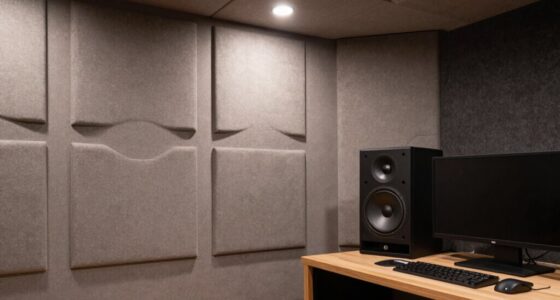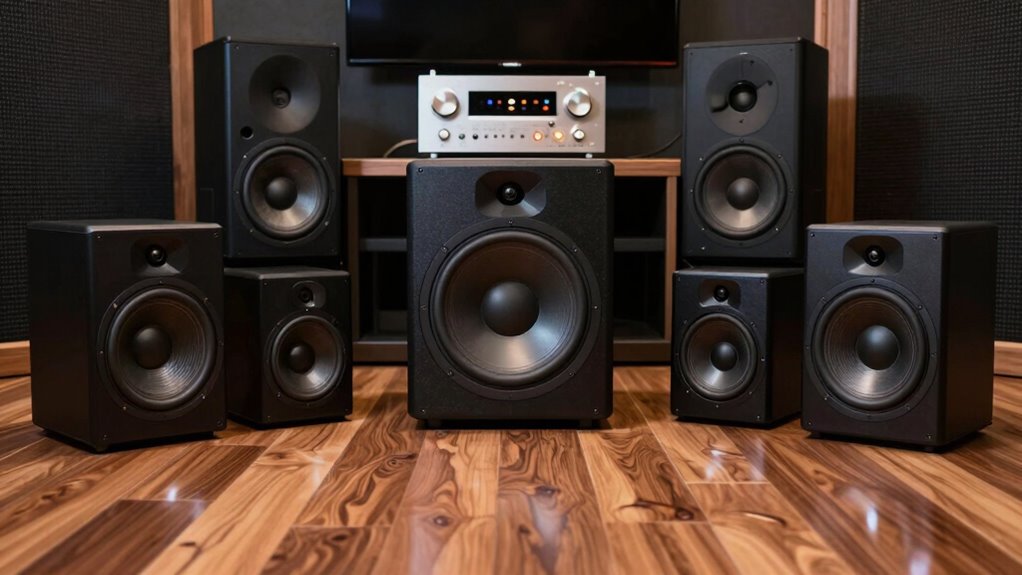

Multi subwoofer systems use two or more subs to distribute bass evenly across your space, resulting in clearer, more powerful, and tighter sound. Proper placement and synchronization are key to avoiding dead spots, boomy sounds, and uneven response. By adjusting phase, crossover, and positioning, you can achieve balanced, immersive bass that enhances movies, music, and gaming. Keep exploring these setup tips to unleash the full potential of your multi subwoofer system.

Turn your quiet moments into listening time
- Thousands of audiobooks, podcasts and originals
- Listen on your phone, tablet or Echo — also offline
- Cancel anytime
Key Takeaways
- Using multiple subwoofers ensures even bass distribution and reduces dead spots in a room.
- Proper placement near walls, corners, or along walls enhances bass response and minimizes room resonances.
- Synchronizing and aligning subwoofers through phase adjustments creates tight, seamless bass.
- Crossover settings and system integration optimize how subs blend with main speakers for balanced sound.
- Fine-tuning placement, phase, and using room correction tools improves overall bass clarity and system performance.
As an affiliate, we earn on qualifying purchases.
What Are Multi Subwoofer Systems and Why Use Them
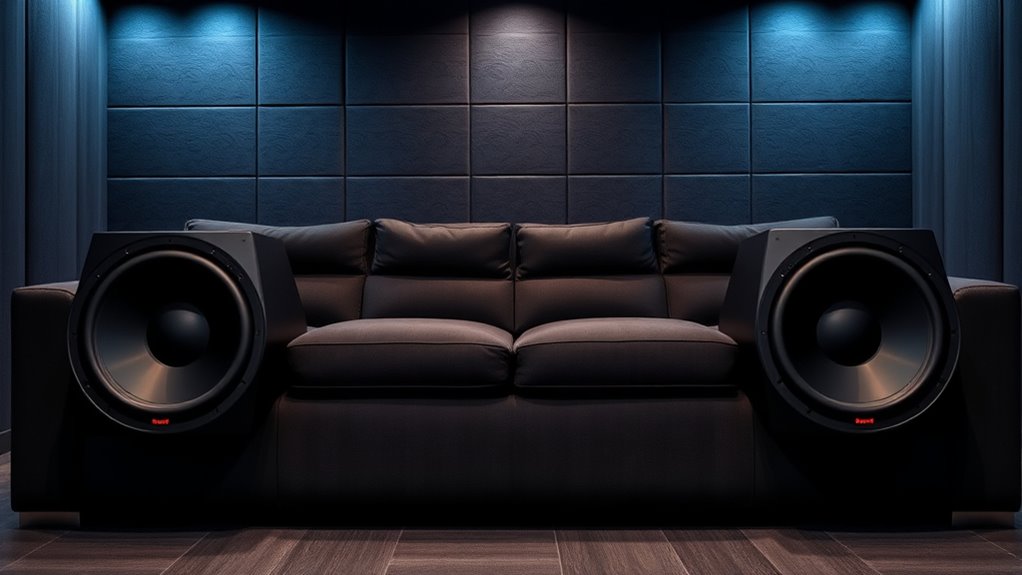
Have you ever wondered how some home theater systems deliver deep, powerful bass without distortion? That’s where multi subwoofer systems come in. These setups use two or more subwoofers to distribute bass frequencies evenly across your space. Instead of relying on a single subwoofer, which can create uneven sound or “dead spots,” multiple subs work together to fill your room with consistent, deep bass. They also help reduce distortion by sharing the workload, allowing for higher volume levels without sacrificing sound clarity. Multi subwoofer systems are especially beneficial in larger rooms or spaces with challenging acoustics. By spreading out the bass, you get a richer, more immersive listening experience, making your movies, music, and games sound more lifelike. Additionally, room acoustics significantly influence how well a multi subwoofer setup performs, making proper placement essential for optimal sound quality. Proper calibration and placement can further enhance the sound distribution, ensuring an even and realistic bass response throughout your space. Understanding phase alignment can also improve how well multiple subs work together for a seamless sound experience. Incorporating advanced audio technology can further optimize performance and tailor the bass response to your specific environment. Moreover, the use of precise measurements can help in fine-tuning the system for the best possible sound quality.
best subwoofers for home theater
As an affiliate, we earn on qualifying purchases.
As an affiliate, we earn on qualifying purchases.
How Multiple Subwoofers Improve Sound Quality
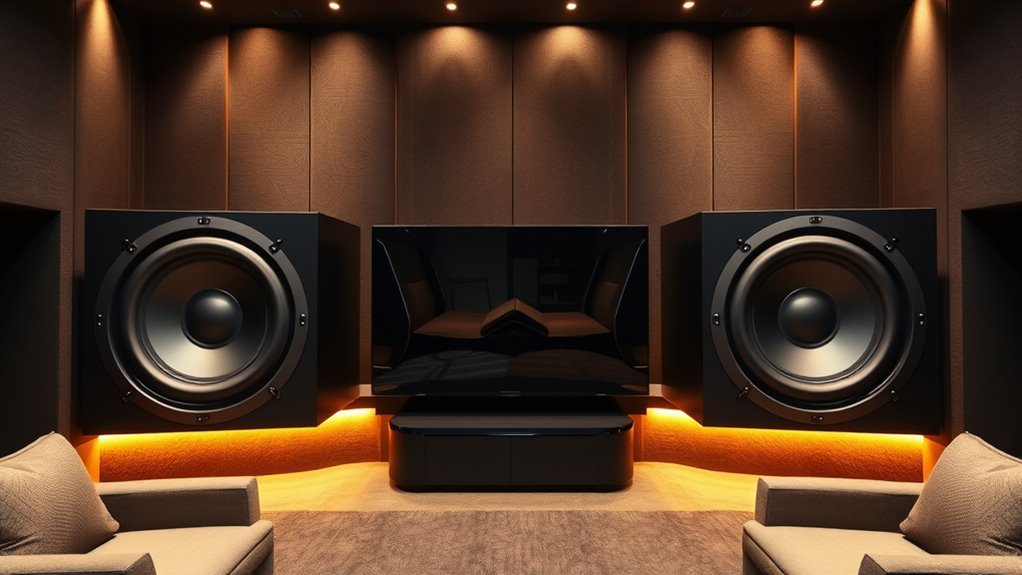
Using multiple subwoofers can considerably enhance sound quality by creating a more uniform and accurate bass response throughout your space. This setup reduces the common dead spots and peaks caused by room acoustics, ensuring bass sounds are consistent no matter where you’re listening. When you have several subwoofers, they work together to smooth out irregularities in sound waves, resulting in clearer, tighter bass. This improves overall sound quality, making music and movies feel more immersive and natural. Additionally, multiple subwoofers can handle higher volume levels without distortion, providing a richer listening experience. By distributing bass more evenly, you avoid overwhelming certain areas while neglecting others, ensuring a balanced sound environment that enhances your entire audio system’s performance. Incorporating connected equipment can further optimize subwoofer placement and performance for an even better sound experience. Moreover, understanding room acoustics can help you strategically position your subwoofers for optimal results. Proper subwoofer placement can significantly improve the overall sound quality in your space by reducing unwanted resonances and standing waves. Employing measurement tools can also assist in fine-tuning your setup for the best possible sound. For example, selecting subwoofers with higher power output can enhance your system’s ability to produce deep, impactful bass.
As an affiliate, we earn on qualifying purchases.
Key Factors to Consider When Setting Up Multiple Subwoofers
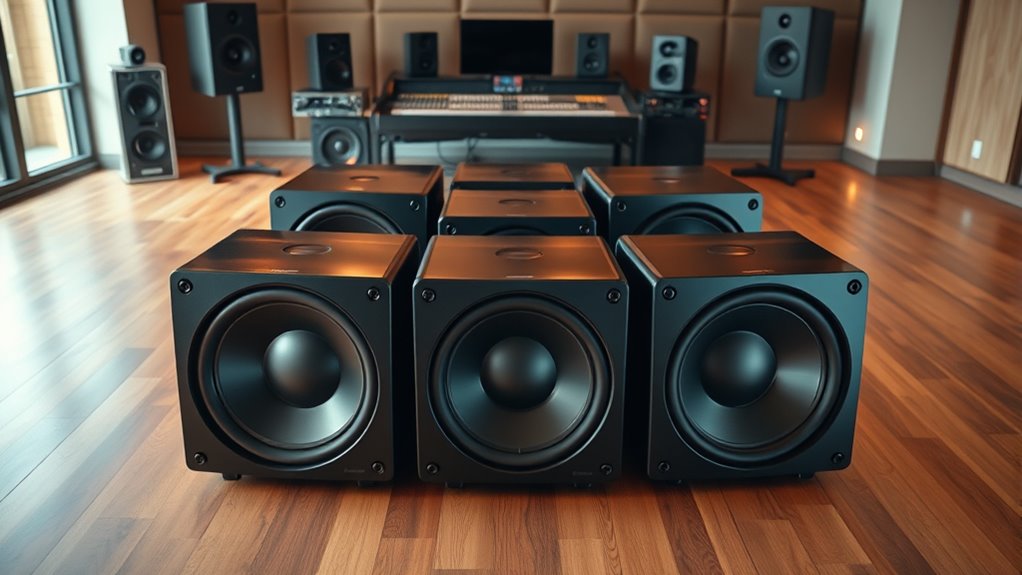
When setting up multiple subwoofers, your placement choices can markedly impact sound quality. You also need to guarantee that phase and timing are aligned properly to prevent cancellations or gaps in bass. Paying attention to these factors helps you achieve a balanced, powerful low-end throughout your space. Additionally, considering the energy efficiency of your setup can contribute to sustainable sound system operation and reduce overall power consumption. Using passive voice detection tools can assist in identifying and correcting passive constructions, leading to clearer and more direct communication in your setup instructions. Incorporating local automation techniques can further optimize subwoofer synchronization and control within your home theater system. Being mindful of acoustic environment factors can also enhance the overall bass performance and clarity. Moreover, understanding source material characteristics can help tailor your system settings for optimal bass response.
Subwoofer Placement Strategies
Proper placement of multiple subwoofers is essential to achieving even bass response and minimizing dead spots in your room. Start by placing subwoofers near walls or corners, as these locations boost bass output. However, avoid placing them too close to each other or in the same spot, which can cause uneven bass and modal issues. A good strategy is to position your subwoofers at different points around the room, then use your ears or measurement tools to fine-tune their locations. Experiment with placements and listen for smooth, balanced bass. Keep in mind that symmetry isn’t always best; sometimes asymmetrical placement yields better results. The goal is to distribute bass energy evenly and reduce areas of excessive or weak bass response throughout your listening space. Additionally, understanding room acoustics and quality assessment can help optimize subwoofer placement for the best sound performance. Using simple tools like BTU and CADR calculators can assist in evaluating how your room interacts with sound, contributing to better placement choices. Incorporating room correction systems can further enhance bass uniformity and overall sound quality.
Phase and Timing Alignment
Achieving seamless bass response from multiple subwoofers hinges on aligning their phase and timing. If the subwoofers aren’t synchronized, you’ll notice bass that sounds hollow, boomy, or uneven. To fix this, start by adjusting the phase controls on each subwoofer, ensuring they work together rather than cancel each other out. Use a phase switch or knob to match their wave peaks. Next, check the timing by using test tones and a sound level meter or room correction software. You may need to delay one subwoofer slightly to align its sound wave with the others. Small adjustments can make a big difference, resulting in a tight, balanced bass response that fills your space smoothly and accurately. Proper system setup is essential for achieving optimal sound quality and avoiding phase issues.
As an affiliate, we earn on qualifying purchases.
Placement Strategies for Optimal Performance
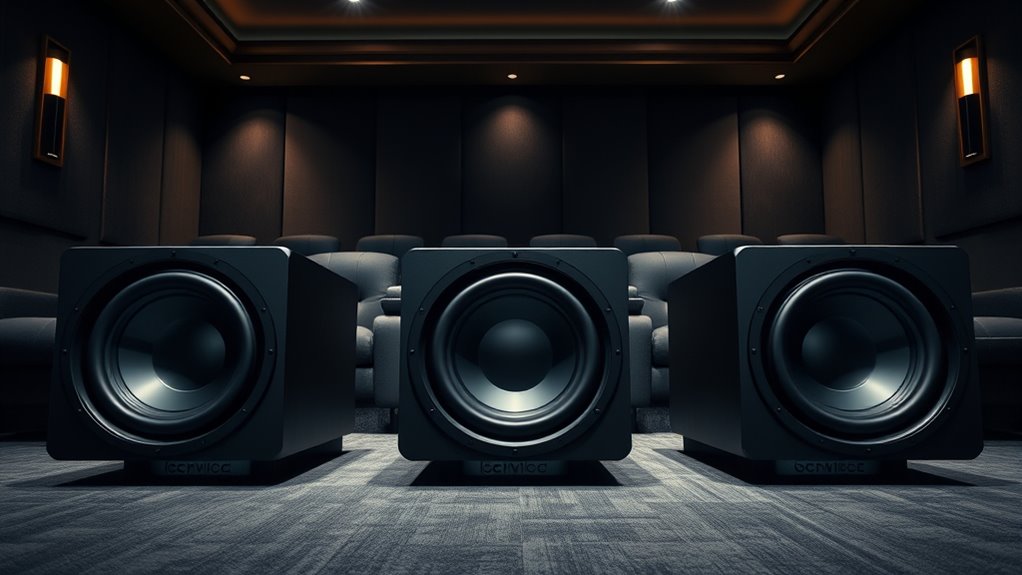
To get the best sound, you should consider placing your subwoofers in room corners, where they can boost bass response. Aligning multiple subs properly helps prevent phase issues and guarantees even sound distribution. Additionally, synchronizing sound waves between all subs is key to achieving tight, seamless bass throughout your space. Proper subwoofer placement is essential for maximizing your sound system’s performance and ensuring a more immersive listening experience. When setting up your system, paying attention to room acoustics can further enhance overall sound quality by minimizing unwanted echoes and resonances. Being aware of acoustic treatments can help optimize your environment for the best audio experience. Applying security zone info best practices can also contribute to creating a controlled environment that minimizes external disturbances affecting your audio setup. Ensuring proper sound wave synchronization can significantly improve bass clarity and prevent muddiness in your audio output.
Room Corner Placement
Placing subwoofers in the corners of a room can especially enhance bass response, but it requires careful consideration. Corners amplify low frequencies because they reflect sound waves, creating a more powerful and deeper bass. However, this placement can also cause uneven bass distribution or boomy sound if not managed properly. To optimize performance, start by positioning your subwoofer in a corner and listen critically. Adjust its placement slightly, moving it along the wall or away from walls if needed, to achieve a balanced, tight bass. Avoid placing the sub directly against the wall or in the corner if you notice excessive boominess. Remember, each room reacts differently, so experiment with placement to find the sweet spot that delivers deep, even bass without distortion.
Multiple Subwoofer Alignment
Using multiple subwoofers can considerably improve bass response and overall sound quality in your room. To achieve *ideal* performance, you should carefully align their placement. Start by placing the subwoofers at different locations around the room rather than all in one spot. This helps reduce bass nulls and peaks caused by room modes. Experiment with positions near walls, corners, or along the same wall to find the best balance. Use measurements or a sound level meter to identify where bass is most even. Once you’ve found promising spots, listen critically to *guarantee* smooth, even bass across the listening area. Proper alignment minimizes phase issues and enhances clarity, *ensuring* your subwoofers work together seamlessly for a richer, more balanced sound experience.
Sound Wave Synchronization
Achieving sound wave synchronization among multiple subwoofers is essential for seamless bass performance. When your subwoofers are in sync, they produce a unified, powerful bass response without cancellation or reinforcement issues. Proper placement ensures the sound waves arrive at your listening position simultaneously, avoiding phase cancellation. To do this effectively, consider your room layout and speaker positions. Use the table below to understand key placement strategies:
| Strategy | Effect | Tip |
|---|---|---|
| Corner placement | Boosts bass volume | Place subwoofers near corners for stronger output |
| Distance equalization | Prevents phase issues | Keep subwoofers equidistant from listening point |
| Trial and error | Fine-tunes synchronization | Adjust positions and listen for smooth bass |
| Use of phase switch | Corrects phase discrepancies | Toggle phase to align wave peaks and troughs |
| Room treatment | Minimizes sound distortion | Add bass traps to reduce standing waves |
Understanding Phase and Crossover Settings
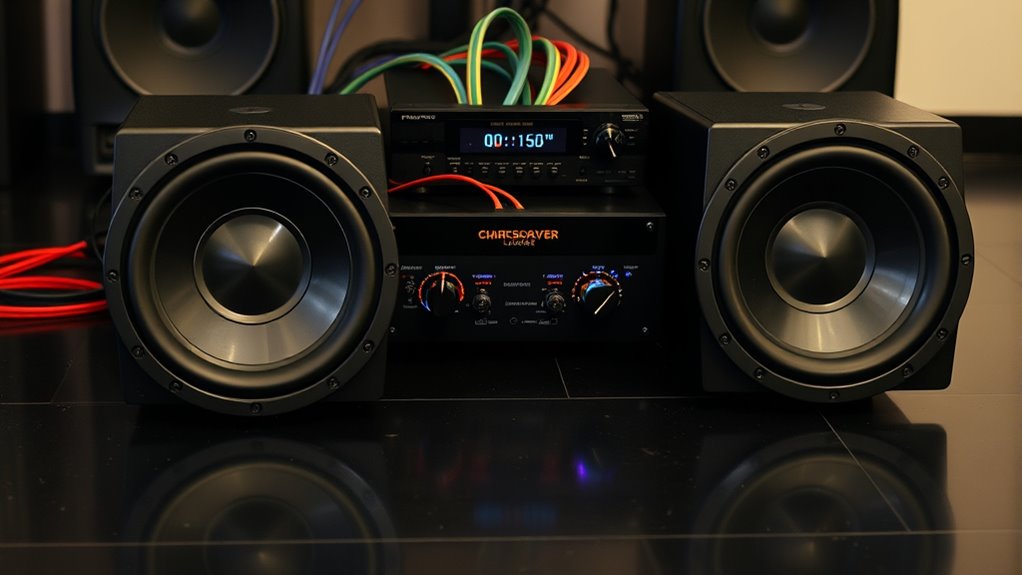
Understanding phase and crossover settings is essential to guarantee your multi-subwoofer system delivers seamless, balanced bass. Phase controls determine how your subwoofers synchronize with your main speakers, preventing cancellations or reinforcement issues that can disrupt sound quality. If your bass sounds hollow or boomy, adjusting the phase can fix it. The crossover setting defines the frequency at which your subwoofers start to produce bass, blending smoothly with your main speakers. Setting this too high or too low can cause gaps or overlap in the bass spectrum. To optimize performance, start with the crossover around 80 Hz and fine-tune based on listening. Carefully adjusting phase and crossover ensures your subwoofers work together harmoniously, providing a consistent and powerful bass experience across your system.
Common Challenges and How to Overcome Them
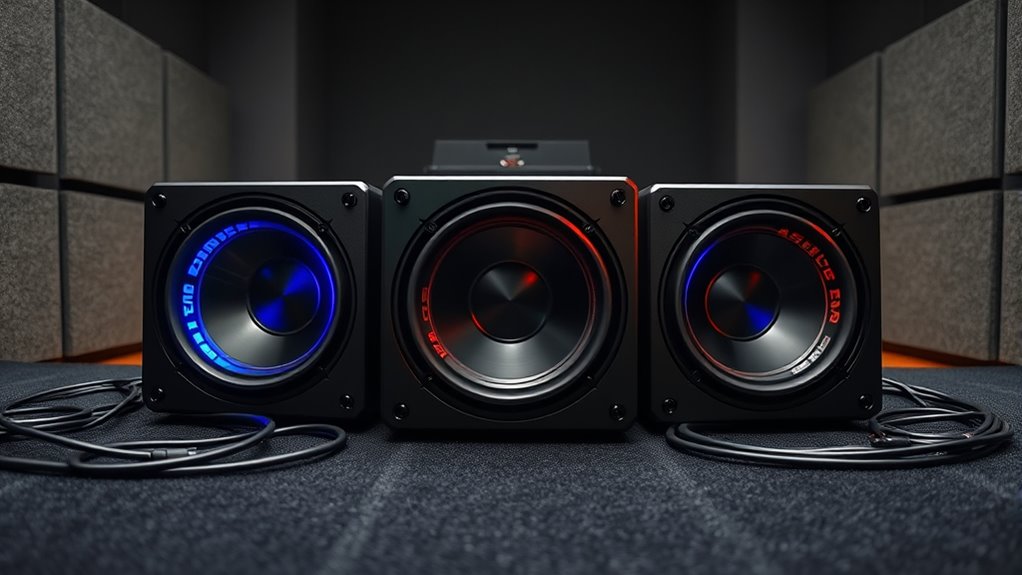
One common challenge when setting up a multi-subwoofer system is achieving a cohesive bass response without gaps or unwanted overlaps. This can cause uneven sound and muddled bass. To overcome this, focus on proper placement, calibration, and phase alignment.
Key points to consider include:
- Place subwoofers strategically to minimize cancellation and reinforce bass in different areas.
- Use calibration tools like room correction software to balance levels and frequency response.
- Align phases to ensure subwoofers work together smoothly, avoiding destructive interference.
Addressing these issues requires patience and careful adjustments. Small changes in position or settings can markedly improve overall sound quality. Remember, each space is different, so tailor your approach for the best results. With proper setup, you’ll achieve powerful, seamless bass across your entire listening area.
Tips for Integrating Multiple Subwoofers Into Your System

Integrating multiple subwoofers into your system can markedly enhance bass performance, but it requires careful planning and execution. First, position your subwoofers strategically around the room to minimize nulls and peaks caused by standing waves. Use calibration tools or room correction software to balance their output and guarantee even bass distribution. Keep the subwoofers in phase by adjusting their wiring or phase settings so they work together seamlessly. Additionally, set the same volume level for each subwoofer to prevent one from overpowering the others. Experiment with placement and settings, listening for smooth, consistent bass. Finally, consider a dedicated subwoofer amplifier or a receiver with multiple subwoofer outputs for simplified control and ideal integration.
Frequently Asked Questions
How Do I Know if I Need Multiple Subwoofers?
You might need multiple subwoofers if you notice uneven bass distribution or dead spots in your space. If your room is large or has challenging acoustics, adding more subwoofers can provide even, powerful bass throughout. Consider your listening preferences—if you crave deep, immersive sound or host large gatherings, multiple subs can enhance your experience. Assess your space and sound needs to determine if extra subs will improve your audio performance.
Can Multiple Subwoofers Be Used in Small Rooms?
Yes, you can use multiple subwoofers in small rooms. In fact, they can help you achieve smoother bass and reduce dead spots, even in tight spaces. When you place them strategically, you’ll notice more consistent sound throughout the room. Keep in mind, too many might cause overpowering bass or muddiness, so start with two and adjust placement until you find the perfect balance for your space.
What Are the Cost Implications of Multiple Subwoofers?
Adding multiple subwoofers increases your overall cost since you’ll need to buy each unit and possibly extra equipment like amplifiers and cables. Installation might also take more time and effort, which can add to the expense. However, investing in multiple subwoofers can improve sound quality and bass response, making it worthwhile if you’re seeking a richer audio experience. Just be prepared for the higher upfront investment.
How Do I Maintain Consistent Sound Across Multiple Subs?
Think of your subs as a choir singing in harmony—you need to tune them carefully. To maintain consistent sound, you should calibrate each sub to match the others’ phase, volume, and crossover settings. Use calibration tools or a sound meter to fine-tune their performance. Regularly check and adjust as needed, especially when moving or adding new subs, ensuring they work together as a cohesive, balanced team.
Are There Specific Brands Best Suited for Multi Subwoofer Setups?
Yes, some brands are better suited for multi subwoofer setups. You’ll want to look at brands like SVS, JL Audio, and REL because they offer powerful, high-quality subs designed for seamless integration. These brands provide models with advanced controls for phase, crossover, and volume, helping you achieve balanced, consistent sound across multiple subs. Investing in reputable brands guarantees durability, better sound quality, and easier calibration for your multi-sub system.
Conclusion
Think of your multi subwoofer system as a symphony conductor guiding an orchestra. When each sub plays its part in harmony, the result is pure, immersive sound that fills your space. By carefully setting up and tuning your subs, you create a seamless bass experience that transports you. With patience and attention to detail, you’ll turn your room into a concert hall — a perfect harmony of power and clarity waiting to be discovered.
Fall Picks
fall essentials
As an affiliate, we earn on qualifying purchases.