When searching for an air quality monitor PM2.5, the goal is to find a device that accurately tracks fine particulate matter to help improve indoor air quality. The best overall pick, the GoveeLife Smart Air Quality Monitor, combines reliable data with user-friendly features. For those needing detailed readings, the Temtop M10+ offers comprehensive measurements including VOCs and formaldehyde. However, tradeoffs between accuracy, ease of use, and price make choosing the right monitor a balancing act. Continue reading for a detailed breakdown of the top options and what to consider before buying.

Turn your quiet moments into listening time
- Thousands of audiobooks, podcasts and originals
- Listen on your phone, tablet or Echo — also offline
- Cancel anytime
Key Takeaways
- The best monitors balance accuracy with ease of use, especially for everyday homeowners.
- Higher-end models tend to include more sensors, providing comprehensive indoor air insights but at a premium price.
- Display quality and app integration significantly influence user experience and data accessibility.
- Many affordable options focus on PM2.5 but may lack features like VOC detection or real-time alerts.
- Choosing a monitor depends heavily on your specific needs—whether for allergy management, pollution tracking, or general indoor air health.
| 16-in-1 Indoor Air Quality Monitor with 7-inch Display and Real-Time Alerts |  | Best Overall for Comprehensive Monitoring and Ease of Use | Parameters Monitored: CO2, PM2.5, PM1.0, PM10, HCHO, TVOC, Temperature, Humidity, AQI, Time | Display: 7-inch LED | Sensor Accuracy: 0.001 units | VIEW ON AMAZON | See Our Full Breakdown |
| GoveeLife Smart Air Quality Monitor with PM2.5, LED Display, Wired |  | Best for Real-Time Data with Smart Integration | PM2.5 Accuracy: ±15 µg/m³ | Temperature Accuracy: ±0.54°F | Humidity Accuracy: ±3% | VIEW ON AMAZON | See Our Full Breakdown |
| Temtop S1 PM2.5 Air Quality Monitor & Indoor Thermometer | 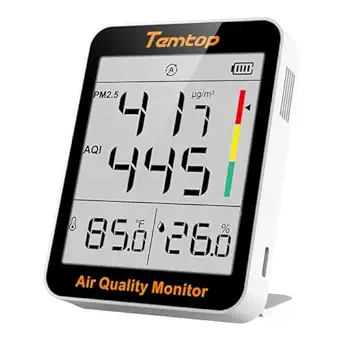 | Best for Portability and Long-Term Use | Air Quality Monitoring: PM2.5, AQI | Battery Life: Up to 60 days | Display: Digital screen | VIEW ON AMAZON | See Our Full Breakdown |
| Temtop M10+ 6-in-1 Indoor Air Quality Monitor |  | Best for Multi-Parameter Monitoring with App Connectivity | Measurements: CO2, PM2.5, TVOCs, temperature, humidity | Battery Life: Up to 60 days | Connectivity: App, Bluetooth | VIEW ON AMAZON | See Our Full Breakdown |
| 16-in-1 Indoor Air Quality Monitor with HD Screen |  | Best for Cordless, Long-Lasting Indoor Monitoring | Parameters Monitored: CO2, PM2.5, PM1.0, PM10, HCHO, TVOC, Temperature, Humidity, AQI | Display Size: 5.5 inches | Battery Life: Up to 10 hours | VIEW ON AMAZON | See Our Full Breakdown |
| Temtop Air Quality Monitor PM2.5 PM10 Formaldehyde VOCs Temperature Humidity AQI Tester |  | Best Overall Multi-Parameter Monitor | Weight: 14.4 ounces | Item Dimensions: 6.97 x 1.26 x 2.56 inches | Sensing Distance: 10 feet | VIEW ON AMAZON | See Our Full Breakdown |
| Temtop P600 PM2.5 Air Quality Monitor & Particle Counter |  | Best for Portable PM2.5 and PM10 Tracking | Sensor: Second-generation PM2.5 laser sensor | Lifespan: 20,000+ hours | Data Storage: 12 hours | VIEW ON AMAZON | See Our Full Breakdown |
| Indoor 10-in-1 Air Quality Monitor with Bluetooth |  | Best for Real-Time Indoor Multi-Parameter Monitoring | Measurement Capabilities: CO2, HCHO, TVOC, temperature, humidity, AQI, PM2.5, PM1.0, PM10 | Display: High-definition color screen | Connectivity: Bluetooth | VIEW ON AMAZON | See Our Full Breakdown |
| 16-in-1 Indoor Air Quality Monitor with HD Color Screen |  | Best for Extensive Parameter Testing and Clarity | Parameters Tested: PM1.0, PM2.5, PM10, CO2, TVOC, HCHO, temperature, humidity | Display: HD color screen | Battery Life: 4-5 hours | VIEW ON AMAZON | See Our Full Breakdown |
| BREATHE Airmonitor Plus Indoor Air Quality Monitor with CO₂, PM, and App (Gen 2) |  | Best for Professional-Grade Remote Monitoring | Battery Life: 6 hours | Data History: 90 days | Sensors: CO₂, PM1, PM2.5, PM10, TVOC, Formaldehyde, Temperature, Humidity | VIEW ON AMAZON | See Our Full Breakdown |
| air quality monitor pm25 | Display | Connectivity | Battery Life |
|---|---|---|---|
| 16-in-1 Indoor Air Quality Mon | 7-inch LED | — | — |
| GoveeLife Smart Air Quality Mo | — | 2.4G Wi-Fi | — |
| Temtop S1 PM2.5 Air Quality Mo | Digital screen | None | Up to 60 days |
| Temtop M10+ 6-in-1 Indoor Air | E-ink | App, Bluetooth | Up to 60 days |
| 16-in-1 Indoor Air Quality Mon | — | — | Up to 10 hours |
| Temtop Air Quality Monitor PM2 | — | — | — |
| Temtop P600 PM2.5 Air Quality | — | — | — |
| Indoor 10-in-1 Air Quality Mon | High-definition color screen | Bluetooth | — |
| 16-in-1 Indoor Air Quality Mon | HD color screen | — | 4-5 hours |
| BREATHE Airmonitor Plus Indoor | Color display | Wi-Fi | 6 hours |
More Details on Our Top Picks
16-in-1 Indoor Air Quality Monitor with 7-inch Display and Real-Time Alerts
This monitor stands out for its large, clear 7-inch display and ability to track 9 key parameters, including PM2.5, CO2, HCHO, and TVOC, providing a holistic view of indoor air quality. Compared with smaller or simpler devices like the Temtop S1, the 16-in-1 offers more detailed data and real-time alerts, making it ideal for users who want thorough insight. However, its complex setup and high cost may be drawbacks for casual users. The high-precision sensors ensure accurate measurements, and the multiple alert options help prevent exposure to harmful pollutants. Still, the sensors require careful handling to maintain accuracy over time.
Pros:- Large, easy-to-read 7-inch LED display
- Detects 9 key parameters for comprehensive monitoring
- Real-time alerts for multiple pollutants
- Adjustable brightness for different lighting conditions
Cons:- Sensors may need careful handling for accuracy
- Setup process can be complex and time-consuming
- High cost compared to basic monitors
Best for: Homeowners or facility managers seeking detailed, all-in-one air quality monitoring with real-time alerts.
Not ideal for: Casual users or those on a budget who prefer simple, straightforward devices with minimal setup.
- Parameters Monitored:CO2, PM2.5, PM1.0, PM10, HCHO, TVOC, Temperature, Humidity, AQI, Time
- Display:7-inch LED
- Sensor Accuracy:0.001 units
- Alert Types:7 distinct AQI alert buzzers
- Power Supply:USB-C cable and charging adapter
- Model Number:AK22A
Our verdict“This monitor is best suited for those needing detailed, all-in-one indoor air quality data with real-time alerts despite its higher price and setup complexity.”
GoveeLife Smart Air Quality Monitor with PM2.5, LED Display, Wired
The GoveeLife monitor excels with its high accuracy and quick 2-second refresh rate, making it ideal for users who want instant updates on PM2.5, temperature, and humidity. Its integration with Govee smart devices allows remote monitoring and data export, setting it apart from simpler models like the Temtop S1, which lacks app connectivity. However, its reliance on a constant power source via Type-C cable limits portability, and Wi-Fi dependency can be problematic in dead zones. Its multifunctionality makes it suitable for tech-savvy users who want to track air quality over time and integrate with smart home systems.
Pros:- High accuracy with fast 2-second refresh
- Supports remote monitoring and data export
- Integrates with Govee smart ecosystem
- Compact and easy to place
Cons:- Requires constant power via Type-C cable
- Wi-Fi dependency limits use in dead zones
- No built-in battery for portable use
Best for: Tech-savvy homeowners who want real-time air quality updates and smart device integration.
Not ideal for: Users seeking a portable, battery-powered device or with unreliable Wi-Fi connections.
- PM2.5 Accuracy:±15 µg/m³
- Temperature Accuracy:±0.54°F
- Humidity Accuracy:±3%
- Response Time:2 seconds
- Dimensions:5.31 x 1.57 x 2.47 inches
- Connectivity:2.4G Wi-Fi
Our verdict“Ideal for users who prioritize real-time data, smart integration, and are okay with wired power requirements over portability.”
Temtop S1 PM2.5 Air Quality Monitor & Indoor Thermometer
The Temtop S1 offers a portable, straightforward solution for monitoring PM2.5 and AQI, along with temperature and humidity. Compared with multi-parameter monitors like the M10+, the S1 excels in battery life, lasting up to 60 days, making it perfect for on-the-go use or temporary setups. Its simplicity, however, means it lacks detailed specs on measurement accuracy and connectivity options, limiting its use for users who want detailed data or app integration. This device is designed for those who prioritize long-term, portable air quality checks over real-time, multi-parameter monitoring.
Pros:- Long battery life of up to 60 days
- Portable and easy to carry
- Measures PM2.5 and AQI accurately
- Simple digital display
Cons:- Limited details on measurement accuracy
- No app or remote monitoring capabilities
- Lacks detailed parameter specifications
Best for: Individuals needing a portable, long-lasting device for periodic air quality checks at home or outdoors.
Not ideal for: Users who want continuous, detailed monitoring with app features or multiple parameters tracked simultaneously.
- Air Quality Monitoring:PM2.5, AQI
- Battery Life:Up to 60 days
- Display:Digital screen
- Portability:Yes
- Connectivity:None
Our verdict“Great for portable, long-term monitoring but not suited for real-time, detailed indoor air analysis.”
Temtop M10+ 6-in-1 Indoor Air Quality Monitor
The Temtop M10+ is ideal for users who want to monitor multiple indoor pollutants like CO2, PM2.5, TVOCs, plus temperature and humidity, all in one device. Its app connectivity enables long-term data logging and remote updates, a feature that sets it apart from Bluetooth-only models like the Temtop S1. Nevertheless, its Bluetooth-only connection means real-time monitoring requires proximity, which could be inconvenient. Its quiet operation and long battery life make it suitable for bedrooms and offices. However, the lack of detailed sensor accuracy info might concern those needing precise measurements for sensitive environments.
Pros:- Tracks CO2, PM2.5, TVOCs, temperature, humidity
- Long battery life up to 60 days
- App connectivity for data logging
- Quiet operation suitable for bedrooms
Cons:- Bluetooth requires proximity for real-time updates
- Limited to Bluetooth—no Wi-Fi
- Unclear sensor accuracy specifics
Best for: Homeowners or office managers seeking multi-parameter indoor air quality data with remote access.
Not ideal for: Users who need instant, real-time alerts or do not want to rely on Bluetooth proximity for updates.
- Measurements:CO2, PM2.5, TVOCs, temperature, humidity
- Battery Life:Up to 60 days
- Connectivity:App, Bluetooth
- Display:E-ink
- Alarm:Adjustable, mute option
Our verdict“Perfect for those wanting multi-parameter indoor air monitoring with remote data access, accepting some limitations in real-time flexibility.”
16-in-1 Indoor Air Quality Monitor with HD Screen
This portable device offers real-time detection of 9 parameters, including PM2.5, CO2, HCHO, and TVOC, with a sizable 5.5-inch display. Its cordless operation and 10-hour battery life make it highly suitable for users who need flexible, on-the-move air quality checks. Compared to wired monitors like the GoveeLife, this model eliminates the need for constant power, but its sensors may require careful handling to stay accurate. The device’s complex settings might pose a challenge for less tech-savvy users, and its focus on indoor use limits versatility for outdoor applications.
Pros:- Provides comprehensive 9-parameter real-time data
- High-precision sensors ensure accuracy
- Large, adjustable display
- Cordless with up to 10 hours of battery life
Cons:- Sensors may need careful handling for accuracy
- Complex settings could be confusing for some
- Limited to indoor use only
Best for: Active users who want portable, real-time indoor air quality data without being tethered to a power outlet.
Not ideal for: Those seeking long-term, continuous monitoring or detailed connectivity options like Wi-Fi or app integration.
- Parameters Monitored:CO2, PM2.5, PM1.0, PM10, HCHO, TVOC, Temperature, Humidity, AQI
- Display Size:5.5 inches
- Battery Life:Up to 10 hours
- Sensor Accuracy:0.001 units
- Power:USB-C
Our verdict“Ideal for users needing portable, real-time indoor air monitoring with a large display and cordless operation, accepting some setup complexity.”
Temtop Air Quality Monitor PM2.5 PM10 Formaldehyde VOCs Temperature Humidity AQI Tester
This 7-in-1 device stands out for its ability to track multiple air quality parameters, including PM2.5, PM10, formaldehyde, VOCs, temperature, humidity, and AQI, all in one compact tool. Compared with the Temtop P600, it offers a broader range of measurements, making it ideal for users needing comprehensive indoor and outdoor data. Its high-accuracy Dart sensor ensures reliable readings, and features like trend analysis and data export support professional use. However, it lacks gas or CO detection, requiring separate alarms for those risks. The portable design makes it suitable for spot checks, but limited battery life of 6-8 hours can be a drawback for extended outdoor use. Also, a warm-up time after moving between environments can delay readings.
Pros:- Tracks multiple parameters simultaneously with high accuracy
- Includes trend analysis and data export for professional reporting
- Portable with built-in battery for spot checks and continuous monitoring
Cons:- Does not detect gases or CO leaks, requiring separate alarms
- Limited battery life of 6-8 hours for portable use
Best for: Environmental professionals or serious homeowners requiring detailed, multi-parameter air quality data in real-time.
Not ideal for: Casual users looking for simple PM2.5 monitoring or long outdoor use, due to its limited battery life and focus on multiple parameters.
- Weight:14.4 ounces
- Item Dimensions:6.97 x 1.26 x 2.56 inches
- Sensing Distance:10 feet
- Maximum Supply Voltage:3.7 volts DC
- Lower Temperature Rating:32 °F
- Upper Temperature Rating:122 °F
Our verdict“This monitor suits users who need detailed, high-accuracy air quality data across multiple parameters for indoor or outdoor environments.”
Temtop P600 PM2.5 Air Quality Monitor & Particle Counter
The Temtop P600 excels at delivering accurate PM2.5 and PM10 readings with a simple, visual health indicator, making it ideal for quick assessments. Compared to the Temtop Air Quality Monitor, it specializes in particle measurement but offers less parameter variety, focusing on ease of use and trend tracking. Its second-generation laser sensor provides stable, reliable readings with a lifespan exceeding 20,000 hours, and the 12-hour data storage helps identify patterns. However, it lacks connectivity features like Bluetooth or Wi-Fi, limiting data sharing options. Its lightweight, portable design makes it perfect for outdoor air quality checks or quick indoor assessments, but users seeking comprehensive multi-parameter monitoring will find it limited.
Pros:- Accurate, stable particle measurement with visual indicators
- Long sensor lifespan and stable performance
- Portable and easy to use indoors and outdoors
Cons:- Limited to PM2.5 and PM10 measurements, no VOC or gas detection
- No connectivity features for data sharing or logging
Best for: Individuals needing a compact, reliable PM2.5/PM10 monitor for outdoor activities or quick indoor checks.
Not ideal for: Users requiring detailed indoor air quality analysis beyond particulate matter, such as VOCs or formaldehyde, as it focuses solely on particles.
- Sensor:Second-generation PM2.5 laser sensor
- Lifespan:20,000+ hours
- Data Storage:12 hours
- Power:Charging cable included
Our verdict“This device is perfect for users who need fast, reliable PM monitoring in portable formats without complex features.”
Indoor 10-in-1 Air Quality Monitor with Bluetooth
This portable indoor air monitor offers a broad set of measurements—CO2, formaldehyde, TVOC, particulate matter, temperature, and humidity—displayed through a high-definition color screen. It makes comparison with the BREATHE Airmonitor Plus, which provides app-based remote monitoring, but is more suited for immediate, on-site readings. Its color-coded alerts simplify risk detection, and Bluetooth calibration ensures ease of setup. However, some users report calibration issues, and without Wi-Fi, its remote capabilities are limited. Its focus on indoor environments makes it ideal for homes, offices, or vehicles, but it’s less suitable for outdoor use or long-term tracking.
Pros:- Measures multiple parameters with real-time, color-coded alerts
- Bluetooth calibration and synchronization for easy setup
- High-definition color display enhances readability
Cons:- Limited details on sensor lifespan and long-term durability
- Calibration may require troubleshooting due to reported issues
Best for: Homeowners or office workers who want quick, visual feedback on multiple indoor air quality parameters.
Not ideal for: Users seeking long-term data logging or remote monitoring that requires Wi-Fi or app connectivity, due to calibration and connectivity limitations.
- Measurement Capabilities:CO2, HCHO, TVOC, temperature, humidity, AQI, PM2.5, PM1.0, PM10
- Display:High-definition color screen
- Connectivity:Bluetooth
- Power:Includes charging cable
Our verdict“This monitor suits users who want immediate, visual insights into indoor air quality with simple calibration processes.”
16-in-1 Indoor Air Quality Monitor with HD Color Screen
This portable device offers a comprehensive suite of 16 parameters, including PM1.0, PM2.5, PM10, CO2, TVOC, formaldehyde, temperature, and humidity. Its high-precision sensors and HD color display make interpreting data straightforward, especially compared with simpler monitors like the Temtop P600. Its 4-5 hour battery life is a limitation for extended outdoor use, but for indoor applications in homes or offices, it provides detailed insights with ease. The lack of advanced connectivity features or data logging limits long-term trend analysis, but for immediate, detailed readings, it excels. It’s best suited for users who prioritize multi-parameter testing and clear visual data.
Pros:- Tests a wide range of parameters simultaneously
- High-precision sensors with real-time updates
- Clear, HD color display simplifies data interpretation
Cons:- Limited battery life of 4-5 hours, requiring frequent charging
- No advanced app connectivity or long-term data storage
Best for: Indoor users who want detailed, real-time monitoring of multiple air quality factors in a portable format.
Not ideal for: Those requiring long-duration monitoring or app-based data management, due to short battery life and limited connectivity features.
- Parameters Tested:PM1.0, PM2.5, PM10, CO2, TVOC, HCHO, temperature, humidity
- Display:HD color screen
- Battery Life:4-5 hours
- Charging:Type-C fast charging
Our verdict“This device is ideal for users seeking a detailed snapshot of indoor air quality with a user-friendly display, despite limited battery endurance.”
BREATHE Airmonitor Plus Indoor Air Quality Monitor with CO₂, PM, and App (Gen 2)
The BREATHE Airmonitor Plus Gen 2 offers a robust suite of 8 sensors, including CO₂, PM1, PM2.5, PM10, VOCs, formaldehyde, temperature, and humidity, making it the most comprehensive in this lineup. Unlike the other monitors, it provides up to 6 hours of portable use and pairs with an app to enable remote monitoring, alerts, and data export—features that are highly valuable for long-term or professional indoor air quality management. The 90-day data history supports trend analysis, but some users note that battery life and Wi-Fi connectivity can limit convenience. This model appeals to those who want a professional, connected monitoring system, but it’s less suited for casual or outdoor use.
Pros:- Comprehensive 8-in-1 sensor suite for detailed indoor air tracking
- App connectivity for remote alerts, data export, and long-term monitoring
- Rechargeable with 6-hour portable use and 90-day data history
Cons:- Battery life may be insufficient for extended outdoor use
- Requires Wi-Fi for full app features, which can limit usability in some settings
Best for: Homeowners or facility managers seeking a detailed, connected indoor air quality system with long-term data tracking.
Not ideal for: Users who prefer simple, stand-alone monitors without app dependencies or need extended outdoor monitoring, due to battery and connectivity constraints.
- Battery Life:6 hours
- Data History:90 days
- Sensors:CO₂, PM1, PM2.5, PM10, TVOC, Formaldehyde, Temperature, Humidity
- Connectivity:Wi-Fi
- Display:Color display
- Power:Rechargeable, USB-C
Our verdict“This monitor is best for users who need in-depth, remote, and long-term indoor air quality management with professional features.”

How We Picked
I evaluated these air quality monitors based on several key criteria: measurement accuracy, sensor variety, ease of use, build quality, and value for money. Devices with reliable PM2.5 detection and additional sensors like VOCs or formaldehyde scored higher, especially if they offer real-time alerts or app integration. I also considered user interface clarity and maintenance ease, favoring models that strike a good balance between sophistication and practicality. The products are ranked based on overall performance, feature set, and how well they serve different types of buyers—from casual users to serious indoor air quality enthusiasts.Factors to Consider When Choosing Air Quality Monitor Pm25
Choosing the right PM2.5 air quality monitor involves more than just looking at features. It’s important to consider how the device will fit into your daily routine, what specific pollutants you want to track, and your budget. Understanding the broader aspects of sensor accuracy, data presentation, and device maintenance can help ensure you pick a monitor that provides trustworthy insights and long-term value. Here are some factors to keep in mind:Sensor Accuracy and Range
Reliable PM2.5 measurement depends on high-quality sensors. Cheaper monitors may provide quick readings but can be less precise or inconsistent over time. Look for devices with proven sensor technologies and ranges suitable for your environment. Keep in mind that some monitors focus exclusively on PM2.5, while others include VOCs, formaldehyde, or CO₂, which might be necessary depending on your concerns. Investing in a sensor with a good reputation ensures your data reflects real air quality conditions, reducing false alarms or overlooked issues.
Ease of Use and Data Presentation
Intuitive interfaces, clear displays, and user-friendly apps make monitoring more accessible. Devices with color-coded indicators or real-time alerts can quickly inform you of air quality changes without needing to interpret complex data. Conversely, overly complicated setups or poorly designed apps can discourage regular use, defeating the purpose of continuous monitoring. Consider whether you prefer a dedicated display or app control, and how easily you can interpret the readings for actionable steps.
Sensor Variety and Additional Features
Some monitors go beyond PM2.5, measuring VOCs, formaldehyde, humidity, temperature, and CO₂. These extra sensors can provide a fuller picture of indoor air health, especially if you have specific sensitivities or concerns. However, more sensors typically come with a higher price tag and potentially more maintenance. Decide which pollutants are most relevant to your environment and choose a monitor that offers those measurements without overwhelming you with unnecessary data.
Build Quality and Maintenance
Durable construction and easy access to sensor calibration or replacement extend a monitor’s lifespan. Cheaper models may require more frequent calibration or replacement, increasing long-term costs. Look for products with solid build quality and clear instructions on maintenance. Proper upkeep ensures accuracy over time and reduces the risk of false readings caused by sensor degradation.
Price and Value
Price ranges widely across these monitors, often correlating with sensor quality, features, and brand reputation. While budget options can be suitable for casual use, investing in a more capable device may be worthwhile if you need precise data or real-time alerts. Consider your budget against the importance of data accuracy, additional sensors, and app features, aiming for a model that offers the best value for your specific needs.
Frequently Asked Questions
How accurate are PM2.5 readings from consumer-grade monitors?
Consumer-grade PM2.5 monitors provide reasonably accurate data for general indoor air quality assessment, but they may not match the precision of professional-grade instruments. These devices are calibrated for everyday use and can be affected by environmental factors like humidity or temperature. For critical applications, such as allergy management or pollution-sensitive environments, consider models with proven sensor technology or professional calibration options. Overall, these monitors are effective for tracking trends and making informed decisions about your indoor air, even if they aren’t perfectly precise.
Can I trust the real-time alerts on these devices?
Most modern air quality monitors with alert features provide timely notifications based on preset thresholds, which are generally reliable for typical indoor conditions. However, the accuracy of alerts depends on the sensor quality and calibration. False alarms can occur if sensors drift or environmental factors interfere, so it’s wise to verify readings with a second device if possible. Setting appropriate thresholds based on health guidelines can improve the usefulness of alerts, helping you respond swiftly to poor air quality episodes.
Are monitors with more sensors worth the extra cost?
Additional sensors such as VOCs, formaldehyde, humidity, and CO₂ add layers of insight that can be valuable for specific concerns, like chemical sensitivities or asthma. While they increase the price, they enable a more comprehensive understanding of indoor air quality. If you’re primarily concerned with PM2.5 and particulate matter, a simpler device may suffice. Evaluate whether the extra data will influence your air quality management or if it introduces unnecessary complexity and expense.
How often do I need to calibrate or replace sensors?
Calibration frequency varies by model, but most consumer devices recommend calibration every 6 to 12 months to maintain accuracy. Some monitors have auto-calibration features or replaceable sensors that make this process easier. Regular maintenance is essential to avoid drift in sensor readings, especially in environments with high pollutant levels or humidity. Check manufacturer guidelines for specific calibration procedures and costs involved, as neglecting this can lead to less reliable data over time.
What should I consider if I want a monitor for a large space?
For larger areas, choose a monitor with a wider detection range and sufficient sensor sensitivity to cover the space effectively. Multiple devices might be necessary in very large or segmented environments to ensure accurate monitoring across zones. Additionally, look for monitors with strong Wi-Fi or Bluetooth connectivity, so data can be aggregated centrally or accessed remotely. Understanding your space’s size and airflow will help determine whether a single higher-capacity monitor suffices or multiple units are needed.
Conclusion
For general indoor air health, the GoveeLife Smart Air Quality Monitor offers a balanced combination of accuracy, ease of use, and affordability, making it ideal for most households. If you prioritize comprehensive data, especially if chemical sensitivities are involved, the Temtop M10+ stands out as a premium choice. Beginners or casual users should consider simplified models that focus on PM2.5 and basic alerts, while those with specific concerns like VOCs or formaldehyde will benefit from multi-sensor options like the BREATHE Airmonitor Plus. Ultimately, selecting the right monitor depends on your environment, budget, and the level of detail you need to maintain healthy indoor air quality.Halloween Picks
halloween
As an affiliate, we earn on qualifying purchases.