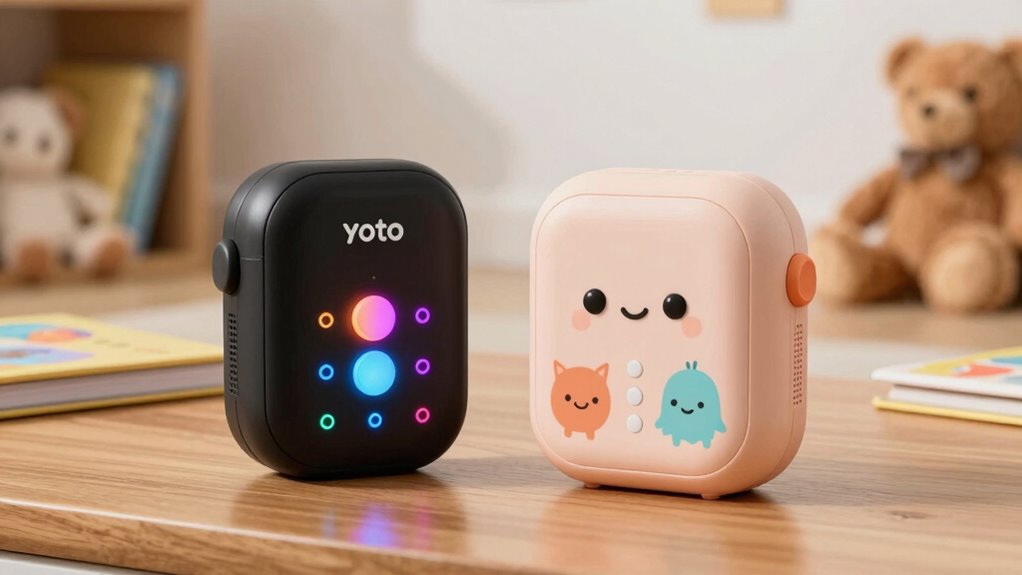

When choosing between a Yoto player and a Toniebox, the decision often hinges on usability, content selection, and price. The Yoto Player (3rd Gen.) stands out as the best overall for its versatile screen-free design and extensive content library. The Toniebox is favored for its simple, tactile interface ideal for very young children, while the Yoto Mini offers better portability for on-the-go use. Each option presents tradeoffs—Yoto’s customizable features versus Toniebox’s straightforward play experience. Continue reading for a detailed comparison of these popular options to find the best fit for your child’s needs.

Turn your quiet moments into listening time
- Thousands of audiobooks, podcasts and originals
- Listen on your phone, tablet or Echo — also offline
- Cancel anytime
Key Takeaways
- The Yoto Player (3rd Gen.) offers the most versatile content options and customization, making it ideal for families seeking variety.
- Toniebox excels in simplicity and durability, which benefits younger children who prefer tactile, easy-to-use devices.
- The Yoto Mini’s compact size makes it perfect for travel and portability, though it may have fewer features than larger models.
- Content ecosystems differ significantly; Yoto relies on digital cards and app management, while Toniebox uses physical figurines for play.
- Price points vary, with Yoto generally costing more but offering more customization, while Toniebox provides a straightforward, durable experience at a slightly lower price.
| Yoto Mini (2024 Edition) Kids Audio Player + Spanish Starter Pack |  | Best for Beginners and Family-Friendly Control | Memory Storage Capacity: 32 GB | Screen Size: 1.3 inches | Supported Standards: MP3, AAC, FLAC, WAV, WMA, OGG, MP4, M4A, AMR | VIEW ON AMAZON | See Our Full Breakdown |
| Yoto The Magic Treehouse Collection – 8 Kids Audio Cards |  | Best for Screen-Free Adventure Enthusiasts | Number of Items: 1 | Included Components: Cards | Language: English | VIEW ON AMAZON | See Our Full Breakdown |
| YOTO Player (3rd Gen.) + Kids Disney Classics Bundle |  | Best for Disney Fans and Multi-Functional Use | Audio Output Mode: Stereo | Mounting Type: Speaker | Internal Memory: 32GB | VIEW ON AMAZON | See Our Full Breakdown |
| Yoto Mini (2024 Edition) – Kids Travel Audio Player, Screen-Free |  | Best for Travel and On-the-Go Use | Battery Life: Up to 14 hours | Content Format: Physical cards | Display: Pixel display | VIEW ON AMAZON | See Our Full Breakdown |
| YOTO Player (3rd Gen.) – Kids Audio Player, Screen-Free |  | Best for Extensive Content and Long Playtime | Audio Output Mode: Stereo | Mounting Type: Tabletop | Internal Memory: 32GB | VIEW ON AMAZON | See Our Full Breakdown |
| YOTO Player (3rd Gen.) + Starter Pack for Little Kids Bundle – Kids Bluetooth Audio Speaker, All-in-1 Screen-Free Device for Stories, Music, Podcasts, Radio, White Noise, Nightlight |  | Best Overall Versatile Kids Audio Device | Audio Output Mode: Stereo | Mounting Type: Speaker | Enclosure Material: Plastic | VIEW ON AMAZON | See Our Full Breakdown |
| Yoto Mini (2024 Edition) + Starter Pack for Little Kids Bundle, Ages 3+ |  | Best Compact Portable Audio Player | Weight: 160 g | Dimensions: 1.57″D x 2.76″W x 2.76″H | Display Technology: Pixel display | VIEW ON AMAZON | See Our Full Breakdown |
More Details on Our Top Picks
Yoto Mini (2024 Edition) Kids Audio Player + Spanish Starter Pack
The Yoto Mini (2024 Edition) stands out for its child-friendly design and straightforward control, making it ideal for young children just starting with screen-free audio. Unlike the YOTO Player 3rd Gen., which offers a larger display and more offline content, the Mini’s compact size and physical card system keep it simple and safe for preschoolers. However, its limited storage and dependency on physical cards mean it might not suit families with extensive media collections or those seeking a fully digital experience. The inclusion of parental controls and a versatile range of functions like sleep sounds and Bluetooth adds value for parents prioritizing safety and multitasking. This pick is perfect for parents seeking an easy-to-use, safe device for children aged 3+, especially in households with limited tech experience.Pros:- Easy to set up and operate with physical cards or app control
- Child-safe with parental controls, no ads or cameras
- Versatile functions including sleep sounds, stories, alarms, and Bluetooth
Cons:- Limited storage for large media collections
- Requires physical audio cards for content playback
- Battery life can vary depending on usage
Best for: Parents of preschool children who want a simple, safe, and engaging audio device with physical controls.
Not ideal for: Families with older children or those wanting extensive digital media libraries without physical cards.
- Memory Storage Capacity:32 GB
- Screen Size:1.3 inches
- Supported Standards:MP3, AAC, FLAC, WAV, WMA, OGG, MP4, M4A, AMR
- Battery Average Life:20 hours
- Item Weight:160 g
- Color:Yoto Mini 2024 & 1, 2, 3, ¡A moverse! Bundle
Our verdict“A great choice for parents seeking a simple, safe, and versatile device for young children just starting with screen-free audio.”
Yoto The Magic Treehouse Collection – 8 Kids Audio Cards
This collection makes a strong case for kids who love storytelling without screens, especially since it features the beloved Magic Tree House series read by Mary Pope Osborne herself. Compared to the YOTO Player (3rd Gen.), which offers a broader library and multimedia capabilities, these cards provide focused, high-quality adventures perfect for children 6 and up. The main tradeoff is that they require a Yoto device to listen, limiting flexibility for non-compatible platforms. While the stories are engaging and easy to use, the limited number of stories means this collection is best suited for children who are already fans of the series or want a curated experience. It’s ideal for families who prefer physical media and want a simple way to foster a love of reading and learning offline.Pros:- Screen-free entertainment with high-quality storytelling
- Includes popular Magic Tree House stories read by the author
- Easy to use with Yoto devices, no need for screens
Cons:- Requires Yoto Player or Mini to listen
- Limited to the included eight stories
- No visual or interactive components
Best for: Parents of children 6+ who want engaging, physical story content to encourage reading and imagination without screens.
Not ideal for: Those seeking a broad digital library or multimedia content that can be accessed across multiple devices without physical cards.
- Number of Items:1
- Included Components:Cards
- Language:English
- Running Time:5 h 42 min
- Age Range:6+
- Best Sellers Rank:#4,032 in Toys & Games
Our verdict“A focused, screen-free story set that’s perfect for young readers and fans of the Magic Tree House series.”
YOTO Player (3rd Gen.) + Kids Disney Classics Bundle
The YOTO Player (3rd Gen.) combines a versatile, screen-free audio experience with an extensive library of Disney stories, making it ideal for children who love familiar characters. Its large 32GB internal memory supports over 600 hours of offline content, unlike the Yoto Mini, which has less storage and fewer features. The device doubles as a nightlight, thermometer, and alarm clock, offering more functionality but at the cost of increased complexity and size. While it lacks visual or video features, its rich content library and multi-use capabilities make it a compelling choice for families seeking a comprehensive device for daily entertainment and education. However, the need for physical Audiobook Cards and occasional setup complexity might be drawbacks for some parents.Pros:- Large internal storage with over 600 hours of content
- Includes Disney classics and multiple functions like nightlight and thermometer
- Supports Bluetooth and Wi-Fi for flexible connectivity
Cons:- Requires physical Audiobook Cards for content
- Some users may find setup or app controls complex
- Larger and heavier than smaller portable options
Best for: Families wanting a multi-purpose, Disney-themed device with extensive offline content for children aged 4+.
Not ideal for: Parents preferring ultra-simple devices or seeking purely digital content without physical cards or extensive features.
- Audio Output Mode:Stereo
- Mounting Type:Speaker
- Internal Memory:32GB
- Speaker Features:Ambient night light, Room temperature monitoring
- Control Method:App, Touch
- Uses:Home entertainment, children’s education, portable use
Our verdict“Ideal for families wanting a robust, multi-use device with a large content library and Disney favorites.”
Yoto Mini (2024 Edition) – Kids Travel Audio Player, Screen-Free
The Yoto Mini (2024 Edition) excels as a portable, screen-free audio companion, especially suited for active families and travel. Its lightweight design and 14-hour battery life surpass larger models like the YOTO Player (3rd Gen.), providing longer playtime between charges. Designed with physical cards, it offers safe, offline entertainment for children aged 3-12, making it a reliable travel partner. However, its reliance on physical cards can be a drawback if cards are lost or misplaced, and it’s limited to audio content without visual features. This device makes the most sense for parents who want dependable, safe entertainment during trips or outings without screens or complex setups.Pros:- Screen-free, safe entertainment on the go
- Long battery life up to 14 hours for travel
- Easy to operate with physical cards and app control
Cons:- Requires physical cards, which can be lost
- Limited to audio content without visual media
- Dependent on parental controls for safe use
Best for: Traveling families or those needing a portable, durable device for children aged 3-12.
Not ideal for: Households seeking large media libraries or digital streaming capabilities for indoor use only.
- Battery Life:Up to 14 hours
- Content Format:Physical cards
- Display:Pixel display
- Age Range:3-12+
- Warranty:Limited
Our verdict“A dependable, travel-ready device for parents who prioritize portability and offline, screen-free listening.”
YOTO Player (3rd Gen.) – Kids Audio Player, Screen-Free
The YOTO Player (3rd Gen.) offers a substantial upgrade in content capacity and features, making it well-suited for families wanting a comprehensive, offline library with minimal fuss. Its 32GB storage supports over 600 hours of content, surpassing smaller models like the Yoto Mini, and the vivid pixel display enhances visual engagement. Its multiple features—nightlight, thermometer, alarms—add convenience, though it’s primarily designed for indoor use and requires physical Audiobook Cards for content. The device’s straightforward setup and control options make it appealing for tech-savvy parents wanting a versatile, long-lasting audio hub, even if some might find the interface basic or the need for physical cards inconvenient.Pros:- Extensive offline content library over 600 hours
- Vivid pixel display enhances visual experience
- Multi-functional with nightlight, thermometer, alarm, and long battery life
Cons:- Requires physical Audiobook Cards for content
- Designed mainly for indoor use due to size
- Basic control interface may seem limited
Best for: Parents seeking a feature-rich, large library device with offline capability for children 3-12, especially for indoor use.
Not ideal for: Families preferring purely digital, app-driven devices or those looking for ultra-portable options for travel.
- Audio Output Mode:Stereo
- Mounting Type:Tabletop
- Internal Memory:32GB
- Speaker Size:4.37 inches
- Power:USB-C fast charge, up to 24hrs playback
- Battery Capacity:4500 mAh
Our verdict“Best suited for families wanting a large, versatile, offline-capable device with extensive content for indoor use.”
YOTO Player (3rd Gen.) + Starter Pack for Little Kids Bundle – Kids Bluetooth Audio Speaker, All-in-1 Screen-Free Device for Stories, Music, Podcasts, Radio, White Noise, Nightlight
The YOTO Player (3rd Gen.) stands out for its all-in-one design, combining storytelling, music, and nightlight functions within a single device. Compared to the Yoto Mini, it offers a larger screen and longer battery life, making it better suited for longer sessions and more interactive experiences. Its parental controls and safe content library provide peace of mind for parents seeking a controlled environment. However, it’s less portable than the Mini and less suited for travel, with a bulkier form factor and limited waterproofing. The device relies on physical audio cards, which adds ongoing costs and may limit content flexibility. Overall, this pick suits families wanting a sturdy, multi-functional device for home use, especially where screen-free entertainment is a priority.
Pros:- Versatile all-in-one device with stories, music, and nightlight
- Screen-free design enhances focus and reduces screen time
- Long battery life of up to 16 hours supports portable use
- Parental controls and safe content library
Cons:- Limited waterproofing makes outdoor or wet use problematic
- Requires purchase of physical audio cards, increasing ongoing costs
- Device size and design may be less appealing for some children
Best for: Families who want a durable, all-in-one device for home use that combines storytelling, music, and nightlight features
Not ideal for: Parents seeking a lightweight, travel-friendly device or those needing waterproof capabilities for outdoor use
- Audio Output Mode:Stereo
- Mounting Type:Speaker
- Enclosure Material:Plastic
- Internal Memory:32GB
- Power:USB-C fast charge
- Battery Life:Up to 16 hours
Our verdict“This device works best for families seeking a durable, feature-rich, screen-free option primarily for home use.”
Yoto Mini (2024 Edition) + Starter Pack for Little Kids Bundle, Ages 3+
The Yoto Mini (2024 Edition) excels as a portable, lightweight device ideal for children on the go. Its compact size (160 grams) and simple pixel display make it easy for young kids to handle independently, especially when compared to the bulkier YOTO Player. It supports Bluetooth connectivity, allowing easy pairing with smartphones or tablets, and is compatible with a wide range of audio cards for storytelling, music, and educational content. However, its battery life of roughly 14 hours lags slightly behind the Player’s, which could limit extended outings. Unlike the Player, it lacks a built-in nightlight or room temperature monitor, making it less suited for nighttime use at home. This makes it perfect for travel, daycare, or car rides, but less comprehensive for full home entertainment without additional accessories.
Pros:- Lightweight and highly portable, perfect for travel
- Parental controls and support for a wide range of audio content
- Supports Bluetooth pairing with various devices
- Child-friendly design with a pixel display for easy navigation
Cons:- Limited to audio content; no visual or video features
- Requires audio cards for content, which adds to ongoing costs
- Battery life of 14 hours may not cover all day-long outings
Best for: Parents wanting a portable, kid-friendly device for travel or on-the-go entertainment
Not ideal for: Families seeking a device with nightlight and home-focused features or long-lasting battery for extended use
- Weight:160 g
- Dimensions:1.57″D x 2.76″W x 2.76″H
- Display Technology:Pixel display
- Connectivity Technology:Bluetooth
- Supported Devices:Laptop, Headphone, Smartphone
- Content Type:Audio Card
Our verdict“This model is ideal for families prioritizing portability and on-the-go audio entertainment for children.”

How We Picked
I evaluated these products based on their performance, usability, build quality, and content ecosystem. Priority was given to devices that are truly screen-free and safe for children, as well as their adaptability for different age groups. I also considered value for money, durability, and how well each device meets common parental needs for simplicity or customization. Devices were ranked by how effectively they balance these factors, helping buyers identify options that suit specific age ranges and usage scenarios.Factors to Consider When Choosing Yoto Player Vs Toniebox Review
Choosing between a Yoto player and a Toniebox involves considering several key factors that impact usability, content, and longevity. Understanding these elements can help you avoid common pitfalls, such as overpaying for features you don’t need or selecting a device that isn’t suitable for your child’s age. The right choice depends on your child’s preferences, your budget, and how much control or simplicity you want in their media experience.Content Ecosystem and Library
The primary difference between Yoto and Toniebox lies in their content delivery. Yoto offers a digital ecosystem with cards, apps, and a wide variety of stories, music, and podcasts, allowing for customizable playlists and updates. Toniebox relies on physical figurines, each representing a specific story or music set, which can limit content variety but simplifies selection. Consider whether your child prefers physical objects or digital content, as this impacts ongoing content management and costs.Ease of Use and Child Engagement
Toniebox is celebrated for its tactile, straightforward design, making it highly accessible for toddlers and preschoolers. No screens or complicated controls are needed, which minimizes frustration. Yoto’s screen-free design is more versatile but requires some setup through an app or physical cards, which may be more suitable for slightly older children who can handle some interaction. Matching the device to your child’s age and ability will improve their experience and reduce frustration.Durability and Design
Both devices are built with children in mind, but Toniebox is generally more rugged, with soft edges and a simple structure designed to withstand rough handling. Yoto devices, especially the larger models, tend to be more delicate but offer more features and flexibility. If durability is a top priority—particularly for younger children or travel—Toniebbox might be the better investment, while Yoto models suit families looking for richer content and customization.Price and Long-Term Value
While Yoto devices tend to have a higher upfront cost, their extensive content library and customization options could provide more value over time. Toniebox often costs less initially but may incur ongoing expenses for figurines or content updates. Balance your budget against your child’s long-term entertainment needs; for instance, if you want a simple, durable device for younger kids, Toniebox could be more economical.Content Management and Updates
Yoto’s digital platform allows parents to easily add new content, update playlists, and control what children access via apps and cards. Toniebox, using physical figurines, offers a more static experience but simplifies content management. Think about whether you prefer the flexibility of digital updates or the ease of physical figurines—each impacts daily use and ongoing costs.Frequently Asked Questions
Is the Yoto Player suitable for very young children?
Yes, the Yoto Player is designed to be safe and easy for children aged 3 and up. Its screen-free, tactile controls and extensive content library make it suitable for young kids who are ready for independent play. However, younger children might find the setup process more challenging, so adult involvement is recommended initially to help them navigate the device.Can I use physical figurines with the Yoto Player?
No, the Yoto Player does not support physical figurines; it relies on digital cards, app content, and downloadable media. If your child prefers physical objects to select stories or music, the Toniebox is the better choice. The two devices differ significantly in how content is accessed and managed.Which device offers better value for long-term use?
The Yoto Player, despite its higher initial cost, provides a broader range of content, customization, and updates, which can translate into better long-term value. The Toniebox is more straightforward and may be less expensive upfront, but ongoing costs for figurines or content may add up. Your choice depends on whether you prioritize variety and flexibility or simplicity and durability.Are there any safety concerns with these devices?
Both devices are designed with children’s safety in mind, featuring sturdy, soft-edged builds and screen-free operation. However, the Yoto Player requires internet and app access, so parents should ensure secure Wi-Fi use and monitor app permissions. Toniebox’s physical design minimizes digital risks but still requires supervision to prevent damage or loss of figurines.How do I choose between a Yoto Mini and a larger Yoto Player?
The Yoto Mini is best for portability, travel, and use in cars or small spaces, while the larger Yoto Player offers a more immersive experience with bigger speakers and more features. Consider where your child will primarily use the device—if mobility is key, the Mini is a great fit; if you want a home-centered device with richer features, go for the larger model.Conclusion
For families seeking the most versatile, content-rich experience, the Yoto Player (3rd Gen.) makes the best overall choice. If durability and simplicity are paramount, especially for younger children, the Toniebox offers excellent value. The Yoto Mini suits those wanting portability, while the Yoto Mini (2024 Edition) with a starter pack is ideal for travel-focused families. Budget-conscious buyers should consider Toniebox, whereas tech-savvy parents aiming for customization may prefer Yoto’s offerings. Ultimately, your child’s age, your content preferences, and how much you want to control the media experience will guide the perfect pick.
Halloween Picks

27FT Giant Inflatable Pumpkin Lighted Outdoor Halloween Decor

9 ft Halloween Inflatable Haunted Castle with Dragon and Ghost

Vexalify 11-Inch Halloween Pumpkin Fog Machine with Bluetooth Speaker and 12-Color LED Lights
As an affiliate, we earn on qualifying purchases.