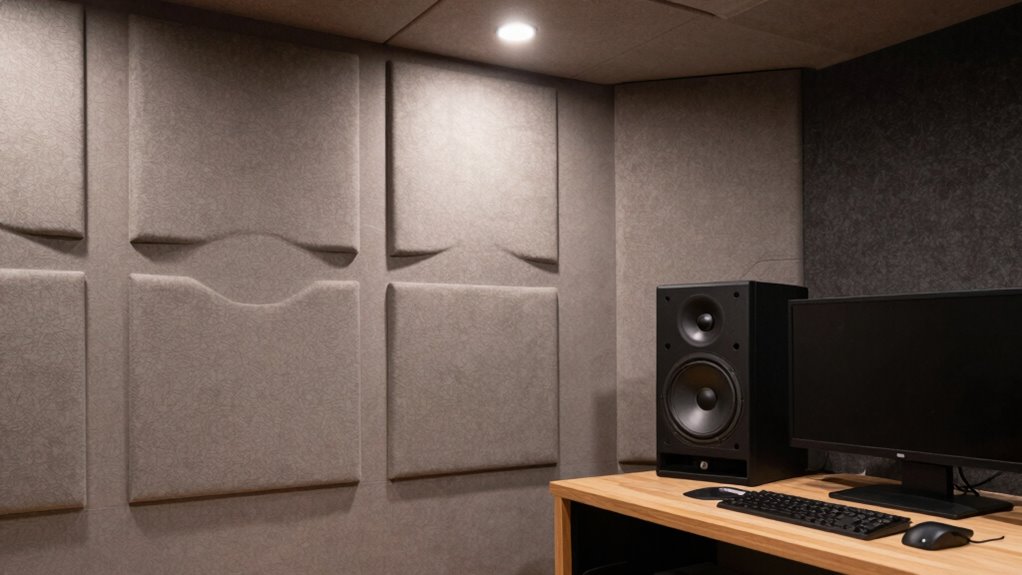

Room treatment involves installing physical materials like acoustic panels, bass traps, and diffusers to control reflections, echoes, and standing waves, providing permanent improvements. Room correction uses digital tools such as equalizers to fine-tune sound after measurements, offering flexible, software-based adjustments. Both methods improve sound quality, but treatments address room issues directly, while correction fine-tunes the audio signal. To optimize your space effectively, understanding how they complement each other can make a noticeable difference—explore further to learn more.
Key Takeaways
- Room treatment involves physical modifications like panels and diffusers, while room correction uses software to adjust sound electronically.
- Treatments target reflections, echoes, and standing waves; correction focuses on fixing frequency response irregularities.
- Physical treatments usually require higher upfront costs and installation effort, whereas correction is more flexible and cost-effective.
- Combining both methods offers comprehensive acoustic improvement, addressing major issues and fine-tuning sound quality.
- Proper assessment of the room helps determine whether physical treatments, correction, or both are needed for optimal results.
Understanding the Basics of Room Treatment and Correction
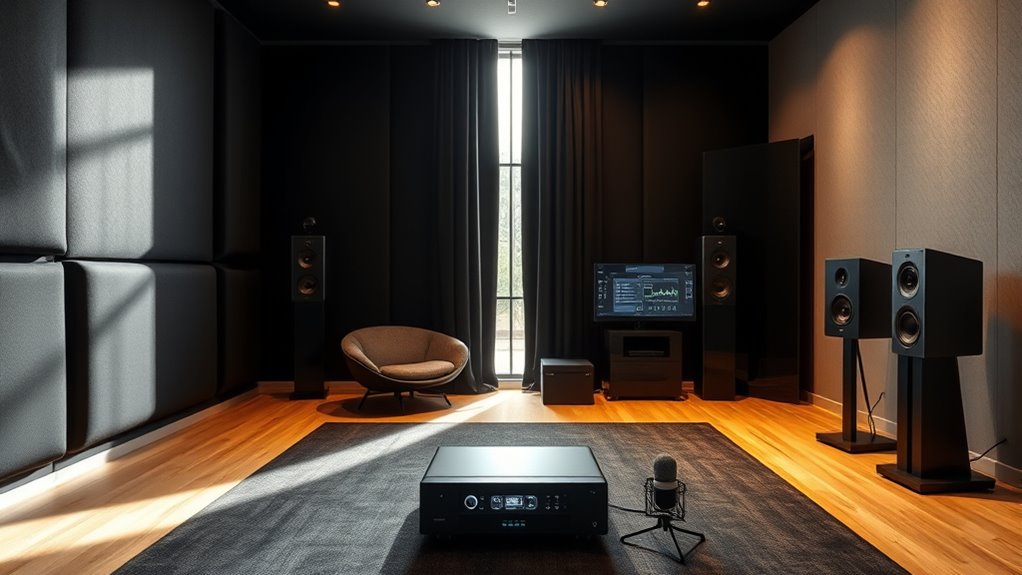
Understanding the basics of room treatment and correction is essential for optimizing your listening environment. Room treatment involves adding materials like acoustic panels, bass traps, and diffusers to improve sound quality by controlling reflections, echoes, and standing waves. These materials help create a clearer, more accurate soundstage, ensuring you hear music or audio as intended. Additionally, proper treatment can reduce unwanted room resonances, which are common issues that negatively impact sound clarity. Implementing effective acoustic treatments can significantly enhance overall sound quality and listening comfort. It is also important to consider how room dimensions influence acoustic behavior, as they can affect the effectiveness of treatments. Room correction, on the other hand, uses electronic devices like equalizers to adjust sound after it’s played through your speakers or headphones. It compensates for room acoustics that are difficult to modify physically. While treatment focuses on altering the environment itself, correction tweaks the audio signal to achieve better sound. Both approaches aim to enhance your listening experience but address different aspects of acoustic challenges. Understanding their roles helps you choose the right solutions for your space, especially when considering free floating designs that minimize interference with room acoustics.
Physical Modifications: Types and Benefits of Room Treatment

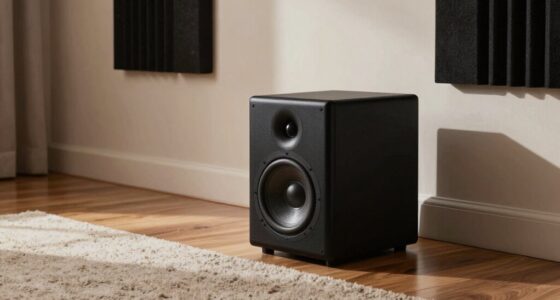
Physical modifications are essential for improving your room’s acoustics by directly addressing sound reflections and standing waves. You can achieve this by adding acoustic panels, bass traps, and diffusers, which absorb or scatter sound energy to reduce echo and muddiness. These treatments help create a clearer, more balanced sound environment. Wall-mounted panels can target early reflections, while bass traps placed in corners control low-frequency issues. Diffusers break up sound waves, preventing harsh echoes without deadening the room. The benefits are immediate: improved clarity, better imaging, and a more natural listening experience. By implementing these physical modifications, you shape your room’s acoustics at the source, providing a solid foundation before considering digital adjustments or other correction methods. Proper placement techniques are crucial for maximizing the effectiveness of each treatment. Additionally, understanding and implementing room resonance control techniques can further enhance acoustic performance. Properly addressing sound reflection helps prevent unwanted echoes and improves overall sound quality. Incorporating acoustic treatment principles ensures your modifications are both effective and tailored to your specific space. Furthermore, selecting the right materials based on your room acoustics can significantly improve overall sound quality and comfort.
Digital Adjustments: How Room Correction Technologies Work
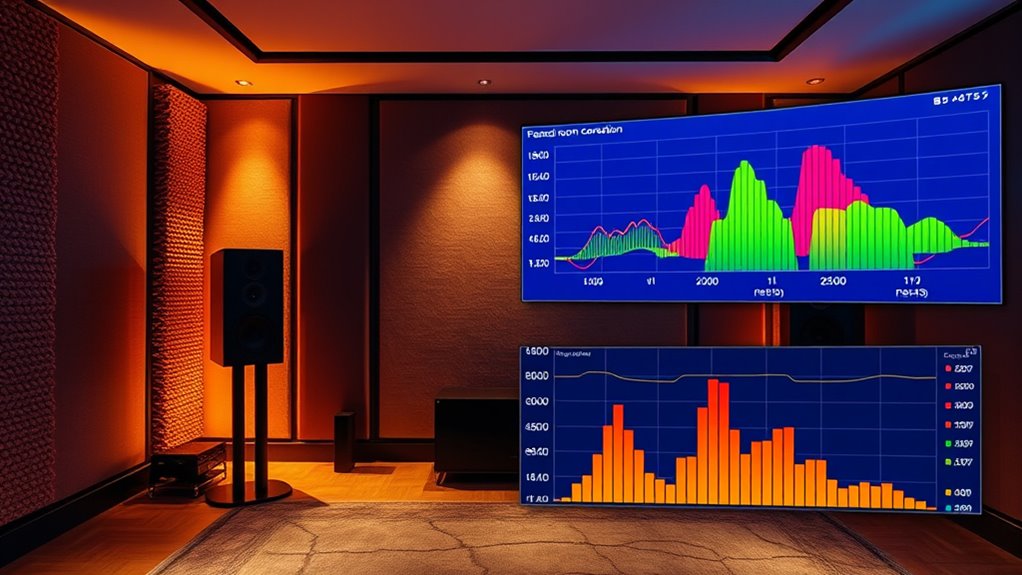
Room correction technologies start by measuring your room’s acoustics using specialized analysis techniques, capturing how sound behaves in your space. They then apply advanced signal processing algorithms to identify problem frequencies and sound distortions. Additionally, incorporating proper setup practices can further enhance the effectiveness of room correction. Understanding audio calibration methods can help you optimize your system’s performance even further. Implementing accurate measurement techniques ensures more precise adjustments, leading to better overall sound quality. Additionally, consistent environmental considerations can improve the accuracy of measurements and overall sound quality, much like how precise field-of-view calculations in deep-sky imaging help achieve clearer results.
Measurement and Analysis Techniques
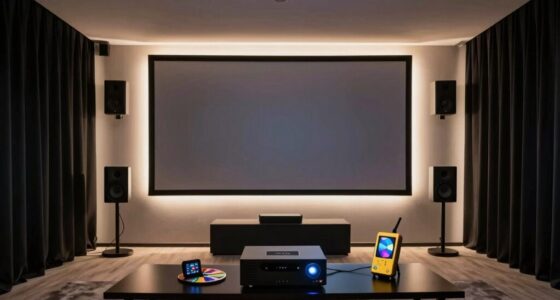
Digital room correction technologies rely on precise measurement and analysis techniques to identify acoustic problems. First, you place a microphone at your listening position to capture sound reflections and frequency responses. Second, a measurement software analyzes the data, revealing issues like peaks, dips, or resonance areas. Third, the system generates a detailed frequency response chart, highlighting problem zones. Fourth, based on this analysis, the correction software creates tailored adjustments to your audio signal, aiming to smooth out irregularities. Additionally, understanding the importance of a high-quality home theater projector can further enhance your overall viewing experience. By accurately diagnosing issues through these steps, room correction devices can apply precise modifications, improving sound quality. This process ensures your system compensates for room anomalies, delivering clearer, more balanced audio without the need for physical treatments. Moreover, integrating smart room calibration tools can streamline this process, making it easier for users to optimize their listening environment. These technologies often utilize digital signal processing to implement corrections efficiently and effectively.
Signal Processing Algorithms
Signal processing algorithms form the core of room correction technologies, transforming measurement data into precise audio adjustments. When you use room correction software, these algorithms analyze your room’s acoustic profile, identifying issues like reflections and standing waves. They then calculate the necessary digital filters to counteract these problems. These filters modify the audio signal in real-time, reducing peaks and dips in frequency response, and smoothing out irregularities. The algorithms guarantee that your sound system compensates for room imperfections without affecting the overall tonal balance. By applying these adjustments digitally, you get a more accurate and balanced listening experience. The effectiveness relies on sophisticated mathematical models that interpret your room’s acoustics, enabling targeted corrections tailored specifically to your space.
Frequency Response Adjustments
Once the algorithms analyze your room’s acoustic profile and determine the necessary filters, these adjustments directly shape the frequency response. This process guarantees your speakers deliver balanced sound tailored to your space. Here’s how it works:
- Identify problem areas like peaks and dips in the frequency spectrum.
- Apply filters such as equalization to boost or cut specific frequencies.
- Smooth out anomalies that cause harshness or muddiness.
- Optimize overall tonal balance for a more natural and accurate sound.
- Leverage advanced digital signal processing techniques to fine-tune audio output precisely. These techniques are based on fundamentals of acoustics, ensuring the corrections are both effective and natural-sounding.
These digital tweaks correct room-induced distortions, making your listening experience more faithful and immersive. Instead of physically altering your space, the technology fine-tunes the audio signal itself, providing precise control over how sound reaches your ears.
Comparing Cost and Implementation Effort
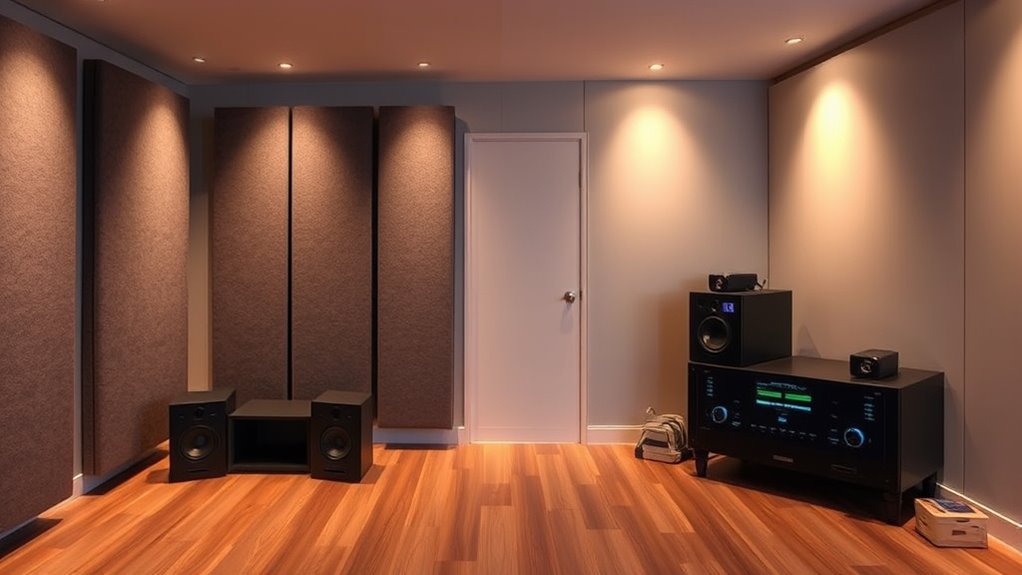
When comparing room treatment and room correction, their costs and implementation efforts can vary considerably. Room treatments often involve purchasing panels, bass traps, and diffusers, which can add up, especially for extensive setups. Installation requires measuring, positioning, and sometimes structural modifications, making it more labor-intensive. Additionally, the initial investment for treatments can be significant, particularly for larger or more detailed acoustic setups. Conversely, room correction systems typically involve a one-time software setup and calibration, which is quicker and less costly overall. Additionally, understanding total-cost clarity can help you make informed decisions about which approach best fits your budget and needs.
Recognizing the passive vs. active nature of each method can further aid in choosing the right solution. Here’s a comparison:
| Aspect | Room Treatment | Room Correction |
|---|---|---|
| Cost | Moderate to high, depending on size | Usually lower, software costs |
| Implementation Effort | Time-consuming, physical setup | Quick, primarily software calibration |
| Flexibility | Permanent adjustments | Software-based, easily adjustable |
Ultimately, treatments demand more upfront investment and effort, while corrections offer a more straightforward, budget-friendly approach. Considering acoustic properties during planning can also influence the effectiveness of either method.
Impact on Sound Quality and Listening Experience
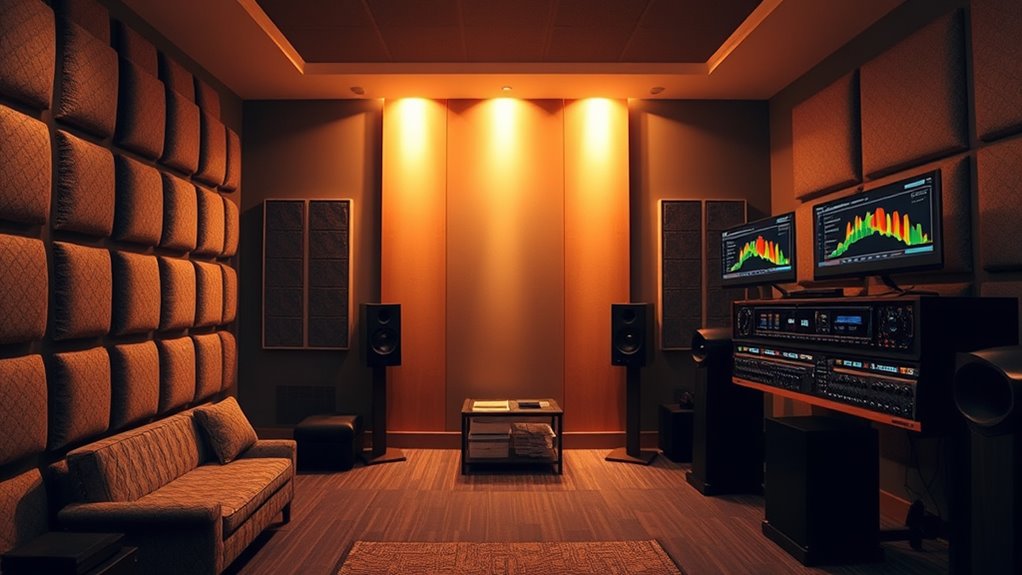
Your acoustic environment directly shapes how you perceive sound, influencing clarity and detail in your listening. When room treatments or correction systems improve these aspects, your overall experience becomes more immersive and enjoyable. Understanding how each approach impacts sound quality helps you make better choices for your listening setup. Implementing thermal behavior considerations can further optimize sound reflection and absorption, enhancing overall acoustic performance.
Acoustic Environment Influence
The acoustic environment plays a essential role in shaping sound quality and your overall listening experience. Your room’s size, shape, and furnishings directly influence how sound behaves. Here’s how:
- Reflections and Echoes: Hard surfaces cause unwanted reflections, muddying clarity.
- Standing Waves: Room dimensions create bass peaks and nulls, affecting balance.
- Absorption: Soft furnishings dampen reflections, smoothing sound but risking dullness.
- Speaker Placement: Room layout impacts sound dispersion, altering perception.
Understanding these factors helps you recognize how your environment influences audio quality. Small adjustments, like adding rugs or repositioning speakers, can make a noticeable difference. Your room’s acoustics are just as essential as the equipment itself in shaping an optimal listening experience.
Clarity and Detail Enhancement
Optimizing your room’s acoustics can considerably improve clarity and detail in your sound. When you reduce unwanted reflections and resonances through proper treatment or correction, individual instrument nuances become more distinct. This means you’ll notice subtle textures, quiet background sounds, and precise spatial cues that might have been masked before. Clearer sound allows you to distinguish different layers within a mix, making vocals more intelligible and instruments more defined. Both room treatment and correction aim to refine the frequency response, but treatment often provides a more natural, transparent enhancement. As a result, your listening experience becomes more engaging, with a richer sense of depth and realism. Overall, this clarity elevates your enjoyment by revealing the intricate details the artist intended.
Overall Listening Immersion
When room treatment and correction are effectively implemented, they transform the listening environment into an immersive experience that draws you deeper into the music. You’ll notice a richer sense of space and a more natural soundstage. This sense of immersion is achieved because:
- The music feels more coherent and seamless, reducing distractions.
- Spatial cues become clearer, placing instruments precisely.
- The soundstage expands, enveloping you with depth and width.
- Listening fatigue decreases, allowing longer, more enjoyable sessions.
These improvements mean you won’t just hear the music—you’ll feel like you’re inside it. Enhanced immersion elevates your overall listening experience by making every note and nuance more engaging, compelling you to listen more intently and fully appreciate the performance.
Limitations and Challenges of Each Approach

While both room treatment and room correction aim to improve sound quality, each faces significant limitations that can hinder their effectiveness. Room treatment often requires extensive modifications, like adding absorbers or diffusers, which can be costly, invasive, and aesthetically unappealing. It also struggles with uneven sound distribution in irregularly shaped rooms. Conversely, room correction relies on digital processing, but it can introduce artifacts, reduce natural sound, or fail to address all acoustic issues, especially at extreme frequencies. It’s also limited by the quality of measurement and calibration tools. Neither approach is a complete fix; treatment can’t correct all issues, and correction may not fully compensate for complex acoustic problems. Recognizing these limitations helps you set realistic expectations for sound improvement.
Combining Room Treatment and Correction for Optimal Results
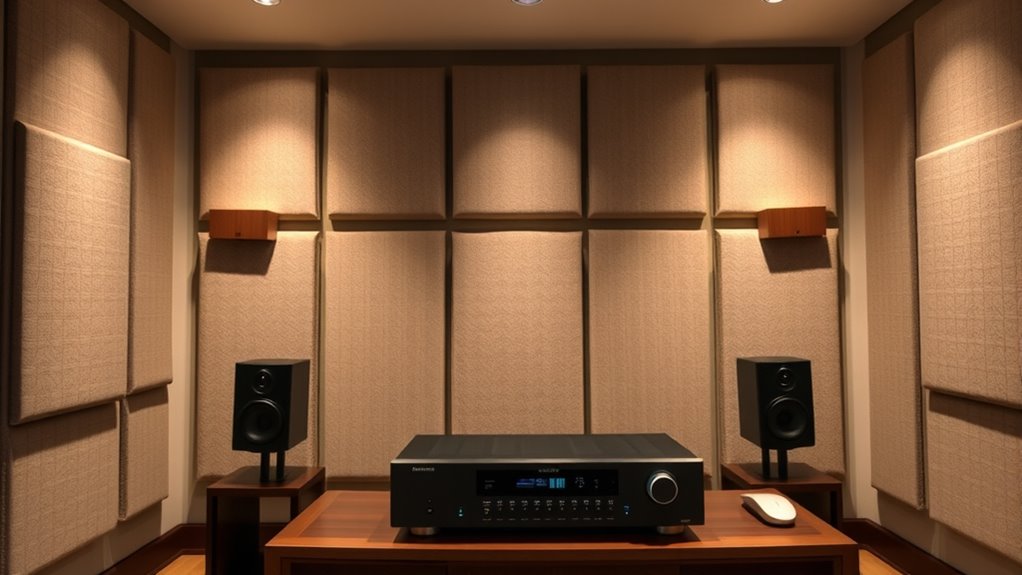
Combining room treatment and correction can substantially enhance your listening environment by leveraging the strengths of both approaches. This synergy allows you to address the room’s worst flaws while fine-tuning the sound digitally. To maximize results, consider these steps:
Enhance your audio experience by combining physical room treatment with digital correction for optimal sound.
- Identify key problem areas with acoustic treatment, like echoes or standing waves.
- Use room correction software to target frequency imbalances that treatment alone can’t fix.
- Balance physical and digital solutions for a thorough approach—treat the room and calibrate your system.
- Continuously evaluate and adjust as your setup or room changes, ensuring ideal sound at all times.
Making the Right Choice for Your Space and Budget
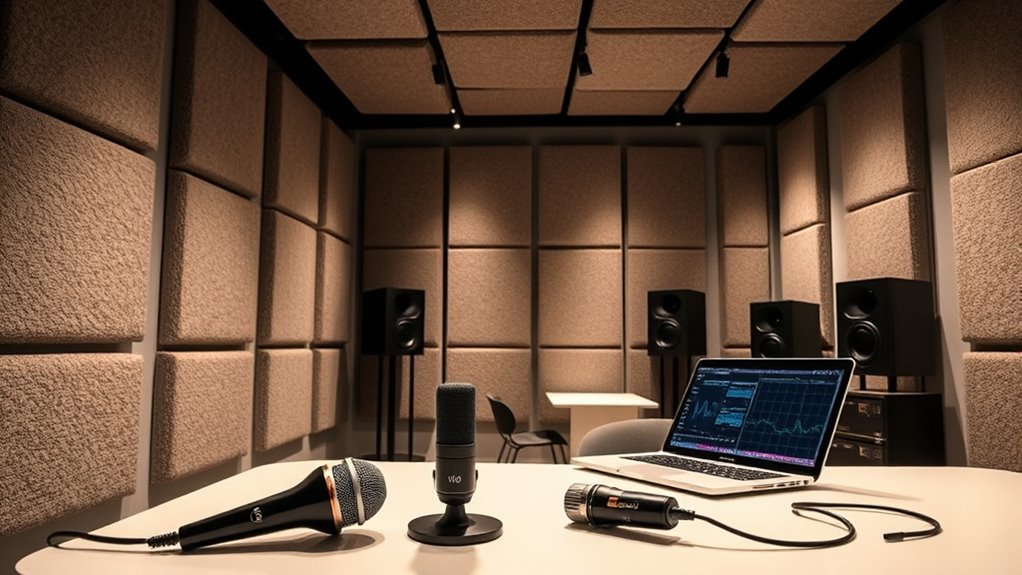
Choosing the right room treatment and correction options depends on your space and budget. If you have a limited budget, starting with affordable acoustic panels or DIY solutions can make a noticeable difference. These are simple to install and target specific issues like echo or flutter. On the other hand, if your room is large or has complex acoustics, investing in advanced room correction systems or professional treatment might be necessary for ideal sound. Consider your room’s size, shape, and use—listening, mixing, or casual enjoyment—to determine what’s essential. Prioritize your needs and allocate your budget accordingly. Sometimes, combining basic treatments with room correction tools offers a balanced, effective approach. Making informed choices ensures you improve your sound environment without overspending.
Frequently Asked Questions
Can Room Correction Fully Replace Physical Acoustic Treatments?
No, room correction can’t fully replace physical acoustic treatments. While it can considerably improve sound quality by adjusting frequencies and reducing some issues, it doesn’t address fundamental problems like echoes, standing waves, or bass traps. Physical treatments modify the room’s physical properties, creating a better listening environment overall. Combining both approaches gives you the best results, ensuring clearer, more accurate sound throughout your space.
How Do Room Treatments Affect Bass Response Specifically?
You might think bass issues are all about equipment, but physical room treatments actually make a big difference. They absorb or diffuse problematic frequencies, reducing boominess and muddiness. While room correction can fine-tune bass response digitally, it can’t fully replace physical treatments. Together, they create a balanced, tight bass response, but neglecting physical treatments often leaves your sound less controlled and less natural.
Are There Any Downsides to Using Digital Room Correction?
Digital room correction can introduce latency and sometimes cause a loss of natural sound quality if not configured properly. It may also lead to over-correction, making the sound unnatural or overly processed. Additionally, relying solely on digital correction might mask underlying issues that room treatment could address more effectively. Always guarantee your settings are carefully calibrated to avoid these downsides and maintain a balanced, accurate listening experience.
Which Approach Is Better for Small Versus Large Rooms?
Think of your room as a stage for sound. For small rooms, digital correction acts like a skilled director, fine-tuning audio to remove imperfections. In large rooms, physical treatments serve as sturdy scenery, absorbing echoes and controlling reflections. You’ll get the best results by combining both approaches, but if you must choose, digital correction is more flexible for small spaces, while physical treatments better suit larger environments.
How Long Does It Typically Take to See Improvements?
You’ll typically notice improvements within a few days to a couple of weeks after implementing room treatment or correction. The exact time depends on the complexity of your setup and the adjustments needed. If you’re proactive in making changes and measuring results, you’ll see noticeable differences sooner. Keep in mind, patience is key, and fine-tuning may be necessary to achieve ideal sound quality.
Conclusion
Remember, a wise man once said, “Don’t put all your eggs in one basket.” When it comes to improving your room’s sound, combining both treatment and correction gives you the best of both worlds. Assess your space and budget carefully, then choose the approach that fits your needs. With patience and the right balance, you’ll create a listening environment that truly elevates your audio experience.