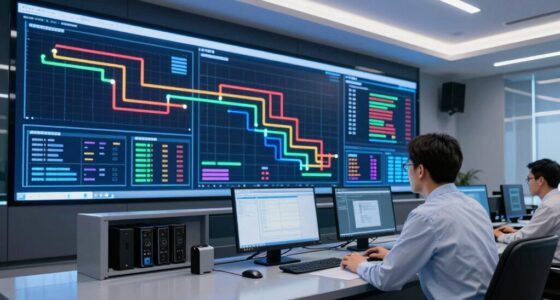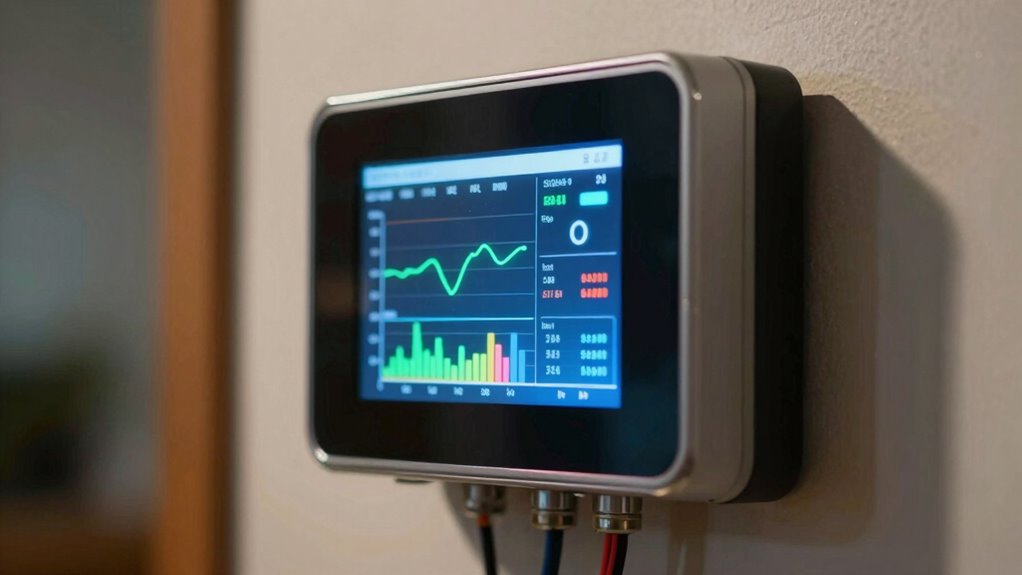

To interpret smart meter data, focus on understanding the types of information collected, such as real-time consumption, peak usage, and event logs, which are stored securely and formatted for analysis. Use techniques like pattern recognition and anomaly detection to identify typical behaviors or unusual activity. Visualization tools help reveal usage trends, while machine learning can predict future consumption. Ensuring data privacy is essential. Keep exploring to discover how these insights can optimize your energy management.

Turn your quiet moments into listening time
- Thousands of audiobooks, podcasts and originals
- Listen on your phone, tablet or Echo — also offline
- Cancel anytime
Key Takeaways
- Analyze energy consumption patterns using time series analysis, clustering, and classification to identify typical behaviors and anomalies.
- Utilize visualization techniques like graphs and dashboards to interpret raw data, revealing trends, fluctuations, and irregularities.
- Extract meaningful features such as statistical metrics and load profiles to enhance predictive modeling and anomaly detection accuracy.
- Implement anomaly detection methods to identify unusual activity, faults, or theft based on data variance, spikes, or flatlining.
- Ensure secure, accurate data storage and preprocessing to support reliable analysis, pattern recognition, and long-term energy management insights.
Understanding Smart Meter Data Types and Formats
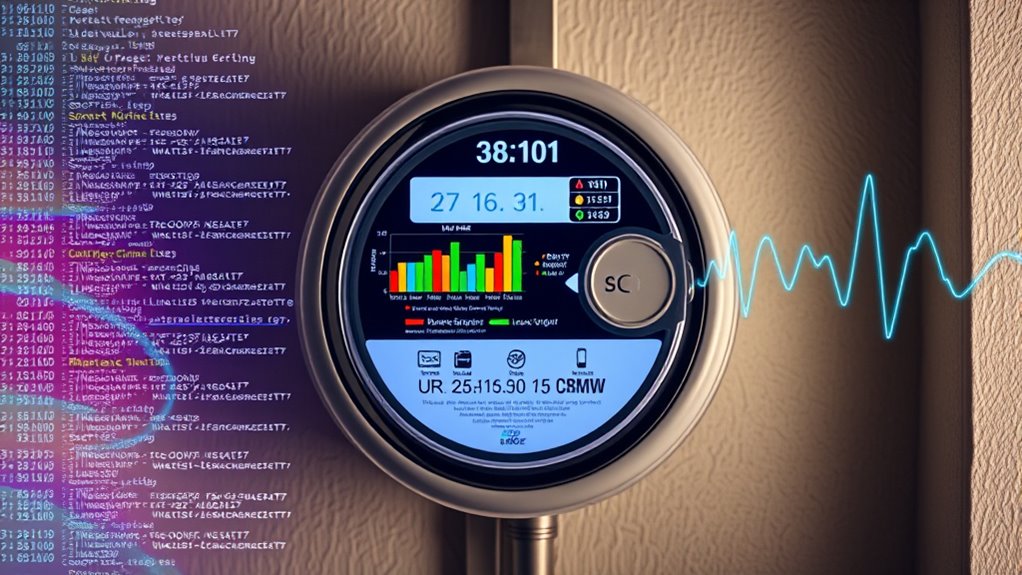
Have you ever wondered what kinds of data smart meters collect and how they present that information? Smart meters gather various data types, including real-time energy consumption, peak usage times, and total usage over billing periods. They often record data in specific formats like numerical values, timestamps, and event logs. Consistent storytelling These formats help utilities analyze your energy habits and identify patterns. Additionally, understanding data formats can help you better interpret your energy consumption data. Some meters display data as simple numbers, while others use graphs or digital screens to present information clearly. Recognizing how your smart meter organizes data can improve your ability to interpret energy patterns, which helps you make informed decisions about energy efficiency. Being familiar with data organization can further enhance your understanding of your energy reports and support sustainable habits.
The Role of Data Collection and Storage
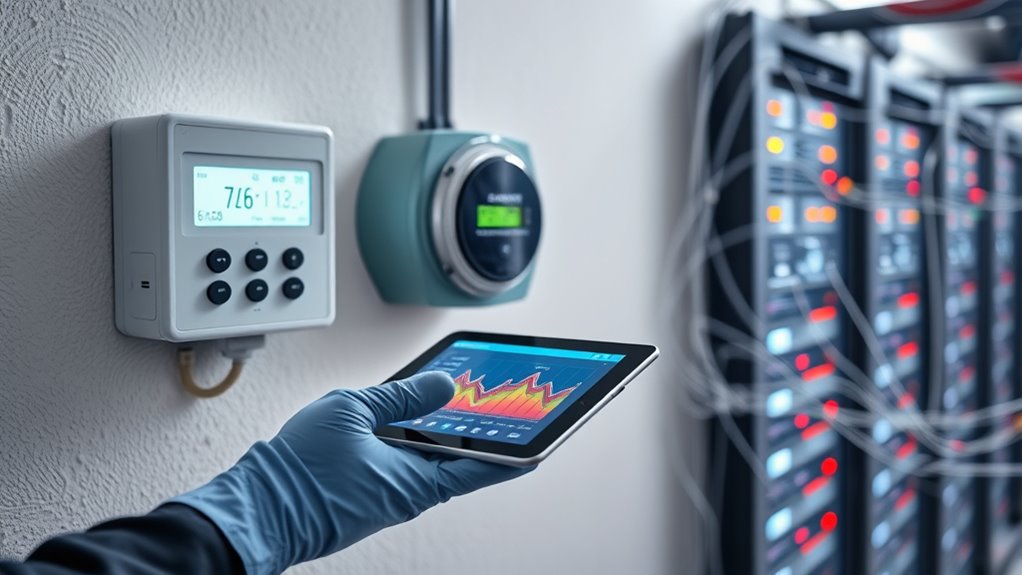
Data collection and storage are central to how smart meters function, guaranteeing that your energy usage is recorded accurately and reliably. When your smart meter gathers data, it captures real-time information on electricity consumption, which is then stored securely within the device or transmitted to a central database. This process allows for consistent monitoring, even if you’re offline temporarily. Proper storage ensures that data remains intact over time and is available for analysis when needed. It also helps protect your privacy by maintaining secure, encrypted records. Without effective data collection and storage, the insights derived from your energy patterns would be incomplete or unreliable. Additionally, data integrity plays a crucial role in maintaining the accuracy of energy records over time. Reliable storage methods contribute to energy management by enabling accurate trend analysis and informed decision-making. Ultimately, this system ensures your energy data is precise, accessible, and protected, forming the backbone of smart meter functionality. Effective data security protocols further ensure that sensitive information remains confidential and resistant to breaches, reinforcing the importance of secure data handling. Moreover, implementing proper data storage techniques helps prevent data loss and maintains long-term data consistency.
Techniques for Analyzing Energy Consumption Patterns
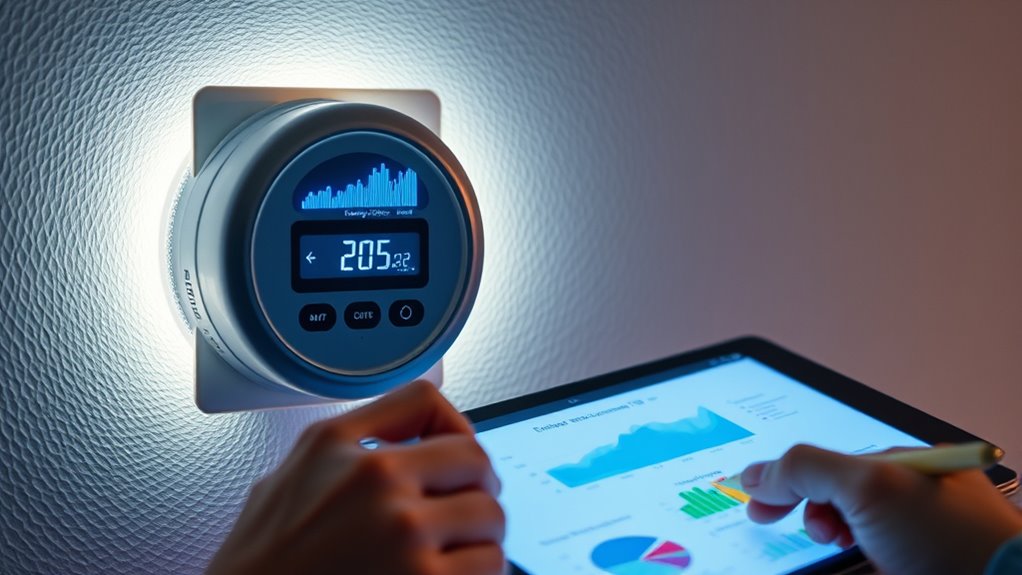
When analyzing energy consumption patterns, you’ll want to explore pattern recognition methods that identify typical usage behaviors. You should also consider anomaly detection strategies to spot unusual or suspicious activity in the data. These techniques help you interpret smart meter data more effectively and make informed decisions. Recognizing Youngster Choice can provide insights into emerging trends in energy use. The evolution of pinball machines, for instance, showcases advanced technology and design that can inspire innovations in smart device interfaces. Incorporating European cloud innovation can enhance data processing capabilities and ensure secure, scalable analysis. Additionally, understanding passive voice detection techniques can streamline your review process and improve the clarity of your reports.
Pattern Recognition Methods
Pattern recognition methods play a crucial role in analyzing energy consumption patterns captured by smart meters. These techniques help you identify recurring behaviors and classify usage data effectively. You might use methods like clustering to group similar consumption profiles or classification algorithms to categorize different user types. Time series analysis allows you to detect daily or weekly patterns, revealing routine behaviors. Dimensionality reduction techniques simplify complex data, making it easier to interpret. Machine learning models, such as neural networks or decision trees, learn from historical data to predict future consumption trends. By applying these methods, you gain insights into typical energy use, which can inform demand management and efficiency strategies. Overall, pattern recognition methods empower you to transform raw data into meaningful, actionable information.
Anomaly Detection Strategies
Detecting anomalies in energy consumption is essential for maintaining system reliability and identifying potential issues. To do this effectively, you can employ various strategies. Statistical methods, like setting thresholds based on historical data, help flag unusual spikes or drops. Machine learning algorithms, such as clustering or classification models, recognize patterns that deviate from normal behavior. Time-series analysis allows you to detect irregularities by examining data trends over time. You might also use rule-based systems that trigger alerts when certain conditions are met. Implementing these strategies ensures you maintain a stable energy system and respond promptly to anomalies, minimizing downtime and optimizing performance. Reliable data collection is fundamental for ensuring the effectiveness of these detection techniques. Plain English explanations can make complex analytical results easier to interpret for non-technical users. Additionally, integrating smart meter data analysis tools can further improve the accuracy of anomaly detection by leveraging detailed consumption insights. Employing real-time monitoring can help identify issues promptly, preventing minor problems from escalating. Furthermore, understanding halal dietary practices and how they influence food choices can be valuable for organizations catering to diverse communities. Implementing these strategies ensures you maintain a stable energy system and respond promptly to anomalies, minimizing downtime and optimizing performance.
Identifying Anomalies and Faults in Data

Identifying anomalies and faults in smart meter data is essential for maintaining the accuracy and reliability of energy consumption analysis. You need to detect unusual patterns that may indicate issues. Here’s how to approach it:
- Monitor for sudden spikes or drops that don’t match typical usage patterns. Consistent data collection helps in establishing baseline behaviors for comparison. Incorporating power tools principles, such as systematic checks, can improve your detection methods. Regular data review procedures can further enhance fault detection accuracy.
- Check for inconsistent data timestamps, which can signal communication errors.
- Identify prolonged flatlining or missing data, pointing to device malfunctions.
- Analyze variance over time to spot irregular fluctuations indicating potential faults.
- Developing a methodical approach ensures systematic detection of issues and enhances overall data quality. Utilizing analytics cookies can assist in tracking the effectiveness of your monitoring strategies.
Leveraging Visualization Tools for Better Insights
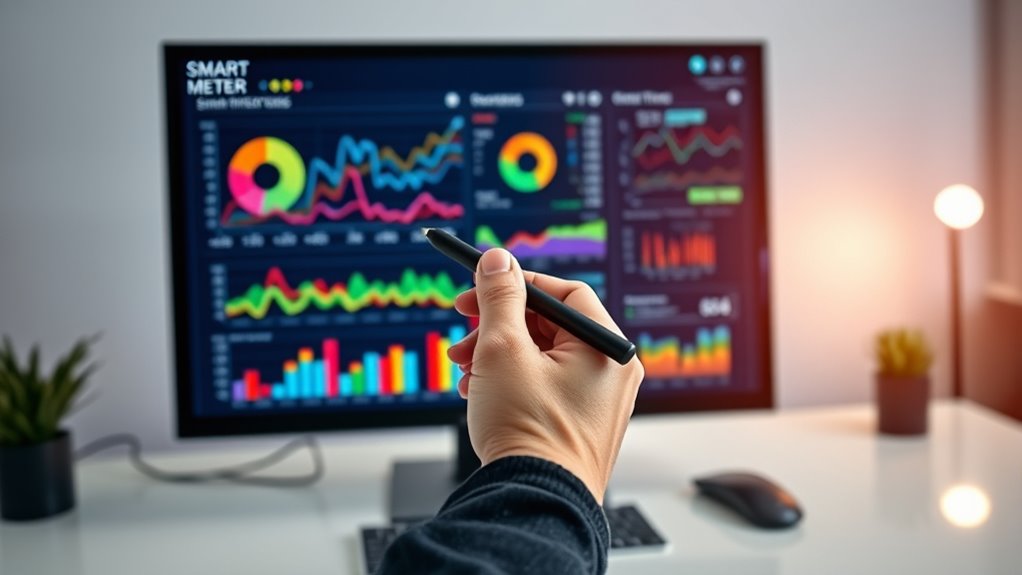
Visualization tools transform complex smart meter data into clear, actionable insights by presenting information in graphical formats. You can quickly identify patterns, trends, and anomalies that might be hidden in raw data. Line graphs reveal usage fluctuations over time, helping you spot peak periods or irregular spikes. Bar charts compare consumption across different days or months, highlighting seasonal variations. Heatmaps visualize high and low activity zones, guiding energy management strategies. Dashboards aggregate multiple visualizations, offering an exhaustive view at a glance. Effective data presentation helps you interpret results more intuitively and efficiently. By leveraging these tools, you can make informed decisions, optimize energy use, and detect issues early. Visualizations make data more accessible and understandable, enabling you to act swiftly and effectively on insights derived from your smart meter data. Understanding data visualization techniques further enhances your ability to interpret complex information effectively.
Applying Machine Learning in Smart Meter Data Analysis
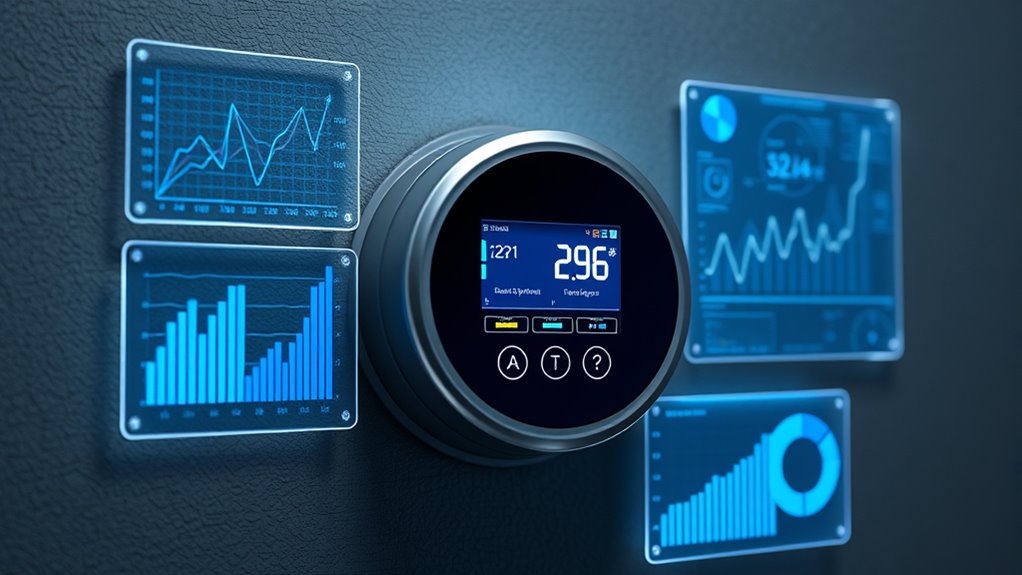
Applying machine learning to smart meter data requires effective data preprocessing to handle noise and missing values. You’ll also need to select relevant features that capture consumption patterns and other important signals. Finally, choosing the right predictive modeling approach helps generate accurate forecasts and insights from the data.
Data Preprocessing Techniques
Have you ever wondered how raw smart meter data becomes useful for analysis? Data preprocessing is vital in transforming messy data into meaningful insights. First, you clean the data by removing errors, duplicates, and outliers that can distort results. Second, you handle missing values through imputation or deletion, guaranteeing consistency. Third, you normalize or scale data to make different features comparable, improving machine learning performance. Lastly, you segment the data into manageable time windows or categories, making patterns easier to detect. These steps help you prepare high-quality data, reducing noise and bias. Proper preprocessing ensures your machine learning models learn from accurate, consistent, and relevant information, leading to better predictions and smarter energy management strategies.
Feature Extraction Methods
Feature extraction is a crucial step in smart meter data analysis because it transforms raw data into meaningful inputs for machine learning models. You can use techniques like statistical features—mean, variance, and skewness—to summarize data patterns. Time-domain features, such as peak consumption and load duration, help capture seasonal or daily variations. Frequency-domain methods, like Fourier transforms, reveal periodicities and hidden cycles in energy usage. Wavelet transforms allow you to analyze data at different resolutions, identifying transient events. Additionally, you might consider extracting features based on domain knowledge, such as appliance-specific signatures or load profiles. These methods help reduce data complexity, highlight essential patterns, and improve the accuracy of subsequent modeling, making your analysis more efficient and insightful.
Predictive Modeling Approaches
Predictive modeling approaches leverage machine learning algorithms to forecast future energy consumption, detect anomalies, and optimize grid operations based on smart meter data. These models analyze historical data to identify patterns and make accurate predictions. Here’s how they work:
- Time Series Forecasting: Predict future energy demand based on past usage trends.
- Anomaly Detection: Spot irregularities indicating faults or theft.
- Clustering Techniques: Segment customers for targeted energy management.
- Regression Models: Quantify the relationship between variables to improve load predictions.
Ensuring Data Privacy and Security
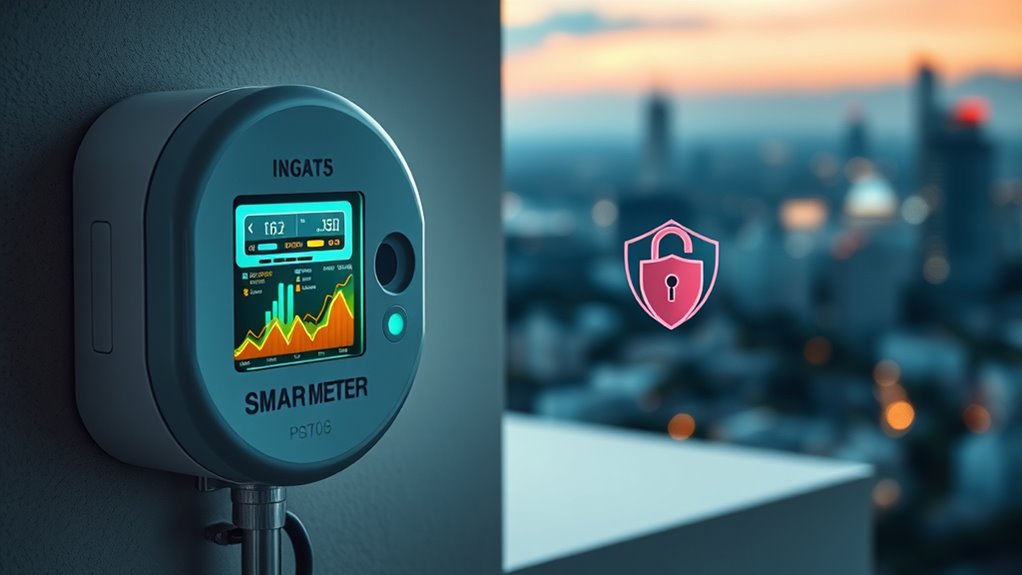
Ensuring data privacy and security is essential as smart meters collect detailed energy consumption data that can reveal personal habits. You need to implement strong encryption methods to protect data during transmission and storage. Regularly updating security protocols helps prevent vulnerabilities. Restrict access to authorized personnel only, and monitor data access logs for suspicious activity. Use the following table to understand security measures better:
| Security Measure | Purpose |
|---|---|
| Data Encryption | Protects data from unauthorized access |
| Access Controls | Limits who can view or modify data |
| Regular Security Audits | Detects and fixes vulnerabilities |
Applying these practices ensures your data remains private, reducing the risk of breaches and maintaining trust.
Practical Applications of Data Interpretation for Consumers and Utilities
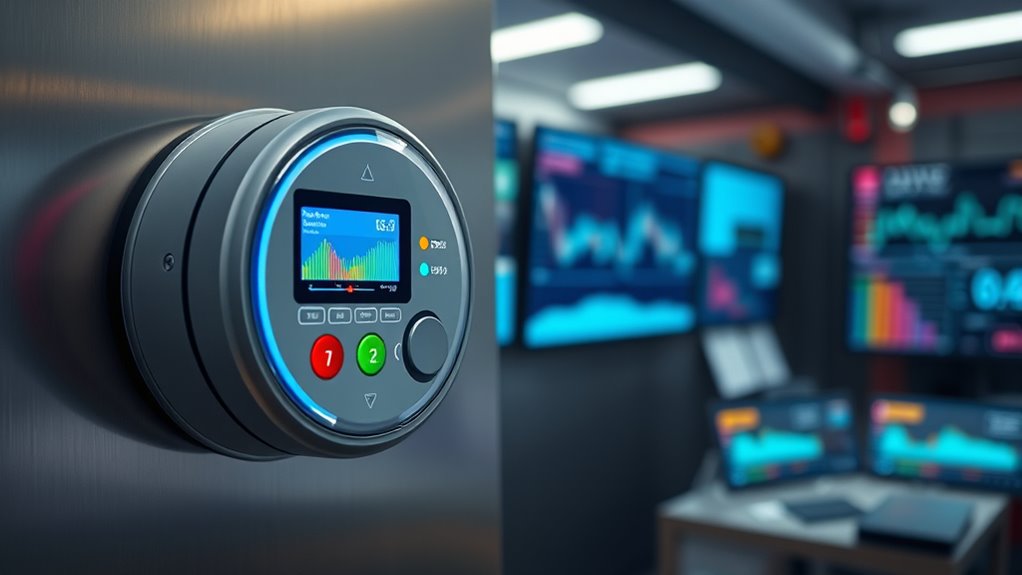
Smart meters generate detailed energy consumption data that can be invaluable for both consumers and utility providers. You can use this data to:
- Identify peak usage times, helping you shift high-energy activities to save money.
- Detect unusual consumption patterns, indicating potential appliance issues or leaks.
- Optimize energy use by understanding which devices consume the most power.
- Improve billing accuracy, ensuring you’re billed fairly based on actual usage.
For utilities, this data enables more efficient grid management, reduces outages, and supports targeted demand response programs. Both parties can make informed decisions that enhance energy savings, reduce costs, and promote sustainability. By interpreting this data effectively, you gain greater control over your energy habits and contribute to a smarter, more efficient energy system.
Future Trends in Smart Meter Data Analytics
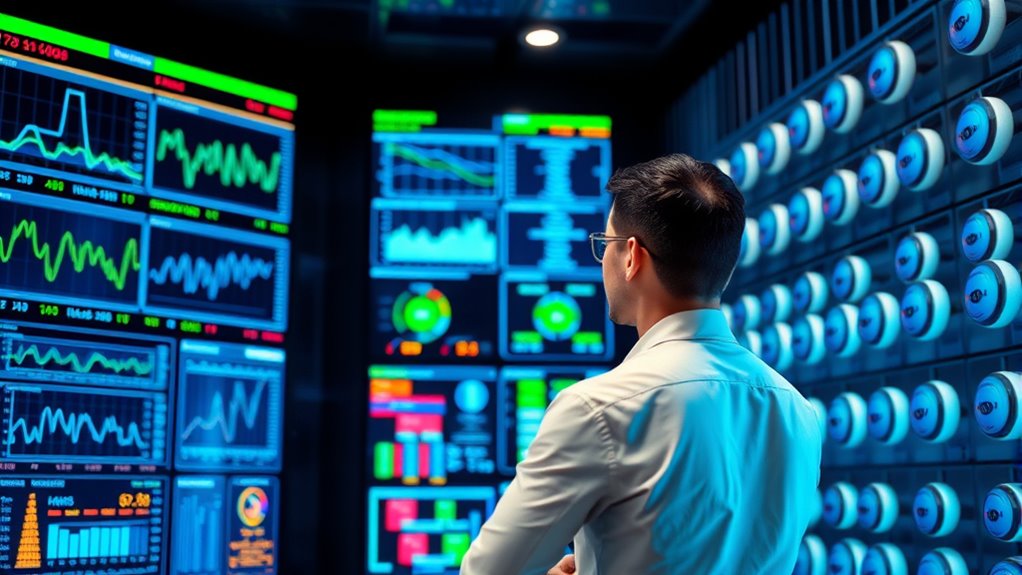
As technology advances, smart meter data analytics are set to become more sophisticated, harnessing artificial intelligence and machine learning to extract deeper insights. You’ll see real-time analysis that predicts usage patterns, enabling proactive energy management. Advanced algorithms will identify inefficiencies and detect anomalies faster, helping utilities prevent outages and improve service. Personalized insights will become more common, empowering you to optimize your energy consumption and reduce costs. Integration with smart home systems will allow seamless automation based on your habits. Additionally, data privacy and security will be prioritized, ensuring your information stays protected. Overall, future trends will make smart meter data more actionable, enabling smarter decisions for consumers and utilities alike—driving efficiency, sustainability, and better resource management.
Frequently Asked Questions
How Can Consumers Interpret Smart Meter Data Without Technical Expertise?
You can interpret smart meter data easily by focusing on your energy usage patterns. Look for daily or weekly trends, noting times when consumption spikes. Many utility companies provide simple apps or online tools that highlight your usage in easy-to-understand graphs. Set goals to reduce peak consumption, and compare your data over time. Don’t worry about technical details—just pay attention to what your energy habits tell you and adjust accordingly.
What Are Common Challenges in Real-Time Smart Meter Data Analysis?
Analyzing smart meter data in real time is like trying to read a rapidly changing map—challenging but manageable. You might face data overload, where too much information floods your system, making it hard to spot useful insights. Connectivity issues can cause delays or data gaps, and interpreting complex patterns without technical skills adds frustration. Overcoming these hurdles requires reliable systems, user-friendly tools, and some basic understanding of energy consumption trends.
How Do Different Utility Companies Customize Data Reports for Consumers?
Utility companies customize data reports for consumers by tailoring the information to match your specific usage patterns and needs. They often include personalized insights, such as peak usage times and cost-saving tips, making the data more relevant and easy to understand. You might also receive reports in different formats—digital, email, or app notifications—so you can access your energy consumption details conveniently and make informed decisions to save on bills.
Can Smart Meter Data Predict Future Energy Consumption Trends Accurately?
Smart meter data can be like a crystal ball, giving you a glimpse of future energy trends, but it’s not always perfectly accurate. It analyzes your past usage patterns and helps predict future consumption, especially when combined with weather and seasonal data. However, unexpected changes—like new appliances or lifestyle shifts—can affect predictions. So, while helpful, it’s best to view these forecasts as informed estimates rather than guarantees.
What Legal Considerations Exist Around Sharing Smart Meter Data With Third Parties?
You need to be aware that sharing smart meter data with third parties involves legal considerations like data privacy laws and regulations. You must obtain explicit consent from consumers before sharing their information and guarantee data is securely handled. Additionally, you should comply with applicable laws such as GDPR or local data protection regulations. Failing to follow these rules can lead to legal penalties and loss of customer trust.
Conclusion
By mastering smart meter data interpretation, you open valuable insights that can save energy and improve efficiency. As the saying goes, “Knowledge is power,” and with the right analysis tools, you can spot patterns, detect faults, and make smarter decisions. Embrace evolving technologies and stay vigilant about privacy. Ultimately, understanding your data puts you ahead, proving that the more you learn, the more you can save—because knowledge truly is power.
Halloween Picks
halloween
As an affiliate, we earn on qualifying purchases.