
To store your power bank long-term, keep its charge level between 40% and 60%. This range minimizes capacity loss and prevents battery degradation caused by full charges or complete discharges. Make sure to check the charge periodically and top it up to this range if it drops below or above. Storing it properly in a cool, dry place also helps prolong its life. Continue exploring for more tips to keep your power bank in top shape.
Key Takeaways
- Store power banks with a charge level between 40% and 60% for optimal long-term preservation.
- Avoid storing fully charged or fully drained batteries, as they degrade faster over time.
- Periodically check and recharge the power bank to maintain the 40–60% level during extended storage.
- Keep the device in a cool, dry environment within the recommended temperature range (20°C to 25°C).
- Use protective cases and store in moisture-free conditions to prevent corrosion and internal damage.
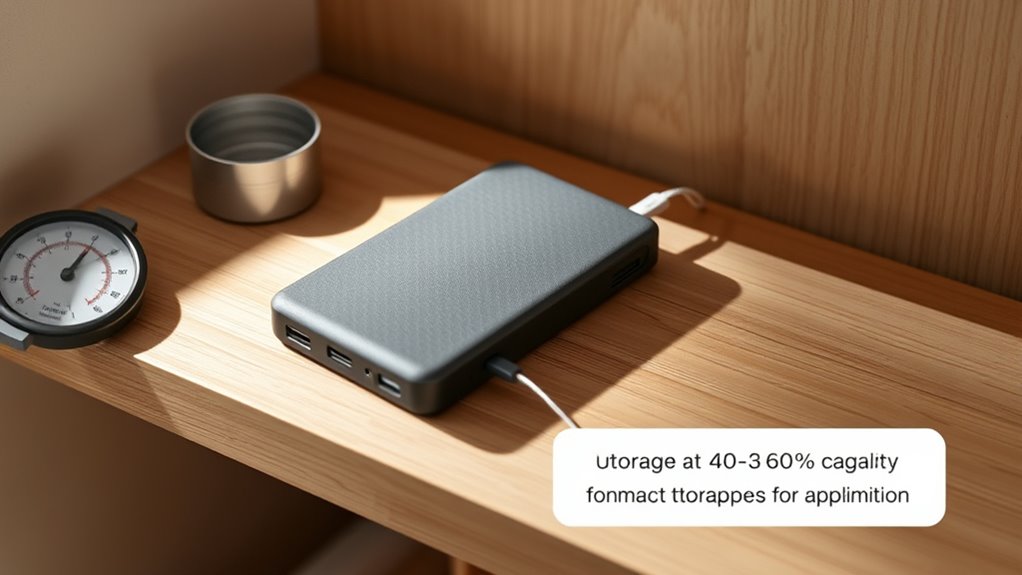
Proper storage is vital to keep your power banks functioning safely and efficiently. When you’re not using your device for an extended period, how you store it can considerably impact its lifespan and performance. One key aspect to consider is battery calibration, which ensures your power bank accurately displays its charge level. Over time, batteries can become uncalibrated, leading to inaccurate readings that might cause you to think your power bank is drained when it still has charge or vice versa. To prevent this, it’s a good idea to periodically calibrate your battery by fully charging and then fully discharging it. This maintains the accuracy of the battery’s indicator, making sure you know exactly how much power you have left when you need it most. Additionally, maintaining optimal storage conditions can significantly prolong your device’s lifespan. Another essential factor is the storage environment. Your power bank’s surroundings should be cool, dry, and free from extreme temperatures. High heat accelerates battery degradation, reducing its capacity and lifespan over time. Conversely, extremely cold temperatures can temporarily diminish the power bank’s performance and may cause internal damage if exposure is prolonged. Avoid storing your power bank in places like a car trunk, attic, or garage where temperature fluctuations are common. Instead, pick a spot with a stable temperature, ideally between 20°C and 25°C (68°F to 77°F). Humidity is also a concern; excessive moisture can cause corrosion and damage internal components. Keep your power bank in a dry place, preferably in a protective pouch or container that shields it from dust and moisture. Following the 40–60% rule during storage can also help preserve battery health. This means you should keep your power bank’s charge level between 40% and 60% if you’re planning to store it for a long time. Storing a fully charged or completely drained battery can accelerate capacity loss over time. A partially charged battery at the recommended level minimizes stress on the cells, helping to maintain its longevity. When storing, check the charge level periodically and top it up to the 40-60% range if needed, especially if you plan to store the device for several months.

Jackery Portable Power Station Explorer 300, 292Wh Backup LiFePO4 Battery, Solar Generator for Outdoors Camping Travel Hunting Blackout (Solar Panel Optional)
SPEED UP YOUR RECHARGEABILITY: It takes only 2 hours to recharge 80% battery of the power station through...
As an affiliate, we earn on qualifying purchases.
Frequently Asked Questions
How Often Should I Check the Power Bank’s Charge During Storage?
You should check your power bank’s charge level every 3 to 6 months during storage. This allows you to monitor charge level effectively and prevent over-discharge or overcharging. Following storage interval guidelines helps maintain battery health. If the charge drops below 40%, recharge it to 50%. If it exceeds 60%, discharge it slightly to stay within the recommended range, ensuring peak performance when you need it.
Can Temperature Fluctuations Damage Stored Power Banks?
Temperature fluctuations can damage your stored power bank, acting like a rollercoaster ride for its battery. When temperatures aren’t stable, the battery experiences stress, leading to accelerated degradation. To keep your power bank in top shape, store it in a cool, dry place with steady temperature stability. Avoid extreme heat or cold, as these conditions hasten battery degradation and shorten its lifespan.
What Is the Ideal Storage Environment for Long-Term Power Bank Storage?
You should store your power bank in a cool, dry place away from direct sunlight and extreme temperatures. Use a breathable storage container to prevent moisture buildup. Keep it at around 40-60% charge to minimize charging cycles and battery degradation over time. Avoid frequent full charges or discharges, and check the storage environment periodically to guarantee ideal conditions for long-term preservation.
Do Different Battery Types Require Different Storage Practices?
Yes, different battery chemistries need specific storage techniques. For example, lithium-ion batteries should be stored at 40-60% charge in a cool, dry environment, while nickel-based batteries require different conditions to prevent capacity loss. You should always verify the manufacturer’s recommendations for your power bank’s battery chemistry. Proper storage techniques ensure your power bank remains effective and safe during long-term storage.
How Does Storage Duration Affect Power Bank Battery Health?
Coincidentally, the longer you store a power bank, the more its battery calibration and self-discharge rate influence its health. If stored improperly or for too long, the battery’s capacity diminishes due to gradual self-discharge, even when unused. To minimize damage, you should periodically check and recharge your power bank, ideally maintaining a 40-60% charge, ensuring peak battery health over extended periods.

Anker SOLIX C1000 Gen 2 Portable Power Station, 2,000W (Peak 3,000W) Solar Generator, Full Charge in 49 Min, 1,024Wh LiFePO4 Battery for Home Backup, Power Outages, and Camping (Optional Solar Panel)
49 Min UltraFast Recharging: With upgraded HyperFlash tech, fully recharge at 1,600W—for outage prepping, camping trips, or tailgating...
As an affiliate, we earn on qualifying purchases.
Conclusion
Remember, keeping your power bank charged between 40-60% during long-term storage isn’t just a tip—it’s supported by battery science. Studies show that storing batteries at this level helps prevent capacity loss and extends their lifespan. So, if you want your power bank ready when you need it, follow this rule. Trust the science, and you’ll ensure your device stays reliable and efficient for years to come.

BLUETTI Elite 100 V2 Portable Power Station, 1024Wh LFP Battery Backup w/ 4 1800W AC Ports (3600W Surge), 35% Smaller, Fast Charge and UPS Solar Generator for Camping, Road Trip, Outages, Home Backup
[Power 11 Devices] - With a 1024Wh capacity, Elite 100 V2 portable power station delivers 1800W AC output...
As an affiliate, we earn on qualifying purchases.

Jackery Explorer 1000 v2 Portable Power Station,1070Wh LiFePO4 Battery,1500W AC/100W USB-C Output, 1 Hr Fast Charge, Solar Generator for Camping,Emergency, RV, Off-Grid Living(Solar Panel Optional)
Powerful yet Compact: Boasting a 1,500W AC output and a 3,000W surge peak, the Solar Generator 1000 V2...
As an affiliate, we earn on qualifying purchases.