

When you encounter visual clutter, it increases your cognitive load by overwhelming your senses with unnecessary information. This forces your brain to work harder to filter out distractions, making focus and decision-making more difficult. Excessive visual details, whether in physical spaces or digital interfaces, drain mental resources and cause fatigue. Managing clutter reduces extraneous load, helping your mind stay clear and alert. Keep going to discover simple strategies to create calmer, more organized environments.
Key Takeaways
- Visual clutter increases extraneous cognitive load by overwhelming the brain with unnecessary visual information.
- Excessive visual elements force the brain to work harder, reducing focus and mental resources for core tasks.
- Cluttered environments and interfaces trigger distractions, fragmenting attention and impairing information processing.
- Reducing visual clutter helps manage cognitive load, enhancing comprehension, decision-making, and overall mental efficiency.
- Effective design minimizes unnecessary visuals, creating clearer environments that support cognitive clarity and reduce mental fatigue.

16 in 1 Air Quality Monitor Indoor 7" Large Display 9 AQI+7 Alerts, CO2 Monitor Air Quality Tester for CO2, TVOC, PM2.5 PM1.0 PM10, HCHO Temperature Humidity AQI & Time Air Quality Meter for Home
【16-in-1 Air Quality Monitor Indoor】Experience the ultimate indoor air quality monitoring with our 16-in-1 Air Quality Monitor, offering...
As an affiliate, we earn on qualifying purchases.
The Definition of Visual Clutter

Visual clutter refers to the overwhelming presence of unnecessary or excessive visual information within a space or interface. When too many elements compete for your attention, your environment feels chaotic and confusing. This clutter can include random objects, bright colors, busy patterns, or too many text labels, all vying for your focus. This often results from poor organization or design choices, making it hard to find what you need quickly. Visual clutter doesn’t just look messy; it affects your brain’s ability to process information efficiently. Instead of smoothly interpreting your surroundings, your mind becomes overwhelmed, leading to frustration and distraction. Recognizing what constitutes visual clutter helps you create cleaner, more organized spaces that support better focus and ease of use. Additionally, understanding the contrast ratio of your environment can help minimize visual strain and improve overall clarity, especially when considering the reliance on cloud services that many users depend on for their daily tasks. Improving the visual hierarchy in your space or interface can further reduce confusion and enhance usability. Being aware of information overload can also help you design environments that promote mental clarity and reduce stress. Incorporating smart home automation can help reduce unnecessary visual stimuli by streamlining routines and notifications.

SAF Aranet4 Home: Wireless Indoor Air Quality Monitor for Office or School (CO2, Temperature, Humidity and More) Portable, Battery Powered, E-Ink Screen, App for Configuration & Data History
BREATHE EASILY: Aranet4 CO2 meter measures CO2 levels, temperature, relative humidity, and atmospheric pressure in real-time, empowering you...
As an affiliate, we earn on qualifying purchases.
How Visual Clutter Affects Our Brain
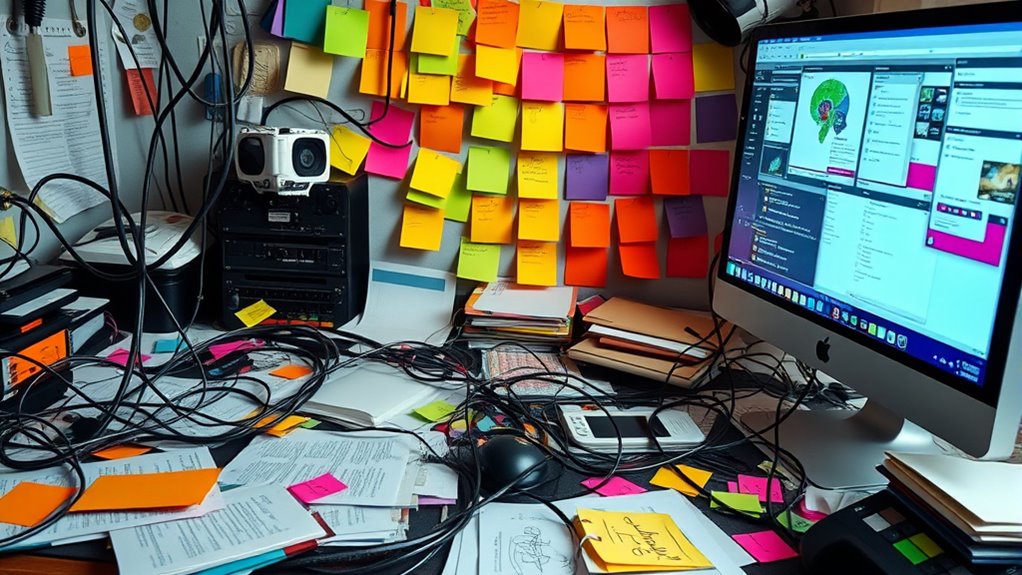
When your environment is filled with clutter, your brain has to work harder to sort through the chaos. This extra effort drains mental resources and hampers focus. Visual clutter overloads your visual cortex, forcing it to process unnecessary details, which reduces your efficiency. As your brain struggles to filter what’s relevant, you become more distracted and less productive. This constant filtering increases stress and decreases cognitive performance. Consider this table to understand the impact: connected equipment, apps, and science-backed training can help create a more organized and efficient environment to support your mental clarity and overall wellbeing. Additionally, understanding how visual processing functions can help you design a space that minimizes unnecessary stimuli and promotes mental clarity. Recognizing how cognitive load impacts decision-making can further inform strategies to declutter and streamline your environment for better mental health. Incorporating grocery savings strategies into daily routines can also reduce mental clutter by decreasing decision fatigue and simplifying choices. Furthermore, managing visual clutter effectively can enhance overall cognitive functioning and reduce mental fatigue.
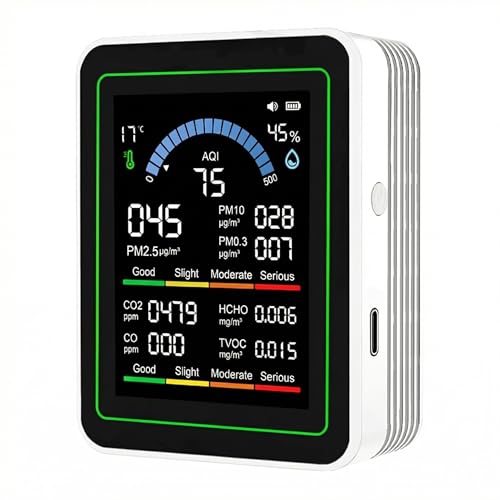
Air Quality Monitor Indoor, 10 in 1 Portable Smartair Quality Tester for CO2 | CO | TVOC | HCHO | Temp | AQI | PM0.3-1 Detection Hum for Home Cars Plants, Pets, Car, Hotel
【10-in-1 Smart Air Quality Monitor: Your All-Round Environmental Guardian】 This portable intelligent air quality tester delivers ultra-precise multi-gas...
As an affiliate, we earn on qualifying purchases.
The Concept of Cognitive Load

Cognitive load refers to the mental effort required to process information, and understanding its types helps you manage your resources effectively. You need to recognize intrinsic load, which comes from the complexity of the task, and extraneous load, caused by unnecessary distractions like visual clutter. By managing these loads, you can improve your focus and learning efficiency. Additionally, awareness of free floating mental states can help reduce unnecessary cognitive strain. Recognizing the impact of visual clutter on cognitive load can guide you in creating a more conducive environment for rest and mental clarity, especially by reducing distractions that can overload your working memory. Understanding cognitive load theory can further enhance your ability to design spaces that support mental well-being and efficient information processing.
Types of Cognitive Load
Understanding the different types of cognitive load is essential for designing effective visual displays and minimizing mental strain. There are three main types: intrinsic, extraneous, and germane load. Intrinsic load relates to the complexity of the information itself and how difficult it is to process. You can’t change this, but you can simplify complex concepts. Recognizing key traits of effective testers helps in designing visuals that align with cognitive capacity. Extraneous load stems from poorly designed visuals or distractions that make learning harder. You should aim to reduce unnecessary clutter and confusing elements. Germane load involves the mental effort needed to build understanding and integrate new information. Your goal is to optimize this load to promote learning without overwhelming your cognitive resources. Recognizing these types helps you create visuals that enhance comprehension while minimizing unnecessary mental effort. Additionally, applying cognitive load management principles in designing visual interfaces can significantly improve user understanding and retention.
Managing Mental Resources
Managing mental resources involves actively controlling how your brain handles different types of cognitive load during information processing. To do this effectively, you need to recognize when your mental capacity is being overwhelmed and adjust accordingly. Prioritize essential information, minimize distractions, and break complex tasks into manageable steps. Use strategies like chunking, visualization, and repetition to optimize learning. The goal is to balance your mental effort to avoid overload while still engaging deeply with the material. Additionally, understanding how visual clutter impacts cognitive load can help in designing more effective learning environments. Incorporating clutter reduction techniques can further improve mental clarity and focus. Recognizing the role of support breakfast options can also provide sustained energy and mental alertness, aiding in managing cognitive demands throughout the day. Being aware of cognitive load theory helps in structuring information in a way that aligns with your brain’s processing limits. Reducing unnecessary visual stimuli in your environment can help lower cognitive load and improve concentration.
Amazon Product B0FPLTB6QS
As an affiliate, we earn on qualifying purchases.
Sources of Visual Clutter in Daily Life

Everyday environments are filled with various sources of visual clutter that can overwhelm your senses and increase mental effort. Common sources include cluttered countertops, crowded desks, and overflowing shelves, which distract your attention and make it harder to focus. Bright colors, inconsistent designs, and excessive patterns also add to the visual load, pulling your gaze in multiple directions. Unorganized spaces with scattered items or unfinished projects create confusion and reduce efficiency. Digital screens can contribute too, with notifications, ads, and multiple open tabs vying for your attention. Even minor details like mismatched decor or cluttered storage areas cumulatively add to the visual noise. Recognizing these sources helps you understand how daily environments can become overwhelming and hinder your ability to concentrate. Additionally, visual clutter can impact your overall sense of calm and mental clarity, making it even more important to develop simple strategies for organization. Minimizing cluttered environments can significantly boost your focus and reduce stress.
Impact of Cluttered Environments on Focus and Productivity

When your environment is cluttered, distractions and interruptions become constant barriers to your focus. These disruptions force your brain to work harder, leading to increased mental fatigue. As a result, your productivity drops, making it harder to complete tasks efficiently.
Distractions and Interruptions
Cluttered environments often serve as constant sources of distraction, making it difficult to maintain focus and complete tasks efficiently. When your workspace is overwhelmed with visual noise, your attention gets pulled in multiple directions, leading to frequent interruptions. These distractions break your concentration, forcing you to shift mental gears repeatedly. Each interruption wastes valuable time and mental energy, reducing your overall productivity. Visual clutter also triggers subconscious cues that demand your attention, even if you’re unaware of it. As a result, you may find yourself multitasking ineffectively or feeling overwhelmed. The more cluttered your environment, the more likely you are to experience fragmented focus and increased mental clutter, which hampers your ability to work smoothly and stay on task.
Mental Fatigue Increase
Persistent visual clutter increases mental fatigue by overloading your brain’s processing capacity. When your environment is cluttered, your mind constantly works to filter out unnecessary information, which drains your mental resources. As a result, you feel more exhausted and less able to concentrate on tasks. This overload makes it harder to stay alert and hampers your decision-making ability. Over time, the persistent strain leads to mental fatigue, reducing your overall productivity. You may notice yourself becoming more irritable or struggling to complete simple tasks. Cluttered spaces don’t just distract you—they actively deplete your mental energy. To maintain focus and energy levels, minimizing visual clutter is essential, helping your brain conserve resources and stay alert longer.
Designing Clarity: Strategies to Reduce Visual Clutter

To create clearer visual environments, you need to adopt specific design strategies that minimize clutter and enhance user focus. Start by simplifying layouts; remove unnecessary elements that distract from the main message. Use ample white space to give your content room to breathe, making it easier to process. Limit color schemes to a few harmonious tones, avoiding overwhelming contrasts. Prioritize essential information by using clear headings, bullet points, and consistent typography. Group related items together to create logical visual hierarchies. Remove redundant visuals and reduce decorative details that don’t serve a functional purpose. By streamlining your design, you guide viewers’ attention more effectively, reducing cognitive load and making your message clearer and easier to understand.
The Role of Digital Interfaces in Visual Overload
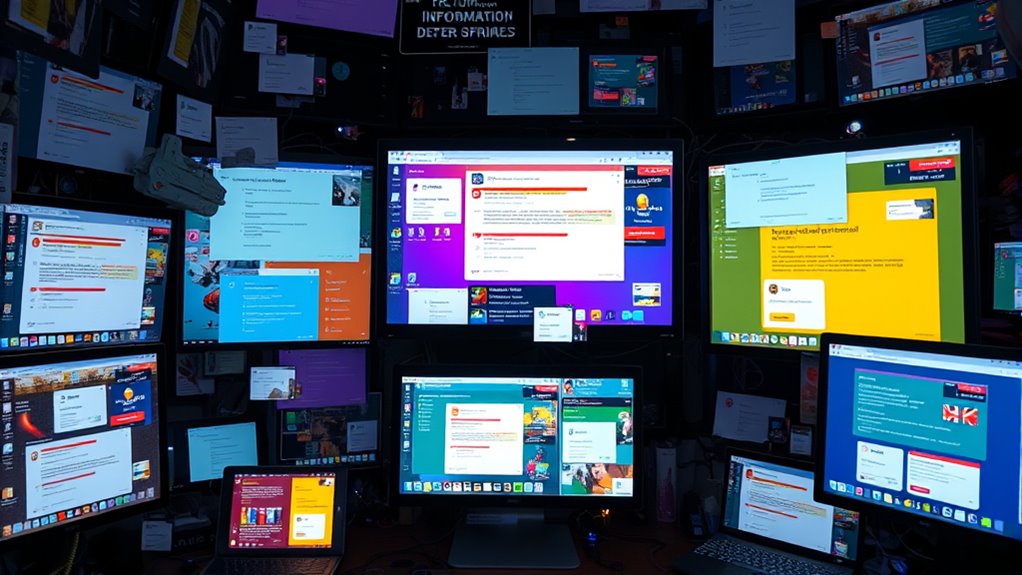
Digital interfaces play a significant role in contributing to visual overload, often overwhelming you with excessive information and interactive elements. When screens are cluttered with buttons, icons, notifications, and ads, your brain struggles to process the influx of stimuli. This overload can cause confusion, frustration, and increased cognitive load, making it harder to focus on the task at hand. Designers sometimes prioritize aesthetics or feature richness over simplicity, unintentionally hindering usability. Fast-paced digital environments, like social media feeds or news apps, bombard you with constant updates, further escalating clutter. To navigate this, you need tools that minimize distractions and prioritize essential information. Recognizing how digital interfaces impact your mental workload is crucial for creating more user-friendly, less overwhelming experiences.
Case Studies: Successful Clutter Reduction

Many successful design initiatives have demonstrated that reducing visual clutter enhances user experience and cognitive ease. For example, companies like Apple have simplified interfaces, focusing on essential elements to guide users smoothly. Another case involves Google’s minimalistic homepage, which eliminates distractions to improve search efficiency. Additionally, project management tools like Trello adopted clean layouts with clear visual hierarchies, helping users prioritize tasks effortlessly. These examples show that intentional clutter reduction leads to increased productivity and user satisfaction. By removing unnecessary elements, these designs make interfaces more intuitive and less overwhelming. As you observe these cases, you’ll see how strategic simplification can transform user interactions, making digital spaces more accessible and less cognitively taxing.
Practical Tips for Creating Calm and Focused Spaces

Building on successful clutter reduction strategies, creating calm and focused spaces involves intentionally designing environments that promote clarity and ease. Start by decluttering regularly, removing items you no longer need or use. Use storage solutions to keep surfaces clear, and designate specific spots for essential items. Choose a neutral color palette to foster a sense of tranquility and minimize visual distractions. Incorporate simple, functional furniture that encourages organization. Limit decorative accessories to a few meaningful pieces to avoid visual overload. Maintain a clean, orderly space by establishing daily routines for tidying up. Proper lighting also plays a key role—use natural light whenever possible and add soft, focused lighting for tasks. These steps help create an environment conducive to concentration and mental calm.
Frequently Asked Questions
How Does Visual Clutter Influence Emotional Well-Being?
Visual clutter can negatively impact your emotional well-being by overwhelming your senses and increasing stress levels. When your surroundings are chaotic, you might feel anxious, distracted, or fatigued, making it harder to relax or focus. Clearing clutter helps create a calmer environment, which boosts your mood and promotes mental clarity. By reducing visual noise, you can feel more centered, peaceful, and in control of your emotional health.
Can Reducing Visual Clutter Improve Decision-Making Skills?
Yes, reducing visual clutter can considerably improve your decision-making skills. When your environment is clear, your mind isn’t overwhelmed by unnecessary stimuli, allowing you to focus better. This heightened focus helps you evaluate options more effectively, avoid impulsive choices, and make decisions faster. By creating a tidy space, you’ll find it easier to concentrate on what truly matters, ultimately enhancing your ability to make sound, confident decisions.
What Are Common Misconceptions About Cognitive Load and Clutter?
You might think that more clutter equals more chaos, but misconceptions say that clutter always overwhelms you. In reality, cognitive load isn’t just about visual mess; it’s how much mental effort a task demands. Sometimes, a busy workspace can boost focus if it aligns with your habits. Over-simplifying to clear clutter ignores how your mind works—sometimes, a little disorder helps you process information better.
How Does Age Affect Sensitivity to Visual Clutter?
As you age, you’re more sensitive to visual clutter because your brain’s ability to filter out unnecessary information diminishes. This makes it harder for you to focus and process what’s important, leading to increased frustration and fatigue. You might find that simple, organized spaces help you concentrate better. To support yourself, minimize unnecessary decorations and keep your environment tidy, making it easier to navigate and stay attentive.
Are There Cultural Differences in Perceptions of Clutter?
Like a tapestry woven with diverse threads, cultural perceptions of clutter vary widely. You may see a space as chaotic, while others find it vibrant and alive. These differences stem from cultural symbols and values that influence what you consider organized or overwhelming. Your background shapes your lens, making clutter a reflection of cultural identity rather than mere disorder. Embracing this diversity enhances your understanding of different environments and perceptions.
Conclusion
By simplifying your environment and digital spaces, you can clear the path for better focus and less mental strain. Reducing visual clutter isn’t just about aesthetics; it’s about giving your brain room to breathe and think clearly. Remember, a cluttered space can make you feel overwhelmed, but a tidy one helps you stay on top of your game. So, don’t let chaos hold you back—tidy up and watch your productivity soar.