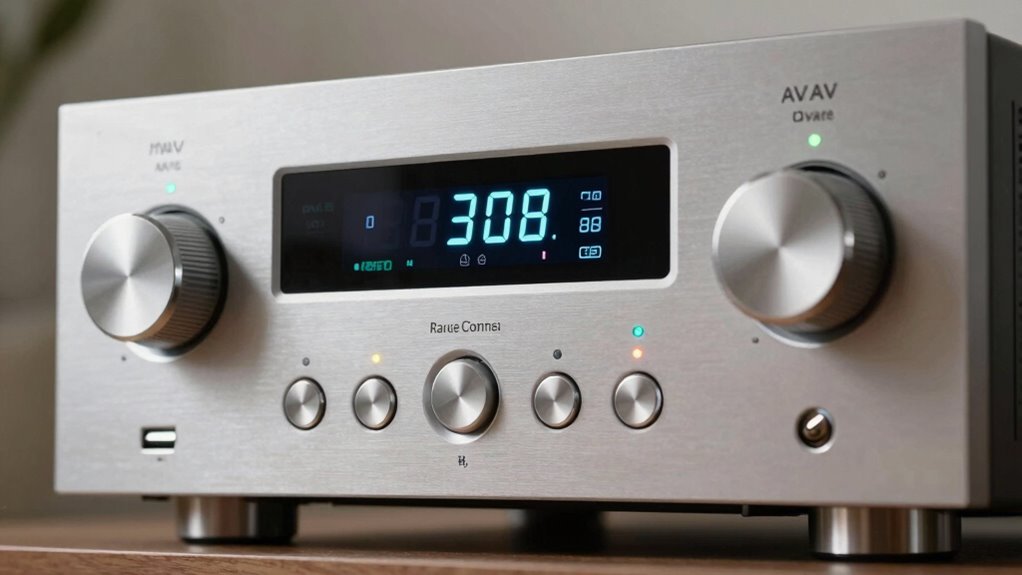

AV receiver power ratings show how much audio power the system can deliver to your speakers, influencing loudness and clarity. They are usually measured in watts and often refer to RMS power, which reflects continuous, real-world performance. Peak power indicates maximum short bursts of power. Keep in mind, higher wattage doesn’t always mean better sound quality. To understand how all these factors work together, explore more below for a clearer picture.
Key Takeaways
- Power ratings indicate the maximum audio power an AV receiver can deliver to speakers, affecting loudness and clarity.
- RMS power reflects continuous, real-world output, while peak power shows maximum short-term capacity.
- Matching receiver wattage with speaker and room size ensures optimal sound without distortion or damage.
- Wattage ratings alone can be misleading; consider amplifier quality, speaker efficiency, and room acoustics for best performance.
- Properly understanding power ratings helps in selecting the right AV receiver for your specific audio setup.
What Are Power Ratings in AV Receivers?

Power ratings in AV receivers indicate how much audio power the device can deliver to each speaker. When you look at these ratings, they tell you the maximum amount of sound your system can produce without distortion. This helps you gauge whether a receiver can handle the size of your room and the power needs of your speakers. Higher power ratings generally mean louder volume and better sound clarity at high volumes, but they don’t tell the whole story about audio quality. Keep in mind that these ratings are often measured under ideal conditions, so real-world performance may vary. Understanding what these ratings mean helps you choose a receiver that matches your listening preferences and speaker setup. Additionally, power ratings are influenced by the technology used in the amplifier, which can affect overall sound performance. For example, the design of the amplifier circuitry plays a crucial role in how efficiently power is delivered to your speakers. Furthermore, considering factors like amplifier efficiency can help ensure you select a receiver that performs reliably over time. It’s also important to recognize that dynamic headroom allows your system to handle sudden loud sounds without distortion, enhancing overall listening experience.
How Power Output Is Measured

To accurately determine how much audio an AV receiver can deliver, engineers measure its power output under specific test conditions. They typically use standardized setups to ensure consistent results. During testing, the receiver is driven with a fixed audio signal, often a sine wave, at a specified frequency. The measurement is made at a set load, usually 8 ohms, to simulate typical speaker impedance. The power output is recorded at different volume levels, often at 1 kHz. Factors influencing the measurement include:
Engineers measure AV receiver power output at 8 ohms using a 1 kHz sine wave signal.
- Test load impedance (e.g., 8 ohms or 4 ohms)
- Signal frequency (commonly 1 kHz)
- Duration of the test signal
- Whether the measurement is continuous or burst
- The use of RMS (root mean square) measurement for accuracy
- The test environment can also affect the results, so understanding these conditions helps interpret power ratings more accurately. Additionally, the measurement methodology can vary between manufacturers, making it important to compare ratings with caution. Variations in testing standards can lead to differences in reported power output, underscoring the importance of understanding these factors. Moreover, testing conditions such as temperature and ventilation can influence the results, further emphasizing the need for standardized procedures. Recognizing the testing equipment used can also shed light on the reliability of the measured power output.
The Significance of Wattage in Home Theater Systems
Understanding wattage helps you choose the right receiver for your space, ensuring clear power output without distortion. Room size matters because higher wattage can fill larger areas more effectively. Keep in mind, overestimating wattage can lead you to buy more power than you actually need, which might not improve sound quality. Additionally, selecting a receiver with appropriate power ratings can enhance your overall home theater experience while maintaining safety. Properly matching wattage to your setup can also prevent unnecessary energy consumption and reduce long-term costs. Knowing how power output interacts with speaker efficiency can further optimize your sound quality and system performance. Recognizing amplifier capabilities ensures you pair components that work well together and deliver optimal sound, especially when considering the wave and wind conditions of your environment.
Power Output Clarity
While wattage is often highlighted when choosing an AV receiver, its true significance lies in how clearly it communicates the system’s capabilities. Power output clarity guarantees you understand exactly how much sound your system can deliver under various conditions. When wattage figures are presented transparently, you can gauge whether the receiver will meet your listening needs without guesswork. Inconsistent ratings create confusion, making it hard to compare models effectively. Clear wattage data helps you assess if your speakers will be driven properly, avoid distortion, and achieve desired volume levels. Additionally, understanding the performance standards used in testing wattage ensures you’re making an informed decision based on real-world expectations. Recognizing the flushing mechanisms and efficiency ratings of a receiver can also influence its overall performance and longevity. Moreover, power measurement methods that adhere to industry standards provide a more accurate picture of a receiver’s true capability. Incorporating audio output specifications can further clarify how your receiver will perform across different listening environments.
Room Size Compatibility
When selecting an AV receiver, knowing how wattage aligns with your room size helps guarantee your system performs at its best. In smaller rooms, lower wattage receivers often suffice because sound doesn’t need to travel far. Overpowering a small space can cause distortion and discomfort. Conversely, larger rooms require higher wattage to fill the space with clear, balanced sound. Insufficient wattage may leave you with weak audio, especially at higher volumes. Consider your room dimensions and acoustics when choosing wattage; bigger rooms demand more power to ensure even sound distribution. Matching wattage to your room size creates a more immersive experience, prevents distortion, and ensures your audio sounds as intended. Proper pairing optimizes performance and enhances your overall home theater experience. Additionally, understanding the importance of wattage helps in creating a comfortable and productive home environment by ensuring your audio setup supports your space effectively. Recognizing how room size compatibility influences performance can also help prevent equipment strain and prolong the lifespan of your AV components. Being aware of power requirements ensures you select equipment that can handle your specific needs without unnecessary strain. Knowing the appropriate wattage for your setup can also improve energy efficiency and reduce operational costs over time. Moreover, selecting the right wattage can contribute to energy savings by avoiding overpowered systems that consume more power than necessary.
Overestimating Wattage
Many people assume that choosing an AV receiver with the highest wattage guarantees the loudest, clearest sound, but overestimating wattage can cause issues. Relying solely on wattage numbers might lead you to select an underpowered system that struggles with dynamic sounds or an overpowered one that risks damaging your speakers. Wattage ratings can be misleading; they don’t always reflect real-world performance or sound quality. Instead, focus on how the receiver complements your speakers and room size.
- Higher wattage doesn’t always mean better clarity
- Overestimating can cause speaker damage
- Power ratings vary between manufacturers
- Speaker efficiency impacts actual needs
- Proper matching yields better sound quality
Understanding RMS Power and Peak Power
Understanding the difference between RMS and peak power helps you choose the right receiver for your setup. You’ll want to know how continuous (RMS) power affects sound quality and how dynamic (peak) power manages sudden volume spikes. This knowledge guarantees you get clear, consistent sound without distortion or damage.
Continuous vs. Dynamic Power
While RMS power provides a consistent measure of an amplifier’s ability to deliver steady audio output, peak power indicates the maximum short-term power it can handle without distortion. Continuous (RMS) power reflects how much power your receiver can sustain over time, ensuring clear sound without damage. Dynamic (peak) power shows the highest power level the amplifier can deliver briefly, often during loud passages, without clipping. Understanding this difference helps you choose equipment suited for your listening habits. Keep in mind:
- RMS power relates to long-term performance
- Peak power affects transient, loud sounds
- High peak power can prevent distortion during peaks
- Matching peak power with speakers ensures safety
- Both ratings influence overall audio quality and durability
Recognizing these distinctions helps you select an AV receiver that balances power, clarity, and longevity.
Measuring Power Output
Have you ever wondered how audio equipment measures its power output? It primarily uses two metrics: RMS (Root Mean Square) power and peak power. RMS power indicates the continuous, average power an amplifier can deliver without distortion, giving you a realistic sense of its steady-state performance. Peak power, on the other hand, represents the maximum power the receiver can produce in short bursts, such as during loud sound effects or musical peaks. While peak power can sound impressive, it doesn’t reflect everyday performance. Most manufacturers emphasize RMS ratings because they better illustrate how the receiver will perform during regular listening. Understanding these measurements helps you compare receivers more accurately and select one that matches your listening needs.
Impact on Sound Quality
RMS power ratings directly influence the sound quality you experience during everyday listening. They determine how well your receiver can deliver consistent, clear audio without distortion or fatigue. Higher RMS ratings generally mean your system can handle louder volumes with better clarity, especially during extended sessions. Peak power, meanwhile, shows the maximum burst of power the receiver can deliver momentarily, which is less relevant for daily use but important during dynamic scenes. Understanding the difference helps you choose equipment suited to your listening habits. Keep in mind:
- RMS power affects overall sound clarity and fullness
- Peak power handles sudden, loud audio peaks
- Too low RMS results in distortion at high volumes
- Excessively high ratings don’t always improve sound quality
- Matching receiver power to speaker capacity prevents damage and guarantees ideal performance
The Role of Impedance in Power Ratings

Impedance plays a crucial role in determining an amplifier’s power ratings because it directly affects how much electrical load the receiver can handle. When you connect speakers with different impedance levels, the receiver’s ability to deliver power varies. Lower impedance speakers, such as 4 ohms, demand more current, which can cause the receiver to work harder and potentially deliver more power. Conversely, higher impedance speakers, like 8 ohms, require less current, resulting in lower power output. Understanding impedance helps you match your speakers to your receiver’s capabilities, ensuring ideal performance and preventing damage. If you mismatch impedance levels, you risk overloading your receiver or not utilizing its full power potential. Correct impedance matching maximizes efficiency, sound quality, and the longevity of your audio system.
How Distortion Affects Power Performance
When a receiver pushes beyond its clean power limits, distortion can creep into the audio signal, affecting overall performance. This distortion occurs when the amplifier is overloaded, causing audio signals to become muddled or harsh. As a result, your sound quality suffers, and the listening experience becomes less enjoyable. Several factors influence how distortion impacts power performance:
Pushing a receiver beyond its power limits causes distortion, muddling sound and reducing audio clarity.
- Increased harmonic distortion at high volumes
- Loss of clarity and detail in audio
- Reduced dynamic range
- Potential damage to speakers over time
- Decreased overall system reliability
Understanding how distortion affects power performance helps you choose a receiver that can handle your desired volume levels without sacrificing sound quality. Staying within the receiver’s power limits guarantees cleaner sound and longer equipment lifespan.
Why Power Ratings Are Not the Only Indicator of Quality
While power ratings are useful for understanding a receiver’s potential volume, they don’t tell the whole story about its overall quality. Other factors, like sound clarity, build quality, and features, play a vital role in your experience. A receiver with a high wattage might perform poorly if it distorts easily or lacks good thermal management. Conversely, a lower-rated model could deliver cleaner, more natural sound if it uses quality components. Compatibility with your setup, user interface, and additional features like room calibration also impact quality. Always consider these aspects alongside power ratings to get a complete picture. Relying solely on wattage might lead you to overlook a receiver that’s better suited for your needs and provides a richer listening experience.
Practical Tips for Choosing the Right Power Rating
Choosing the right power rating for your AV receiver involves matching it to your listening space, speaker setup, and typical usage volume. Start by evaluating your room size; larger spaces need more power to fill with sound. Consider your speakers’ impedance and sensitivity—higher sensitivity speakers require less power. Think about your listening habits; if you often watch movies loudly, opt for a receiver with a higher wattage. Avoid underpowering your system, which can cause distortion. Here are some practical tips:
- Match wattage to your room size and speaker specifications
- Prioritize clarity and headroom over raw wattage
- Check your speakers’ impedance and sensitivity ratings
- Consider future upgrades or expansions
- Test different power levels in-store if possible
These steps help ensure your receiver delivers clean, efficient sound without wasted investment.
Common Misconceptions About AV Receiver Power
Many people assume that higher wattage always means better sound quality or louder volumes, but this isn’t necessarily true. Wattage alone doesn’t determine how good your audio sounds or how loud it gets. Other factors like speaker efficiency, room size, and amplifier quality play vital roles. For example, a lower-wattage receiver can produce clear, powerful sound if paired with efficient speakers and used in a suitable space. Conversely, a high-wattage receiver doesn’t guarantee better sound if your speakers can’t handle that power or if the room isn’t optimized. It’s a common misconception that more watts equals better performance. Instead, focus on matching your receiver’s power output to your speakers’ capabilities and your listening environment for the best results.
Frequently Asked Questions
How Does Room Size Influence AV Receiver Power Needs?
Room size directly impacts the power you need from an AV receiver. In larger rooms, you’ll require a more powerful receiver to fill the space with sound without distortion. Smaller rooms need less power, so a lower wattage receiver suffices. Remember, a powerful receiver guarantees clear, balanced audio, especially at higher volumes. Always consider your room’s dimensions and acoustics to choose the right power rating for your setup.
Can Higher Wattage Receivers Damage Speakers?
Higher wattage receivers won’t necessarily harm your speakers if used properly. You need to match the receiver’s power output with your speakers’ power handling capacity. Overdriving your system or setting the volume too high can cause distortion, which might damage the speakers over time. Always make certain your receiver’s wattage aligns with your speakers’ ratings and avoid pushing the volume beyond safe levels to protect your equipment.
What Is the Ideal Power Rating for Small Rooms?
For small rooms, look for an AV receiver with a power rating around 50 to 100 watts per channel. This range provides enough power to fill the space with clear sound without risking damage to your speakers. Keep in mind, speaker sensitivity and room acoustics also influence sound quality. You don’t need the highest wattage; rather, a balanced power output suited to your room size will give you the best listening experience.
How Does Speaker Sensitivity Affect Power Requirements?
Imagine your speakers as eager listeners, their sensitivity acting like a beacon guiding how much power they need. Higher sensitivity speakers, like attentive friends, require less power to produce loud sounds, saving your receiver’s energy. Conversely, lower sensitivity speakers demand more power to reach the same volume, meaning your receiver must work harder. So, when choosing speakers, consider their sensitivity to guarantee your system delivers clear, powerful sound without overloading.
Are Higher Power Ratings Always Better for Sound Quality?
Higher power ratings aren’t always better for sound quality. You might get louder volume or handle more demanding speakers, but that doesn’t guarantee better sound. Focus on matching your receiver’s power with your speakers’ needs and your room size. Overpowering can cause distortion or damage, so prioritize compatibility and clarity over raw wattage. Ultimately, the best sound depends on balanced power, quality components, and proper speaker setup.
Conclusion
So, next time you see that shiny AV receiver boasting massive wattage, remember it’s like a car with a big engine—looks impressive, but doesn’t guarantee smooth rides or perfect sound. Don’t get blinded by numbers; your ears and room size matter more. Think of power ratings as a fancy hat—nice to have, but not the whole outfit. Choose wisely, and your home theater will thank you with stellar sound, not just a flashy display.