To set up a smart home network, guarantee your router supports Wi-Fi 5 or Wi-Fi 6 for fast, reliable connections. Place it centrally and away from interference sources, and use a strong, unique password with security protocols like WPA3. Segment your network to keep smart devices separate from your main devices for security and performance. Regularly update firmware, manage bandwidth, and troubleshoot issues quickly to keep everything running smoothly. Learn more to optimize your smart home experience.
Key Takeaways
- Use a dual-band Wi-Fi router supporting Wi-Fi 5 or Wi-Fi 6 for optimal smart device connectivity.
- Place your router centrally and elevate it to maximize Wi-Fi coverage throughout your home.
- Segment your network with separate SSIDs or VLANs to isolate IoT devices from main devices for security.
- Enable WPA3 encryption and update router firmware regularly to enhance security for smart home devices.
- Manage bandwidth with QoS settings, prioritize critical devices, and monitor network performance for reliability.

LEVOIT Air Purifier for Home Large Room Up to 1073Ft² with Air Quality Monitor, AHAM VERIFIDE, Smart WiFi, Washable Pre-Filter, HEPA Sleep Mode for Pets, Allergies, Dust, Pollen, Vital 100S-P, White
𝐖𝐇𝐘 𝐂𝐇𝐎𝐎𝐒𝐄 𝐀𝐇𝐀𝐌 𝐕𝐄𝐑𝐈𝐅𝐈𝐃𝐄 𝐀𝐈𝐑 𝐏𝐔𝐑𝐈𝐅𝐈𝐄𝐑𝐒: AHAM (Association of Home Appliance Manufacturers) is an ANSI-accredited organization that sets...
As an affiliate, we earn on qualifying purchases.
Understanding Your Home Network Basics

To effectively set up and manage your smart home devices, it’s essential to understand the basics of your home network. Your network connects all your devices, allowing them to communicate and share data. It typically consists of a modem, which connects you to the internet, and a router, which distributes the connection throughout your home. Devices like smart lights, thermostats, and security cameras connect to your network either via Wi-Fi or wired Ethernet. Wi-Fi is most common, providing wireless convenience. Knowing your network’s layout helps troubleshoot issues and optimize performance. Your home network has an IP address—like a digital address—that identifies it on the internet. Understanding these basics helps you guarantee your smart devices work smoothly and securely. Wireless connectivity plays a crucial role in ensuring seamless communication between your devices. Additionally, understanding the network’s security features can help protect your smart home from unauthorized access and cyber threats. Being familiar with network management tools can also assist in monitoring and controlling your device connections more effectively. Moreover, staying informed about best practices for network security can further safeguard your smart devices from vulnerabilities.

KNKA Air Purifier for Home Bedroom Large Room Up to 1,695 Ft² in 1 Hr, HEPA Air Cleaner with Washable Pre-Filter, AQI Display, ECO Mode, Sleep Mode, Pet Mode for Pets, Dust, Pollen, APH4000
𝐇𝐢𝐠𝐡 𝐂𝐀𝐃𝐑 𝐕𝐚𝐥𝐮𝐞: This air purifier provides reliable performance with a Smoke/Dust/PM2.5 CADR of 226 CFM (384 m³/h)...
As an affiliate, we earn on qualifying purchases.
Choosing the Right Router for Smart Devices
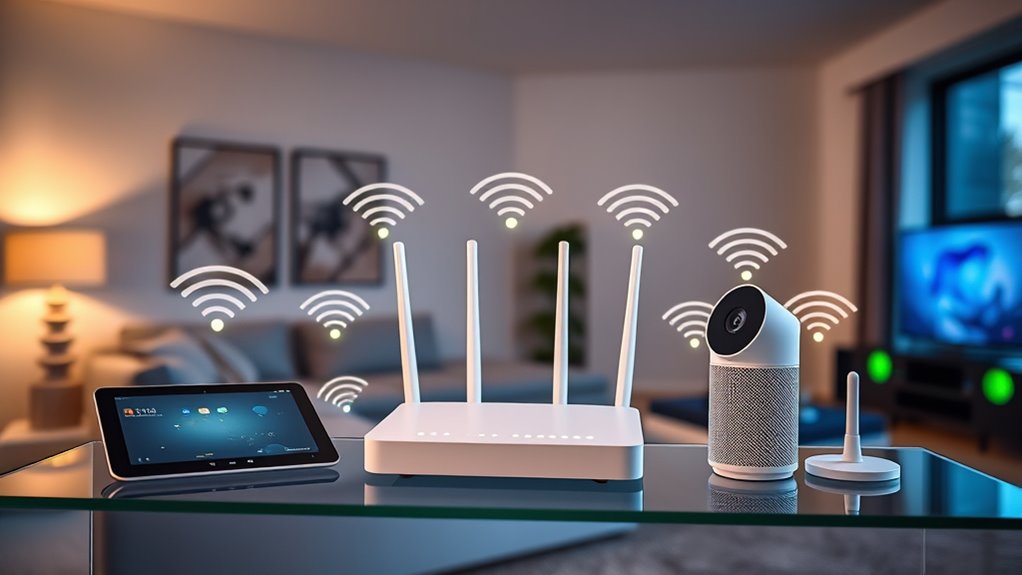
When selecting a router for your smart devices, you need to consider its speed requirements to ensure smooth performance. You should also look for security features that protect your home network from threats. Additionally, make sure the router supports your device compatibility needs to avoid connectivity issues. For households with multiple interconnected devices or high data demands, choosing a high-performance router can significantly improve overall network stability. To maintain optimal performance, it’s also important to consider network management capabilities that allow you to monitor and control your connected devices effectively. A secure network is essential for safeguarding sensitive information and preventing unauthorized access. Incorporating a router with advanced security protocols can further enhance your network’s defenses against cyber threats. Understanding device compatibility will help ensure seamless integration of all your smart devices into the network.
Router Speed Requirements
Choosing the right router speed is essential for ensuring your smart devices work seamlessly. Smart gadgets like security cameras, voice assistants, and smart thermostats require sufficient bandwidth to function properly without lag. If your router’s speed is too slow, devices may experience buffering, delays, or disconnections, reducing their effectiveness. For most smart home setups, a router supporting at least AC1200 or higher speeds is recommended. Consider your number of devices and their data demands—more devices or high-bandwidth activities like streaming or video calls need faster speeds. Additionally, future-proof your network by opting for a router with support for Wi-Fi 6, which offers increased speed and capacity. Ultimately, matching your router speed to your smart home’s needs guarantees reliable, smooth operation.
Network Security Features
Are your smart devices protected against cyber threats? Choosing a router with strong security features is essential. Look for routers that support WPA3 encryption, which offers better protection than older standards. Enable a unique, complex Wi-Fi password to prevent unauthorized access. Many routers include built-in firewalls that monitor and block suspicious activity—make sure it’s activated. Regular firmware updates are vital; they fix vulnerabilities and improve security. Some routers offer guest networks, isolating your main devices from visitors’ devices. Additionally, consider routers with automatic security alerts or intrusion detection systems. By prioritizing these security features, you create a safer environment for your smart devices, safeguarding your data and maintaining your home’s privacy. Consulting wireless security basics can help you better understand how to enhance your network’s defenses. Staying informed about network security standards ensures you are implementing the most effective protections for your home network. Regularly reviewing your router security settings can further strengthen your network against potential threats.
Device Compatibility Options
Selecting a router that’s compatible with your smart devices guarantees seamless connectivity and peak performance. To verify compatibility, check if the router supports your device’s Wi-Fi standards, like Wi-Fi 5 (802.11ac) or Wi-Fi 6 (802.11ax). Many smart devices work best with dual-band routers, which offer both 2.4 GHz and 5 GHz networks, reducing congestion. Look for routers that support the latest security protocols, such as WPA3, to protect your devices. Additionally, consider routers with multiple Ethernet ports if you plan to connect devices directly. Compatibility also involves device-specific features, like mesh networking for large homes or smart home hubs. By choosing a router aligned with your devices’ specifications, you’ll optimize performance and enjoy a reliable smart home experience. Understanding device compatibility helps ensure your network setup is future-proof and efficient. Wireless standards are a crucial aspect of ensuring your smart devices function correctly on your network. Checking for device compatibility ensures your smart home functions smoothly across all devices.

LEVOIT Air Purifiers for Home Large Room Up to 1875 Ft² with Washable Pre-Filter, AHAM VERIFIDE, Air Quality Monitor, HEPA Sleep Mode for Allergies, Pet Hair in Bedroom, Vital 200S-P, White
𝐖𝐇𝐘 𝐂𝐇𝐎𝐎𝐒𝐄 𝐀𝐇𝐀𝐌 𝐕𝐄𝐑𝐈𝐅𝐈𝐃𝐄 𝐏𝐑𝐎𝐃𝐔𝐂𝐓𝐒: AHAM (Association of Home Appliance Manufacturers) is an ANSI-accredited organization that sets strict...
As an affiliate, we earn on qualifying purchases.
Setting Up a Secure Wireless Network

Setting up a secure wireless network is essential to protect your smart devices from unauthorized access and potential cyber threats. First, change the default network name (SSID) to something unique, so hackers can’t easily identify your router. Enable WPA3 encryption if available; otherwise, choose WPA2. This encrypts data exchanged between your devices and the router, making it harder for intruders to intercept information. Set a strong, complex password that combines letters, numbers, and symbols—avoid common phrases or personal details. Regularly update your router’s firmware to patch security vulnerabilities. Disable remote management features unless absolutely necessary, and turn off WPS, which can be exploited. By following these steps, you considerably strengthen your wireless network’s defenses, keeping your smart devices safe from cyber threats. Incorporating proper security measures can further safeguard your network from evolving cyber risks, especially as cybersecurity threats continue to develop.

Jackery Portable Power Station Explorer 300, 292Wh Backup LiFePO4 Battery, Solar Generator for Outdoors Camping Travel Hunting Blackout (Solar Panel Optional)
SPEED UP YOUR RECHARGEABILITY: It takes only 2 hours to recharge 80% battery of the power station through...
As an affiliate, we earn on qualifying purchases.
Optimizing Wi-Fi Coverage Throughout Your Home
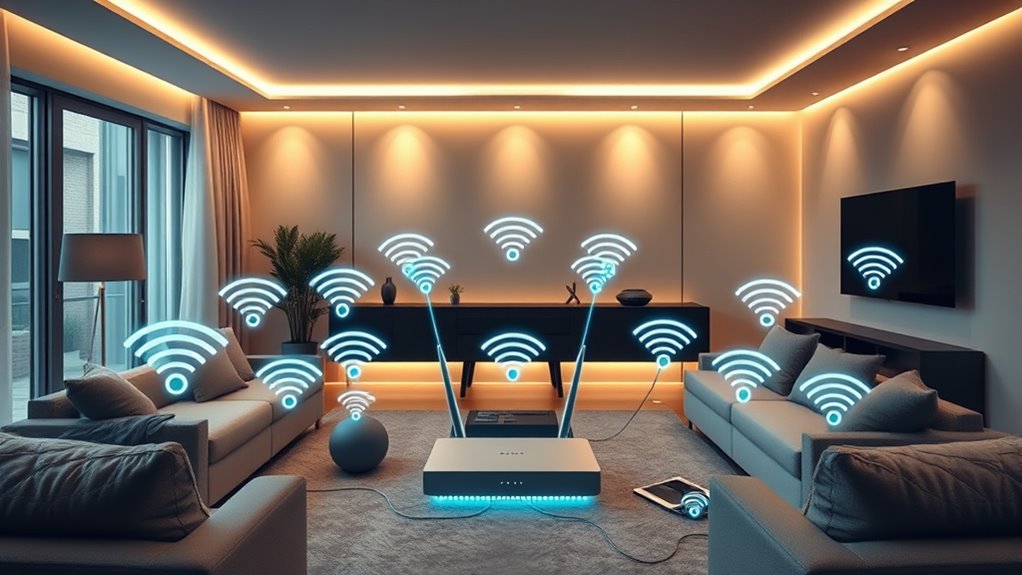
To get the best Wi-Fi coverage, start by placing your router in a central, open spot away from obstructions. Use signal boosters if needed to extend coverage into hard-to-reach areas. Also, keep your router away from devices that can cause interference, like microwaves and cordless phones, to guarantee a strong, reliable connection. Understanding Wi-Fi interference can help you identify and minimize sources of signal disruption for even better coverage. Additionally, ensuring proper router placement can significantly enhance overall network performance and reduce dead zones throughout your home. Regularly checking and maintaining your equipment, including filtering and pump protection, can also contribute to a more stable and efficient network environment.
Strategic Router Placement
Placing your router strategically is vital to guarantee strong Wi-Fi coverage throughout your home. To maximize performance, consider these key points:
- Central Location: Position your router in the heart of your home to evenly distribute signals.
- Elevated Position: Place it on a high shelf or mount it on a wall to reduce obstructions.
- Avoid Interference: Keep it away from microwaves, cordless phones, and thick walls that can weaken signals.
- Open Space: Ensure there’s minimal clutter around the router to allow unobstructed Wi-Fi flow.
Wi-Fi Signal Boosters
If your Wi-Fi signals struggle to reach every corner of your home, installing Wi-Fi signal boosters can substantially improve coverage. These devices amplify your existing Wi-Fi signal, extending its range into hard-to-reach areas. You simply place a booster halfway between your router and the dead zones, guaranteeing a stronger connection in those spots. Many boosters are easy to set up with a simple plug-in and follow-instructions, making the process straightforward. They work well in large homes or spaces with thick walls that weaken signals. Keep in mind, for peak performance, choose a booster compatible with your router’s frequency band and ensure it covers the size of your home. Selecting the right hardware is essential for optimal results. Signal boosters are a cost-effective way to eliminate weak spots and keep all your smart devices connected seamlessly. Additionally, considering the safety and compatibility of your setup can prevent potential interference and ensure reliable operation. For example, selecting a booster with mesh networking capabilities can further enhance coverage in complex home layouts, especially when combined with modern routers that support dual-band or tri-band frequencies.
Minimizing Interference
While signal boosters can extend your Wi-Fi coverage, interference from other electronic devices, walls, and household materials can still weaken your connection. To minimize this, consider these steps:
- Place your router centrally to reduce walls and obstacles blocking signals.
- Keep devices away from microwaves, cordless phones, and Bluetooth gadgets, which operate on similar frequencies.
- Use 5 GHz networks when possible, as they’re less crowded and less prone to interference.
- Limit the number of active devices on your network during peak times to prevent congestion.
Segmenting Your Network for Better Management
To manage your network more effectively, you should consider segmenting it into separate zones. This approach helps isolate smart devices from other traffic, reducing congestion and potential security risks. For example, you can create a dedicated IoT or smart device network, separate from your main household network. This setup ensures that any vulnerabilities in smart devices don’t affect your personal computers or sensitive data. Using VLANs or separate Wi-Fi networks makes this process straightforward. You’ll also find it easier to monitor and troubleshoot issues when devices are segmented. Additionally, managing bandwidth becomes simpler because you can allocate resources based on each zone’s needs. Overall, network segmentation enhances performance, security, and control, making your smart home more reliable and easier to maintain.
Prioritizing Traffic for Smart Devices
To guarantee your smart devices work smoothly, you need to prioritize their traffic effectively. You can assign device priorities, manage bandwidth, and set up Quality of Service to keep important tasks running seamlessly. These steps help you control network performance and prevent slowdowns during busy times.
Assigning Device Priorities
Assigning device priorities guarantees your most important smart devices get the bandwidth they need when the network is busy. To do this effectively, consider these key points:
- Identify critical devices like security cameras and smart locks that require constant connectivity.
- Use your router’s Quality of Service (QoS) settings to assign higher priority levels to these devices.
- Limit or schedule bandwidth for less essential devices, such as guest Wi-Fi or streaming devices.
- Regularly review and update priorities as your household’s needs evolve.
Managing Bandwidth Distribution
Effective bandwidth management guarantees your smart devices operate smoothly even when your network is busy. By controlling how bandwidth is allocated, you ensure crucial devices stay connected without lag. Prioritizing traffic prevents streaming interruptions, slow downloads, and dropped connections. You can allocate bandwidth based on device importance or activity. Here’s a simple example:
| Device | Priority Level | Typical Usage |
|---|---|---|
| Security Camera | High | Continuous video feed |
| Smart Thermostat | Medium | Periodic updates |
| Smart Light | Low | Occasional commands |
Managing distribution helps balance network load, avoiding congestion caused by multiple devices competing for bandwidth. Set priorities thoughtfully, so essential tasks always have enough resources, keeping your smart home responsive and efficient.
Implementing Quality of Service
Implementing Quality of Service (QoS) allows you to explicitly prioritize traffic for your smart devices, ensuring they get the bandwidth they need when the network gets busy. By configuring QoS settings, you can control which devices or applications receive priority during peak usage. This helps prevent smart home devices from lagging during streaming or video calls. To effectively use QoS, consider these key points:
- Identify critical devices like security cameras or smart thermostats.
- Assign higher priority to real-time traffic such as voice or video streams.
- Set bandwidth limits for less essential devices to avoid congestion.
- Regularly review and adjust QoS rules as your device lineup evolves.
This approach guarantees smooth performance and reliable connectivity for your smart home system.
Implementing Strong Security Measures
Securing your smart home network is essential to protect your devices and personal data from cyber threats. Begin by changing default passwords on your routers and smart devices to strong, unique ones. Enable WPA3 encryption on your Wi-Fi network to improve security. Keep your firmware and software up to date; manufacturers often release patches for vulnerabilities. Use a separate network or VLAN for your smart devices, isolating them from your main devices like computers and phones. Activate two-factor authentication whenever possible for added protection. Regularly monitor connected devices for suspicious activity and disable features you don’t use. By implementing these measures, you create a robust security foundation that minimizes risks and keeps your smart home safe from cyber intrusions.
Managing Device Connections and Bandwidth

Managing device connections and bandwidth is essential to guarantee your smart home runs smoothly without interruptions. To do this effectively, consider these key strategies:
- Prioritize critical devices like security cameras and smart locks to ensure they function seamlessly.
- Limit the number of devices connected at once, especially during high-demand periods.
- Use Quality of Service (QoS) settings on your router to allocate bandwidth where it’s needed most.
- Regularly monitor your network to identify and address congestion or slowdowns.
Keeping Firmware and Software Up to Date

Keeping your firmware and software up to date is essential for maintaining the security and ideal performance of your smart home devices. Manufacturers regularly release updates that fix security vulnerabilities, improve functionality, and add new features. To stay protected, check for updates frequently through your device’s app or web interface. Enable automatic updates if available, so you don’t forget to update manually. Avoid delaying updates, as outdated firmware can expose your network to cyber threats and cause compatibility issues. Make it a habit to review update notifications, especially after major software releases. Keeping everything current ensures your devices run smoothly, reduces bugs, and keeps your smart home secure from potential exploits. Regular updates are a simple yet powerful way to enhance your home network’s reliability.
Troubleshooting Common Connectivity Issues
Even with regular updates, connectivity issues can still disrupt your smart home devices. When this happens, try these steps to troubleshoot effectively:
- Restart your router and devices to refresh the network connection.
- Check your Wi-Fi signal strength; move devices closer to the router if needed.
- Verify network settings to ensure devices are on the correct network and have proper IP addresses.
- Update device firmware if available, as outdated firmware can cause connectivity problems.
Frequently Asked Questions
How Can I Improve My Smart Device Battery Life via Network Settings?
To improve your smart device’s battery life through network settings, start by disabling Wi-Fi or Bluetooth when not in use. Use low-power modes available on your device, and make certain your device isn’t constantly searching for networks. Adjust network settings to limit background data and push notifications, which drain power. Connecting to stable Wi-Fi networks can also reduce energy use compared to cellular data, helping your device last longer between charges.
What Are the Best Practices for Integrating New Smart Devices Into My Network?
Imagine adding a new smart device is like inviting a friend over—you want a smooth experience. First, update its firmware for security and performance. Connect it to a dedicated network segment or VLAN to keep your main network stable. Use strong, unique passwords and enable network encryption. Finally, monitor its activity regularly, ensuring it isn’t overloading your bandwidth. These steps keep your network secure and your smart devices running seamlessly.
How Do I Monitor and Analyze Network Traffic for Smart Device Performance?
You can monitor and analyze network traffic for your smart device performance by using network monitoring tools like Wireshark or your router’s built-in analytics. Regularly check device activity, bandwidth usage, and connection stability through these tools. Setting up alerts for unusual traffic helps identify issues early. Keep firmware updated and segment your network to isolate smart devices, ensuring peak performance and security.
Can I Set up Guest Networks Specifically for Smart Home Devices?
Yes, you can set up guest networks specifically for your smart home devices. You’ll need to access your router’s settings, typically through a web interface or app. Create a separate Wi-Fi network labeled as a guest network, then connect your smart devices to this network. This enhances security by isolating your main network from potential vulnerabilities, and many routers allow you to customize and manage these guest networks easily.
What Troubleshooting Steps Are Recommended for Intermittent Smart Device Connectivity?
You should restart your smart device and router to resolve connectivity issues. Check your Wi-Fi signal strength and move devices closer to your router if needed. Make sure your firmware and app are updated for peak performance. Disable any interfering devices or networks, and switch to a less congested Wi-Fi band if possible. If problems persist, reset your device’s network settings and consider replacing outdated hardware.
Conclusion
Think of your home network as a bustling city — with the right planning and security, it runs smoothly and safely. By understanding your setup, choosing the right gear, and keeping everything up to date, you’ll be the master architect of your connected world. With a little effort, your smart devices will dance in harmony like a well-orchestrated symphony, turning your home into a smart haven where everything works seamlessly and securely.