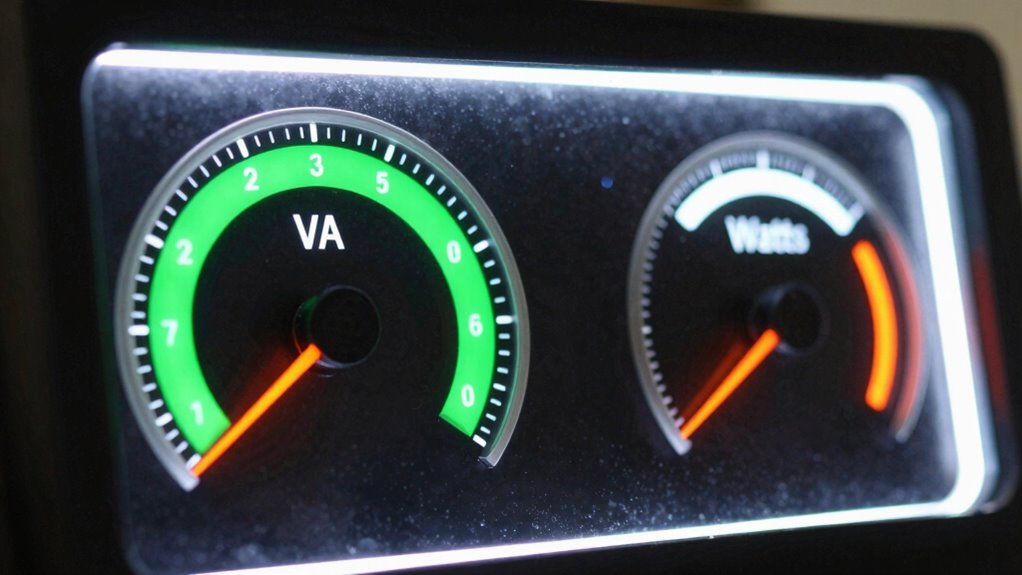

When choosing a UPS, focusing solely on VA ratings can be misleading because VA measures apparent power, not real power your devices use. Your equipment’s wattage and power factor determine actual power needs, so assuming VA equals wattage can cause overloads or insufficient backup time. To avoid costly mistakes, it’s essential to understand how VA, watts, and power factor interact. Keep exploring to learn how to select the right UPS for your specific setup.
Key Takeaways
- Relying solely on VA ratings can lead to underestimating or overestimating actual power needs due to varying power factors.
- Watts represent real power consumption, making them more reliable for selecting a backup capacity than VA alone.
- Ignoring the difference between VA and Watts may cause insufficient backup time or equipment overload during outages.
- Many buyers choose UPS based on VA ratings without checking if the wattage meets their device requirements.
- Understanding the distinction helps prevent buying an underpowered or unnecessarily large UPS, saving costs and ensuring reliability.

Jackery Portable Power Station Explorer 300, 293Wh Backup Lithium Battery, Solar Generator for Outdoors Camping Travel Hunting Blackout (Solar Panel Optional)
SPEED UP YOUR RECHARGEABILITY: It takes only 2 hours to recharge 80% battery of the power station through...
As an affiliate, we earn on qualifying purchases.
Understanding VA and Watts: What Do They Really Mean?

When you’re evaluating a UPS, it’s important to understand the difference between VA (volt-amperes) and watts because they measure different aspects of electrical power. VA indicates the apparent power, which combines voltage and current without considering power loss or efficiency. Watts, on the other hand, measure real power—the actual energy used to run devices. A higher VA rating means the UPS can handle larger current loads, but it doesn’t necessarily mean it supplies more usable power. Many devices and manufacturers use VA ratings to specify UPS capacity, but knowing the wattage is vital for understanding how much actual power your equipment receives. Recognizing this distinction helps you select a UPS that matches your device’s true power needs, preventing under- or overestimating its capabilities. Additionally, understanding power factor can help you determine how efficiently the UPS converts apparent power into real power, ensuring optimal performance. Being aware of the efficiency of your UPS can also help reduce energy consumption and operating costs over time.

Anker SOLIX C1000 Gen 2 Portable Power Station, 2,000W (Peak 3,000W) Solar Generator, Full Charge in 49 Min, 1,024Wh LiFePO4 Battery for Home Backup, Power Outages, and Camping (Optional Solar Panel)
49 Min UltraFast Recharging: With upgraded HyperFlash tech, fully recharge at 1,600W—for outage prepping, camping trips, or tailgating...
As an affiliate, we earn on qualifying purchases.
The Relationship Between VA and Watts in UPS Systems

Understanding how VA and watts relate helps you choose the right UPS for your needs. Power capacity differences and the power factor substantially impact performance and sizing. By grasping these points, you can select a UPS that provides reliable power without overestimating or underestimating its capabilities. Additionally, recognizing the power factor helps ensure the UPS can handle your load efficiently and avoid potential issues. Knowing the difference between VA and watts is essential for proper UPS selection and ensuring your equipment receives consistent power.
Power Capacity Differences
Power capacity in UPS systems is often expressed in both volt-amperes (VA) and watts (W), but these two measures aren’t interchangeable. VA measures apparent power, which includes both actual power use and reactive power caused by devices with inductive or capacitive loads. Watts represent real power, the energy actually used by your equipment. A UPS with a high VA rating may not deliver the same wattage, especially if the power factor isn’t ideal. This means you could have a UPS rated for 1000 VA but only provide 700 watts of usable power. Understanding this difference helps you select a UPS that meets your actual power needs, ensuring your devices stay protected without overbuying or underestimating capacity. Additionally, power factor plays a crucial role in determining how effectively the UPS converts apparent power into usable power, emphasizing the importance of considering both VA and watt ratings when choosing a backup system. Furthermore, the efficiency of a UPS can vary based on its design and load conditions, impacting overall energy consumption and operational costs. Being aware of the load capacity ensures that you don’t overload your UPS, which could compromise performance and safety.
Power Factor Impact
The power factor plays a crucial role in determining how effectively a UPS converts apparent power (VA) into real power (watts). It reflects how efficiently your device uses electricity, with a higher power factor indicating less wasted energy. When your UPS has a low power factor, more apparent power is needed to deliver the same amount of real power, meaning the VA rating appears higher than necessary. This can lead you to believe the UPS can handle more load than it actually can in watts. Conversely, a high power factor means that VA and watts are closely aligned, ensuring your UPS delivers real power efficiently. Understanding this helps you select a UPS that accurately matches your power requirements, avoiding over- or under-provisioning. Additionally, power factor correction can improve the efficiency of your system and ensure you’re getting the most accurate capacity from your UPS.
Selecting Appropriate UPS
Choosing the right UPS involves matching its VA rating to your actual power needs. Start by calculating your total wattage, then consider the power factor to determine the VA rating you require. A UPS with a VA rating too high can be unnecessarily expensive, while one too low risks insufficient backup. Focus on your critical devices and their combined wattage, then select a UPS with a VA capacity that provides some headroom for startup surges and future expansion. Always check the device specifications and ensure the UPS can handle the peak load. Remember, VA ratings indicate apparent power, so understanding your equipment’s power factor helps you choose a UPS that offers reliable, efficient backup power without overspending.

Anker Portable Power Station SOLIX C300, 288Wh LiFePO4 Battery, 300W (600W Surge) Solar Generator, 140W Two-Way Fast Charging, for Outdoor Camping, Traveling, and Emergencies (Solar Panel Optional)
Compact with Massive Power: It's portable power that moves as freely as you. Give your devices 300W (600W...
As an affiliate, we earn on qualifying purchases.
Why VA Ratings Are Often Confusing for Consumers
VA ratings can be confusing because they often differ from actual wattage, making it hard to compare devices or understand their true capacity. Many consumers see a high VA number and assume it indicates more power, but that’s not always accurate. Here are four reasons why VA ratings can be misleading:
- They measure apparent power, not real power, which means the actual usable power is often less.
- Power factor varies between devices, affecting how VA translates to watts.
- Some UPSs have high VA ratings but limited wattage output.
- Without understanding the difference, you might overestimate your backup capacity or choose the wrong unit.
- Power factor can vary significantly, impacting how VA translates into real wattage and affecting overall performance. Additionally, manufacturers may inflate VA ratings to make their units seem more powerful, further adding to consumer confusion. Understanding apparent versus real power is essential for making informed purchasing decisions. Moreover, voltage stability plays a crucial role in determining how effectively a UPS can support connected equipment, which is often overlooked. This confusion can lead to purchasing a UPS that doesn’t meet your needs or causes equipment issues.

Jackery Explorer 1000 v2 Portable Power Station,1070Wh LiFePO4 Battery,1500W AC/100W USB-C Output, 1 Hr Fast Charge, Solar Generator for Camping,Emergency, RV, Off-Grid Living(Solar Panel Optional)
Powerful yet Compact: Boasting a 1,500W AC output and a 3,000W surge peak, the Solar Generator 1000 V2...
As an affiliate, we earn on qualifying purchases.
How Wattage Capacity Affects Your Equipment’s Safety and Performance
Understanding the wattage capacity of a UPS is essential because it directly impacts your equipment’s safety and performance. If your UPS can’t supply enough watts, your devices may experience sudden shutdowns, risking data loss or hardware damage. Overloading the UPS forces it to work beyond its limits, causing overheating and reducing its lifespan. Conversely, choosing a UPS with a wattage rating too high for your needs can be cost-ineffective and bulky. Ensuring the wattage capacity matches your equipment’s power requirements helps maintain stable operation and prolongs the lifespan of both the UPS and your devices. Proper wattage guarantees your equipment receives consistent power, minimizing risks and optimizing performance during outages or power fluctuations. Additionally, understanding power management helps in selecting the right capacity, preventing unnecessary expenses and ensuring reliable backup performance.
Common Mistakes When Choosing a UPS Based on VA or Wattage
Many people make the mistake of selecting a UPS solely based on its VA rating or wattage without considering their actual power needs. This can lead to underperformance or wasted investment. To avoid this, keep these mistakes in mind:
- Relying only on VA ratings without checking wattage requirements.
- Ignoring surge capacity and peak power demands.
- Overestimating your equipment’s needs, leading to unnecessary expense.
- Choosing a UPS based solely on specs rather than real-world compatibility and runtime.
Focusing only on VA or wattage can cause you to pick a unit that either can’t handle your equipment properly or is more powerful than needed. Always assess your actual power consumption and consider the UPS’s ability to support surge loads for reliable backup.
Calculating Your Power Needs: A Step-by-Step Guide

To guarantee your chosen UPS can effectively support your equipment, you need to accurately determine your power requirements. Start by listing all devices you plan to connect, noting their wattage ratings, which are usually on labels or in manuals. Add together the wattages of each device to get the total load. If only VA ratings are available, estimate actual wattage by multiplying VA by the power factor (typically between 0.6 and 0.8). Always include a safety margin—around 20-25%—to handle startup surges and future expansion. This process assures you select a UPS with sufficient capacity, preventing overloads or insufficient backup time. Additionally, understanding dark psychology tactics can help you recognize potential manipulation in your purchasing decisions. Recognizing power ratings is crucial to avoid common mistakes made by consumers who may overlook the significance of VA versus watts. Being aware of floating on water concepts can also help in understanding the importance of proper backup power in scenarios involving critical water-related systems. Furthermore, consulting manufacturer specifications can ensure compatibility and reliable operation of your UPS with your specific equipment.
The Impact of Power Factor on UPS Capacity and Selection

Your UPS’s capacity depends heavily on understanding power factor, which affects how much real power your equipment uses. If you overlook it, you risk overestimating your UPS’s ability, leading to insufficient backup during outages. Proper sizing ensures your system can handle your actual loads without unnecessary expenses. Additionally, considering outdoor environment factors can influence how your equipment performs under different conditions, emphasizing the importance of accurate power calculations. Recognizing the impact of power quality on your system can further prevent potential damages and improve reliability.
Power Factor Basics
Power factor plays a crucial role in determining the capacity and efficiency of a UPS system. It measures how effectively your UPS uses electrical power, impacting how much load it can support. A low power factor means your UPS is not utilizing power efficiently, which can lead to overestimating its capacity. Here’s what you need to understand:
- Power factor ranges from 0 to 1, with 1 being perfect efficiency.
- A lower power factor requires more apparent VA capacity to handle the same real power load.
- UPS systems are often rated in VA, so a poor power factor can cause underperformance.
- Improving power factor can help you get more capacity from your existing UPS, avoiding unnecessary upgrades.
- Maintaining an optimal power factor is essential to ensure your power distribution remains stable and efficient. Additionally, understanding and managing power quality can prevent equipment damage caused by inefficiencies and power quality issues. Properly managing power factor correction can also lead to cost savings by reducing energy waste and improving overall system performance.
Capacity Overestimation Risks
Since a low power factor means your UPS isn’t using electrical power efficiently, there’s a significant risk of overestimating its true capacity. If you rely solely on VA ratings, you might believe your UPS can handle more load than it actually can. This mismatch occurs because VA measures apparent power, not real power, which is what your equipment consumes. When the power factor is low, the real power delivered is less than the VA rating suggests. Overestimating capacity can lead to insufficient backup time, equipment shutdowns, or damage. It also increases the risk of selecting a UPS that doesn’t meet your actual power needs, resulting in costly upgrades or replacements. Always consider the power factor to accurately assess your UPS’s true capacity and avoid these pitfalls. Additionally, understanding your equipment’s power consumption can help you make more informed decisions and ensure your backup system is appropriately sized.
Proper UPS Sizing
Proper UPS sizing requires understanding how the power factor affects capacity. Power factor indicates how efficiently your UPS converts electrical power into usable work. A low power factor means more apparent power (VA) is needed for the same real power (Watts). To size your UPS correctly:
- Check your equipment’s power factor rating to avoid underestimating capacity.
- Select a UPS with a capacity (VA) that accounts for the power factor, not just wattage.
- Use the formula: VA = Watts ÷ Power Factor, ensuring your UPS can handle the apparent power.
- Consider future expansion needs, as adding devices may increase apparent power demands.
Understanding this relationship helps prevent overloads and ensures your backup system is reliable during outages.
Real-World Examples of VA Vs Watt Mismatches
Understanding real-world examples of VA versus watt mismatches can help you better grasp how these measurements impact your electrical systems. For example, a small office PC with a 300W power supply might have a VA rating of 600VAs due to high power factor. If you choose a UPS rated only by VA, it could seem sufficient but may not handle the actual wattage needed. Here’s a quick comparison:
| Device | Power Factor | VA Rating | Wattage (W) |
|---|---|---|---|
| Desktop Computer | 0.5 | 600 VA | 300 W |
| Laser Printer | 0.3 | 900 VA | 270 W |
| LED Monitor | 0.8 | 160 VA | 128 W |
| Network Switch | 0.6 | 120 VA | 72 W |
This mismatch can lead to insufficient backup power.
Tips for Selecting the Right UPS for Your Specific Requirements
Choosing the right UPS starts with accurately evaluating your equipment’s power needs. First, determine the total wattage of all devices you’ll connect, not just VA ratings. Second, consider your backup time requirements—how long you need power during outages. Third, check the surge capacity to protect against power spikes. Fourth, assess the form factor and placement space to ensure it fits your setup. Additionally, think about features like LCD displays, USB ports, and management software for easier monitoring. Avoid solely focusing on VA ratings; wattage provides a clearer picture of actual power consumption. By understanding these factors, you’ll select a UPS that reliably supports your equipment without overspending or risking insufficient backup. Make informed choices for seamless, dependable power.
Frequently Asked Questions
How Does Altitude Affect UPS VA and Watt Ratings?
Altitude reduces a UPS’s watt and VA ratings because higher elevations mean thinner air, which cools the equipment less effectively. As a result, components may overheat, lowering the UPS’s efficiency and capacity. You should check the manufacturer’s specifications for altitude derating, as most UPS units have reduced ratings at higher elevations—often around a 10% decrease per 1,000 meters—so you can select the right backup for your environment.
Can a UPS With Higher VA Handle More Devices Safely?
Yes, a UPS with higher VA can typically handle more devices safely, but only if the total wattage of those devices doesn’t exceed its watt rating. VA measures apparent power, while watts measure real power. Make sure you check both ratings and add up the wattage of your devices. Overloading a UPS can cause it to fail or reduce backup time, so always stay within its specified limits.
What Is the Impact of Power Surges on VA and Watt Ratings?
Power surges can temporarily increase the voltage supplied to your UPS, which may cause the VA and watt ratings to appear higher than normal. This can lead you to overestimate your backup capacity, risking overload. Surges can also damage connected devices and the UPS itself. To protect your equipment, use surge protectors alongside your UPS, and always consider the rated surge current when choosing a backup system.
Are There Industry Standards for VA and Watt Measurement Accuracy?
Yes, industry standards exist for VA and watt measurement accuracy, primarily set by organizations like IEEE and IEC. These standards guarantee manufacturers provide consistent, reliable ratings, helping you make informed choices. However, some products might still have slight variances due to testing conditions. Always verify specs from reputable brands and look for certifications to ensure you’re getting accurate VA and watt measurements for your backup needs.
How Often Should I Recalibrate My UPS Based on Changing Loads?
You should recalibrate your UPS whenever your load substantially changes, such as adding or removing equipment, or if you notice unexpected shutdowns or performance issues. Regularly check the manufacturer’s guidelines—many recommend doing this annually or after six months of heavy use. Recalibrating guarantees your UPS accurately measures power and provides reliable backup, preventing under or overestimating capacity and protecting your equipment effectively.
Conclusion
Did you know that over 60% of consumers choose UPS systems based solely on VA ratings, often risking insufficient power? Understanding the difference between VA and Watts can save your equipment from damage and guarantee reliable backup. Don’t let confusing specs lead you astray—calculate your needs carefully. By making informed choices, you’ll protect your devices and avoid costly mistakes, giving you peace of mind when power’s out.