
To estimate your household energy use quickly, gather the wattage ratings from appliance labels or manuals. Most refrigerators draw between 100-800 watts, microwaves around 600-1200 watts, and small devices under 50 watts. Multiply each appliance’s wattage by the hours you use them daily to calculate energy consumption. Keeping track helps identify high-use devices and saves you money. Continue exploring to learn simple tips for more efficient energy management.
Key Takeaways
- Check appliance labels or manuals for wattage details to quickly identify power consumption.
- Use a simple multiplication of wattage and hours of use to estimate energy consumption in kilowatt-hours.
- Focus on high-wattage appliances like refrigerators and microwaves to prioritize energy efficiency.
- Utilize energy monitoring tools for real-time insights into household appliance usage.
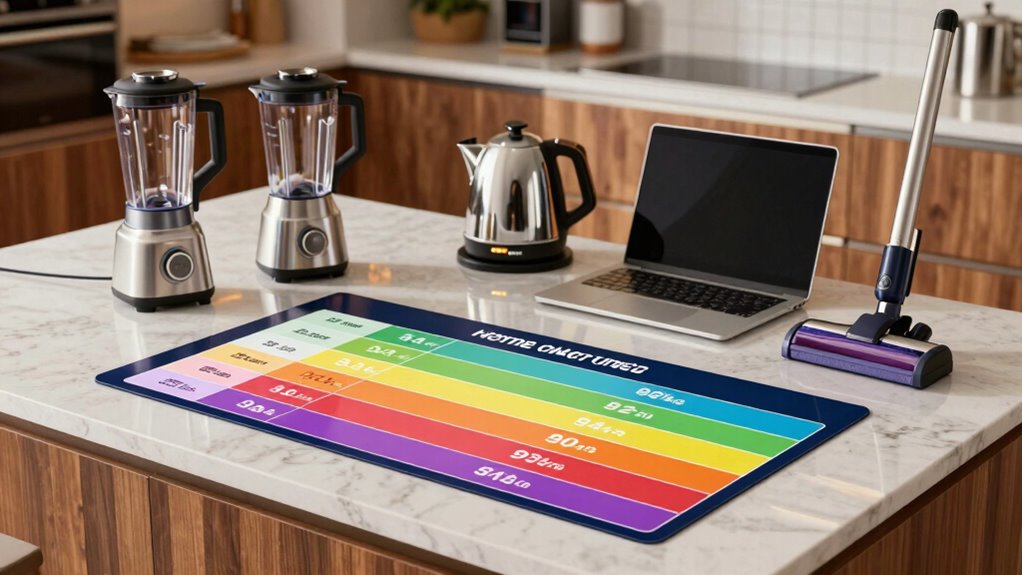
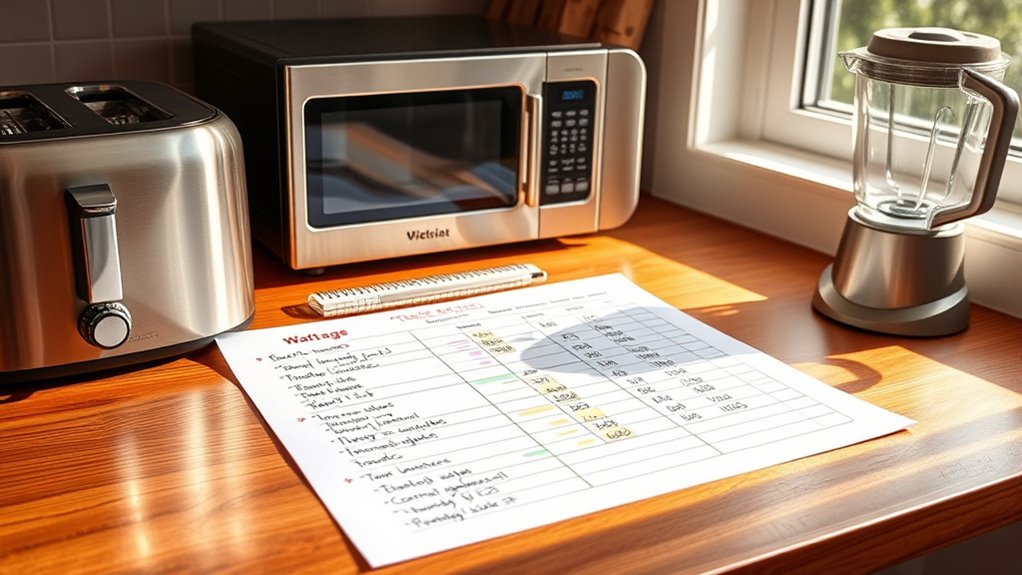
- Create a quick reference chart of common appliances and their typical wattages for easy estimation.
Ever wonder how much power your household appliances actually consume? Understanding the energy consumption of your devices is key to managing your electricity bills and reducing your carbon footprint. The good news is, with a little knowledge about appliance wattage, you can quickly estimate how much energy each device uses and identify opportunities to save. Appliance efficiency plays a vital role here; newer, more efficient models often use less power for the same performance, making them smarter choices in the long run. By knowing the wattage of your appliances, you can make informed decisions about usage and even optimize your home’s energy habits.
Knowing your appliance wattage helps you save energy and lower bills effortlessly.
Most household appliances have their wattage listed on labels or in the user manual. This number indicates how much power they draw when operating. For example, a standard refrigerator might use between 100 and 800 watts, depending on size and age, while a microwave typically consumes around 600 to 1200 watts when in use. Small devices like chargers and lamps tend to draw far less—often under 50 watts—but cumulatively, they can add up. When you’re aware of these figures, you can better gauge how much energy each appliance consumes over time, especially if you’re trying to cut down on electricity costs.
Estimating energy consumption begins with understanding wattage and how long a device runs. Multiplying an appliance’s wattage by the number of hours it operates gives you its energy use in watt-hours. For instance, if your dishwasher uses 1500 watts and runs for 1.5 hours, it consumes 2250 watt-hours, or 2.25 kilowatt-hours (kWh). Knowing this helps you compare appliances and decide which ones to use less frequently or replace with more efficient models. Investing in appliances with higher efficiency ratings can considerably cut your energy bills, especially for devices that run often. Over time, even small savings on individual appliances can add up to substantial financial and environmental benefits.
Being aware of appliance wattage also helps you avoid wasting energy. You might realize that leaving a rarely used space heater on all day isn’t necessary or that unplugging chargers when not in use can prevent phantom loads. Understanding energy consumption and prioritizing appliance efficiency encourages smarter choices, like upgrading to ENERGY STAR-rated appliances, which use less power for the same tasks. Additionally, energy monitoring tools can help you track your actual usage and identify further savings opportunities. With just a few minutes of research and some simple calculations, you can get a clear picture of your home’s energy habits. This knowledge empowers you to reduce unnecessary power use, lower your utility bills, and contribute to a more sustainable lifestyle—all without complicated tools or extensive effort.
Frequently Asked Questions
How Accurate Are Wattage Estimates for Appliances?
Wattage estimates for appliances are generally quite accurate if you consider their appliance lifespan and energy efficiency ratings. You can trust these estimates because they reflect typical power consumption. However, actual usage varies with how often you use the appliance and its condition. Regularly checking your appliance’s energy efficiency ratings and maintaining it can help you get even more precise estimates for your energy bills.
Can Wattage Vary Between Different Brands or Models?
Did you know wattage can vary by up to 30% between brands and models? Yes, brand variations and model differences considerably impact appliance wattage. When shopping or estimating energy use, don’t assume all similar devices consume the same power. Always check the label or specifications, as some models are more energy-efficient than others, helping you save money and reduce your environmental footprint.
How Do I Calculate Monthly Energy Costs Using Wattage?
To calculate your monthly energy costs, you start with the appliance’s wattage. Multiply the wattage by the hours used per day, then by 30 days to get total watt-hours. Convert that to kilowatt-hours (divide by 1,000) and multiply by your utility rate. This simple energy cost calculation helps you identify appliance energy savings, allowing you to cut costs by choosing more efficient devices or reducing usage.
Are There Safety Concerns With High-Wattage Appliances?
High-wattage appliances can pose safety risks if you don’t follow proper precautions. Always guarantee your appliances are plugged into grounded outlets and avoid overloading circuits. Keep flammable materials away and don’t operate damaged appliances. Regularly check cords and plugs for wear. Following these safety precautions helps prevent electrical fires and appliance malfunctions, ensuring your home remains safe. Always prioritize appliance safety to avoid accidents and damage.
How Often Should I Check or Update My Appliance Wattages?
You should check or update your appliance wattages during an energy audit or whenever you notice significant changes in your energy bills. Don’t wait too long—appliance wattages can shift as they age, affecting efficiency and lifespan. Regularly reviewing your wattages helps you spot potential issues early, ensuring your appliances run effectively and last longer. Stay vigilant; a small update now could save you money and extend your appliance’s life.
Conclusion
By using this wattage cheat sheet, you can quickly estimate your home’s energy use and save on bills. Did you know that running a standard refrigerator consumes about 150 watts daily? Visualizing your appliances’ power helps you make smarter choices. With just a few minutes, you’ll gain a clearer picture of your energy habits, empowering you to optimize efficiency and cut costs effortlessly. Small changes can lead to big savings over time.