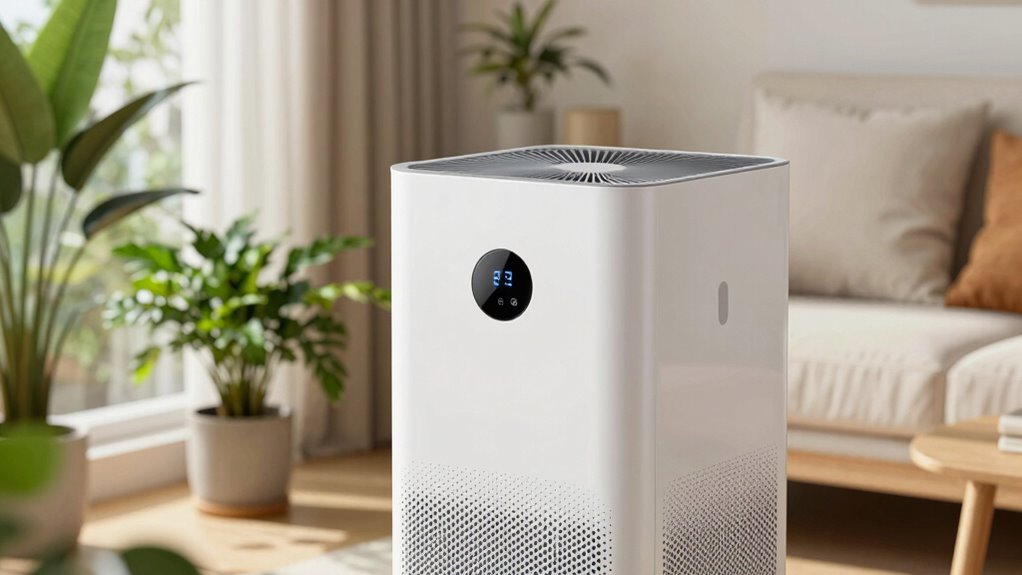
CADR, or Clean Air Delivery Rate, is the key measurement that shows how effectively an air purifier removes pollutants like smoke, dust, and pollen. It is tested by measuring the amount of clean air produced in cubic feet per minute, helping you match a model to your room size and needs. Higher CADR numbers mean faster, better filtration. If you want to understand how this impacts your air quality and what it really means, keep exploring.
Key Takeaways
- CADR measures an air purifier’s efficiency in filtering specific pollutants, indicating its cleaning speed in cubic feet per minute (CFM).
- Higher CADR ratings correspond to faster and more effective removal of smoke, dust, and pollen particles.
- Matching CADR to room size ensures optimal air cleaning performance and energy efficiency.
- CADR ratings are standardized, allowing objective comparison between different air purifier models.
- CADR does not account for real-world factors like room layout, airflow, noise, or maintenance needs.
What Is CADR and How Is It Measured?
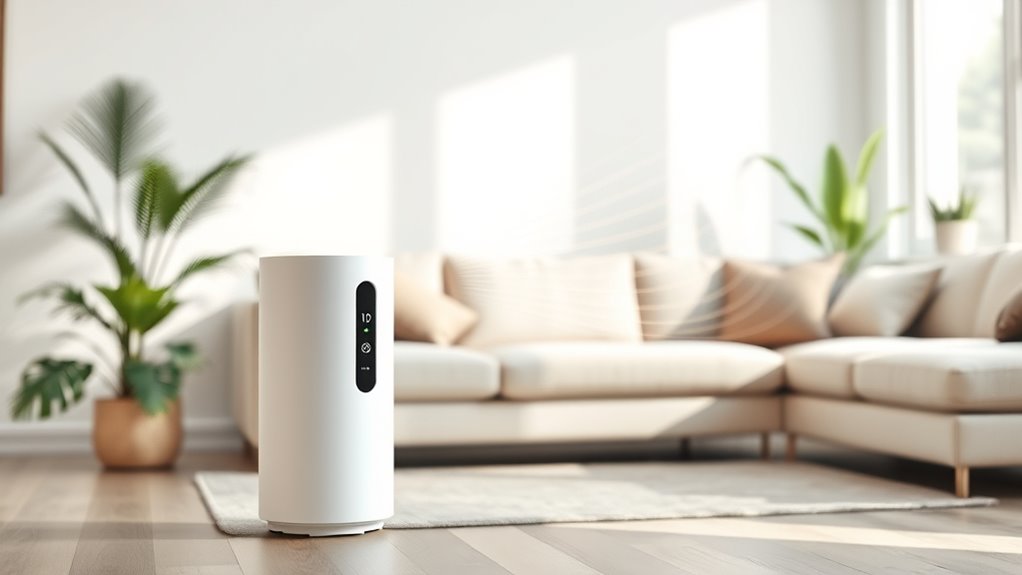
What exactly is CADR, and how do manufacturers determine it? CADR stands for Clean Air Delivery Rate, a metric that shows how effectively an air purifier filters pollutants. Manufacturers test CADR by measuring how much clean air the device produces per minute, specifically for common indoor pollutants like dust, pollen, and smoke. They run standardized tests in controlled environments, introducing known amounts of particles and then measuring how many are removed over time. The results are expressed in cubic feet per minute (CFM). A higher CADR indicates a better ability to clean the air quickly. This measurement helps you compare different models and understand their performance, giving you a clear idea of how well an air purifier can improve your indoor air quality. Additionally, understanding the test conditions used in these measurements ensures you select a device that performs well under real-world scenarios, which may vary depending on environmental factors. It’s also helpful to consider how airflow dynamics influence the overall effectiveness of an air purifier in different room sizes and layouts. Being aware of testing standards used in CADR ratings can further assist you in choosing a device that meets recognized performance benchmarks. Moreover, proper placement of the air purifier within a room can significantly impact its efficiency and overall air cleaning performance.
Why CADR Is Crucial for Evaluating Air Purifiers
CADR gives you an accurate way to measure how well an air purifier performs. It provides a standardized comparison method, so you can easily see which model cleans the air most effectively. Understanding CADR helps you make smarter choices for cleaner indoor air. Incorporating clear, step-by-step guidance ensures you can confidently select and maintain your air purifier to achieve optimal air quality. Knowing how air quality metrics are measured allows you to interpret CADR ratings more effectively. Additionally, comprehending the testing procedures behind CADR ratings can help you assess the reliability of the data provided by different manufacturers. Recognizing the testing standards used in these procedures enables consumers to evaluate the accuracy and consistency of the ratings across various brands. A thorough understanding of these performance tests can also guide you in choosing models that meet your specific air quality needs.
Accurate Performance Measure
Since an accurate performance measure is essential for comparing air purifiers, knowing how well a device cleans the air helps you make informed decisions. CADR provides this clarity by quantifying a purifier’s ability to remove specific pollutants, such as smoke, dust, and pollen. Without a reliable metric like CADR, you might rely on vague claims or manufacturer specifications that don’t reflect real-world performance. An accurate measure guarantees you’re investing in a device that effectively improves air quality in your space. It also helps you compare different models objectively, avoiding guesswork or overestimating capabilities. Understanding CADR ratings is crucial because they directly relate to how well an air purifier performs in real-world conditions. Using a standardized performance metric like CADR ensures that your expectations align with actual device capabilities, providing peace of mind when making a purchase. Additionally, CADR ratings are established through industry standards that ensure consistency and reliability across different brands and models.
Standardized Comparison Method
Without a standardized way to compare air purifiers, evaluating their true performance can be confusing and unreliable. That’s where CADR, or Clean Air Delivery Rate, comes in. It provides a consistent, measurable way to compare different models based on how much clean air they produce in a set period. CADR factors in both airflow and filtration efficiency, giving you a clear picture of a purifier’s effectiveness. Because everyone uses the same testing procedures, you can trust CADR ratings across brands and models. This standardization helps you make informed decisions, ensuring you pick an air purifier that truly improves your indoor air quality. testing procedures and adherence to testing standards guarantee that CADR ratings are accurate and comparable across various products. Relying on CADR simplifies your choice, saving you time and giving peace of mind.
The Components of a CADR Rating: Smoke, Dust, and Pollen
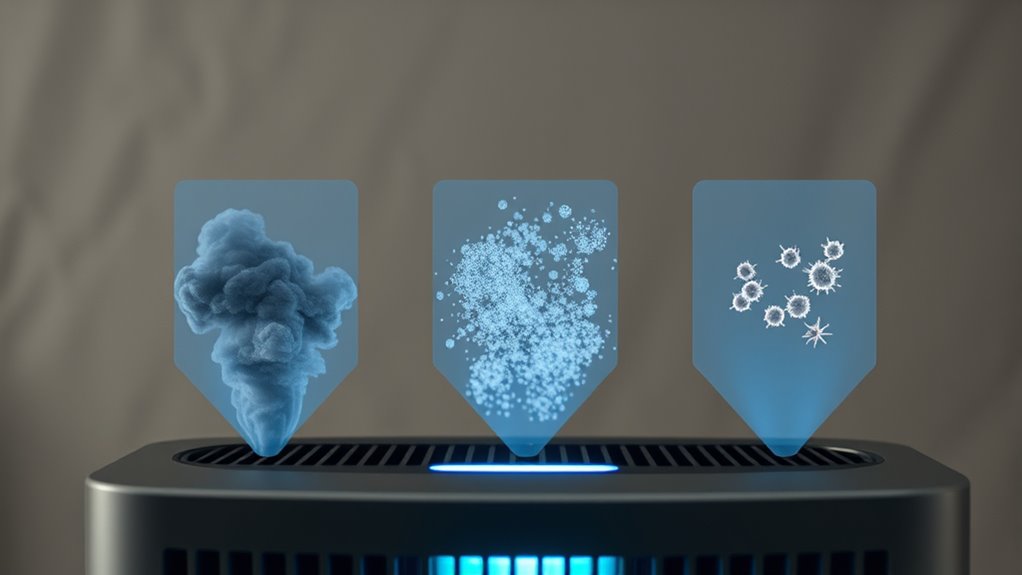
Understanding the components of a CADR rating is essential for choosing the right air purifier because these ratings measure how effectively it cleans different types of airborne particles. CADR ratings are broken down into three categories: smoke, dust, and pollen. Smoke CADR indicates how well the purifier removes airborne smoke particles, which are tiny and highly penetrating. Dust CAD measures the device’s ability to clear larger dust particles, like pet dander and household debris. Pollen CAD reflects how effectively it filters out pollen grains that trigger allergies. Each component helps you understand how well the air purifier handles specific pollutants, ensuring you select a model suited to your needs. Recognizing these components allows you to compare purifiers more accurately and choose one that provides ideal clean air for your environment. Additionally, proper air purifier maintenance ensures that these components continue to perform optimally over time. Being aware of how each component functions can also guide you in selecting an air purifier with the appropriate filtering capabilities for your particular environment, especially considering different airborne pollutants that may be present in your space. Regularly monitoring filter performance can help maintain optimal air quality and extend the lifespan of your device.
How to Read and Compare CADR Numbers
How can you effectively compare CADR numbers when choosing an air purifier? First, look at the CADR ratings for smoke, dust, and pollen. Higher numbers mean better performance. But keep in mind, a CADR rating is specific to room size and pollutant type. To compare models accurately, check if the ratings match your needs. Use this table to understand key points:
| CADR Rating | Room Size Suitability | Pollutant Focus |
|---|---|---|
| 300+ | Large rooms | All pollutants |
| 150-300 | Medium rooms | Dust and pollen |
| Below 150 | Small rooms | Smoke, dust, pollen |
Additionally, understanding air cleaner performance can help you select the right model for your space. Ensuring you interpret the CADR ratings correctly is essential for making an informed decision. When comparing ratings, consider how room size compatibility aligns with your actual room dimensions to ensure optimal results. Matching these ratings with your space and needs helps you choose the best air purifier. It’s also helpful to consider the ventilation considerations to maximize efficiency in your environment. Being aware of filter types and replacement costs can further influence your choice for long-term maintenance.
Limitations of CADR and What It Doesn’t Tell You
While CADR ratings provide a useful snapshot of an air purifier’s performance, they don’t tell the full story. For example, CADR measures how well a device clears specific particles in a controlled environment, but it doesn’t account for real-world factors like room size, layout, or airflow. A high CADR doesn’t guarantee the purifier will effectively clean every corner of your space. Additionally, CADR doesn’t reflect noise levels, energy efficiency, or how well the device handles gases and odors. It also overlooks maintenance needs, such as filter replacement. Relying solely on CADR can lead to choosing a model that underperforms in your particular situation. To ensure cleaner air, consider these other factors alongside CADR when selecting an air purifier. Moreover, AI tools can assist in analyzing various product features and user reviews to make a more informed decision.
Choosing the Right CADR for Your Space
To choose the right CADR, you need to take into account your room size and how much air purification it requires. You’ll find a range of CADR options, so selecting one that matches your space and air quality needs is essential. By matching the right CADR to your environment, you’ll ensure cleaner air and a healthier space.
Room Size Compatibility
Choosing the right CADR for your space guarantees your air purifier functions effectively. To do this, measure your room’s square footage accurately. Once you have the size, match it to an air purifier with a CADR rating that covers or exceeds that area. For example, if your room is 200 square feet, select a model with at least a 200 CADR rating for dust, smoke, and pollen. Don’t forget to take into account ceiling height; taller rooms need higher CADR ratings to ensure proper air circulation. Using an air purifier with too low a CADR leaves pollutants lingering, while too high a rating might waste energy. Proper sizing ensures efficient cleaning, improved air quality, and ideal performance from your device.
CADR Range Options
Selecting the appropriate CADR range guarantees your air purifier effectively cleans your space without wasting energy. To choose the right option, consider the size of your room and your air quality goals. Here are some CADR range options:
- Low CADR (100-150) – Suitable for small rooms, bedrooms, or spaces with minimal pollution.
- Medium CADR (151-250) – Ideal for medium-sized living areas or offices with moderate pollution.
- High CADR (251+) – Best for large rooms, open areas, or spaces with high levels of allergens or pollutants.
Matching your room size and needs ensures top performance and efficiency. Remember, higher CADR ratings don’t always mean better for small spaces—choose wisely to avoid unnecessary energy use.
Air Quality Needs
Understanding the air quality in your space is essential for picking the right CADR. If your indoor air is polluted with dust, pet dander, smoke, or other particles, you’ll need a higher CADR to effectively clean the air quickly. For spaces with heavy pollution or multiple occupants, aim for a CADR that matches or exceeds the room’s size and pollution level. Conversely, if your air is relatively clean, a lower CADR may suffice. Think about your specific needs—do you need quick relief from allergens or just occasional purification? Evaluating your air quality helps you choose a device that ensures comfort and health without overspending on unnecessary power. Properly matching CADR to your air quality needs creates a healthier, more comfortable environment.
Practical Tips for Using CADR to Improve Indoor Air Quality
To effectively improve your indoor air quality using CADR ratings, you should start by evaluating the size of the space you want to purify. Knowing this helps you choose a cleaner with an appropriate CADR that matches your room’s square footage. Next, confirm the CADR rating aligns with your specific needs—higher for pollution-prone areas or larger rooms. Finally, position the air purifier properly: place it in a central location away from walls or obstructions to maximize airflow and efficiency.
Here are some practical tips:
- Match CADR to your room’s size for optimal performance
- Regularly monitor air quality to adjust purifier settings if needed
- Keep doors and windows closed during operation to prevent outside pollutants from entering
Frequently Asked Questions
How Does CADR Compare to Other Air Purifier Performance Metrics?
CADR directly measures how quickly an air purifier cleans specific pollutants, making it more practical than other metrics like noise levels or filter lifetime. You can compare CADR ratings to see which purifier cleans air faster and more effectively in a room. While other specs matter, CADR gives you a clear, quantitative way to judge performance, helping you choose the best device for your space and needs.
Can CADR Ratings Vary Between Different Brands for the Same Model?
Yes, CADR ratings can vary between brands for the same model due to differences in testing procedures or measurement standards. You might notice slight discrepancies even if the models are identical, so it’s wise to compare ratings carefully. Always check the testing protocols and verify you’re comparing like-for-like ratings, as variations can influence your decision on which air purifier performs best for your needs.
Is a Higher CADR Always Better for Every Room Size?
Think of CADR as a race car’s horsepower—higher numbers mean more speed, but only if the track matches your car’s size. A higher CADR isn’t always better for every room; it’s like trying to fit a sports car into a compact garage. You need a CADR that matches your room’s size for ideal performance. Choose wisely, or your air cleaner might be overkill or underperforming.
How Often Should I Check or Update My Air Purifier’s CADR Rating?
You should check your air purifier’s CADR rating whenever you notice performance issues or when replacing filters. Typically, it’s a good idea to review the specs annually to make sure it still meets your needs, especially if you move to a different room or buy a new model. Regularly maintaining and verifying the CADR helps keep your air clean and your purifier functioning efficiently.
Does CADR Account for Noise Levels or Energy Efficiency?
CADR primarily calculates how effectively an air purifier clears particles, but it doesn’t account for noise levels or energy efficiency. When choosing an air purifier, you should consider these factors separately. Look for models with noise ratings or decibel levels, and check energy consumption specs to guarantee your device operates quietly and efficiently. Remember, a high CADR doesn’t guarantee a peaceful or power-saving experience.
Conclusion
Just like the hero’s trusted sword, understanding CADR guides you through the battle for clean air. By knowing what the numbers mean and how to choose wisely, you’re equipped to protect your space. Remember, even Harry’s wand has its limits—so use CADR as your magic wand for smarter decisions. With this knowledge, you can turn your home into a fortress of fresh, healthy air, no spells required.